
Book view
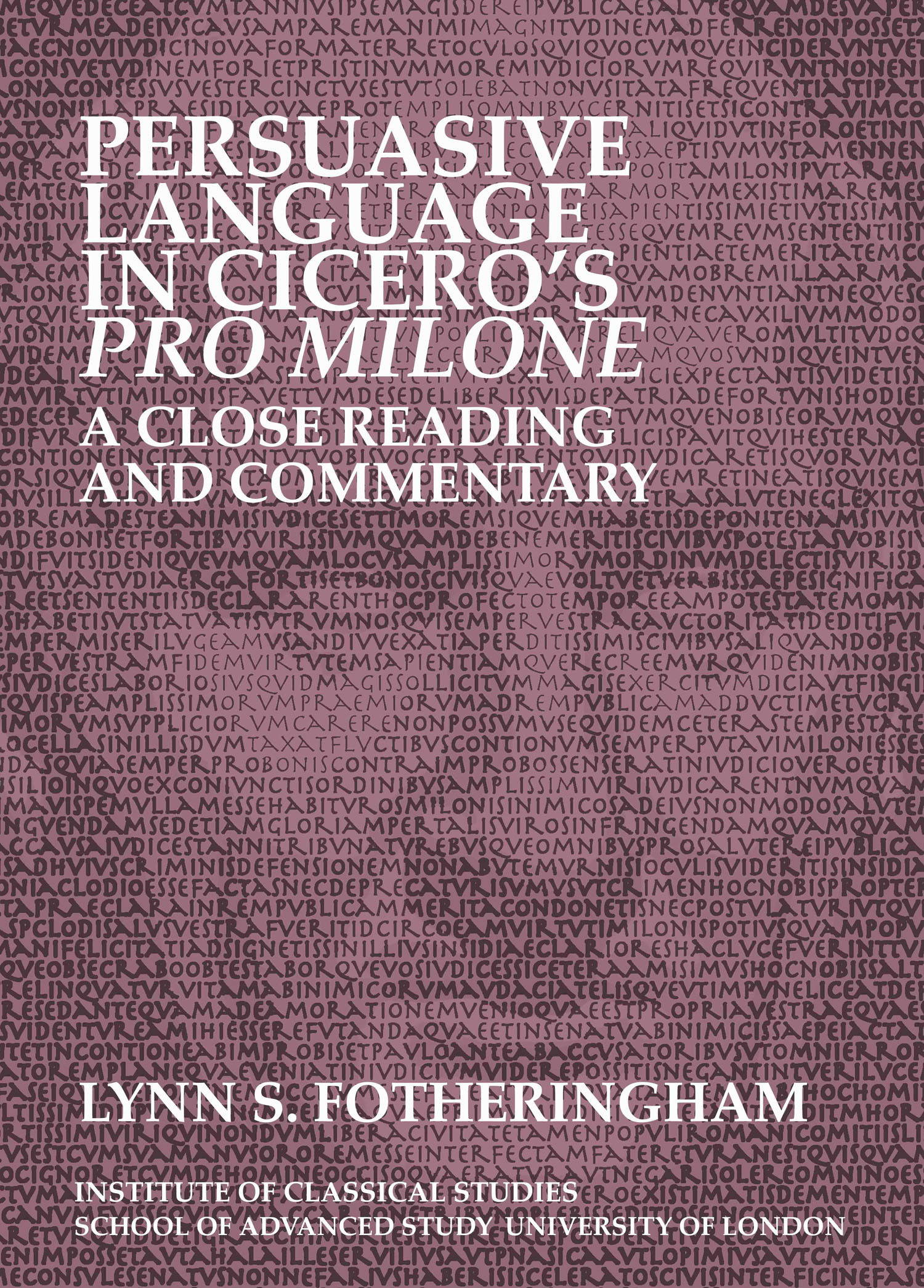
Persuasive Language in Cicero’s Pro Milone: A close reading and commentary
Book information
- Publisher
- University of London Press
- Publication
- Published 1 September 2017
- Place
- London, GB
- Series
- Bulletin of the Institute of Classical Studies Supplements
- Catalogue record
- View in the catalogue
Abstract
This innovative approach to Cicero's persuasive language analyses the style and structure of one of his important speeches in more detail than has ever been done before.
It applies ideas from modern linguistics (sentential topic, lexical patterning, interactional discourse), and explores the possibilities and limitations of quantitative analysis, made easier by modern computing power, in the areas of syntax and vocabulary.
The result is a reading of the Pro Milone as a unified text, whether aimed at persuading the jury to acquit Milo or at persuading a wider audience that Milo should have been acquitted.
This reading not only contributes to our understanding of late republican discourse, but also suggests a new methodology for using the study of language and style to illuminate literary/historical aspects of texts.
Where its authors and editors are based
Countries of the institutions the book's authors, editors and chapter authors were affiliated to when it was published.
- AUTHORS / EDITORS
- CITATIONS Phase 2
- USAGE Phase 3
No affiliations with a known country in these years yet.
About this data
These figures cover 1 work. Each value comes from the most trusted source that has it; a correction made by OBC staff outranks every source.
| Source | Confidence | Works |
|---|---|---|
| Thoth | 90 / 100 | 1 |
| Works with a publication date | 100% |
|---|---|
| Works with a DOI | 100% |
| Works with a funder recorded | 0% |
| Authors with an affiliation | 0% |
Countries come from the institution each author was affiliated to when they published, as recorded in ROR. A country is never guessed, so authors without a matched institution are not counted on the maps.
Funders come from OpenAlex for articles and Thoth for books, where publishers recorded them. Most works record none, so a funder's figures show what is recorded, not everything it funded.
Chapters count as works: their authors and editors, and the countries of their institutions, are in every figure where Thoth records an affiliation for them.
Citations (Phase 2) and usage (Phase 3) are not collected yet.