
Book information
- Publisher
- University of London Press
- Publication
- Published 1 June 2021
- Place
- London, GB
- Catalogue record
- View in the catalogue
Abstract
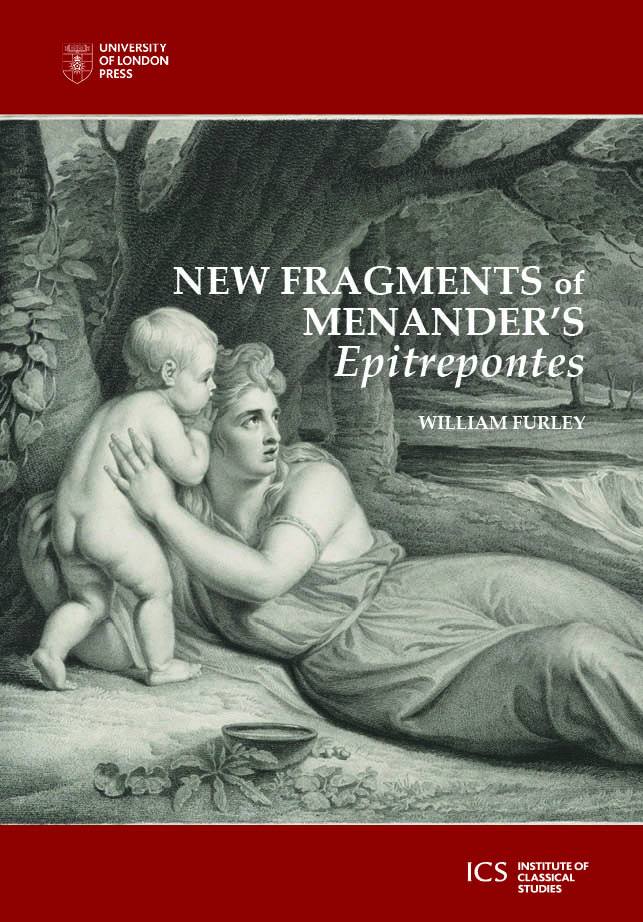
In this brand new and exquisite 2021 translation of the classic Greek play, Epitrepontes, or 'The Arbitration', produced around 300 BC, Menander tackles the subject of a broken marriage. Charisios has left his young wife Pamphile over a suspected infidelity and moved in with his neighbour to drown his sorrows in wine and women, specifically, a spirited harp-girl called Habrotonon. The irate father-in-law will not tolerate this waste of a good dowry and demands of his daughter that she divorce. Bravely she holds out against her father's tirades and remains loyal to her husband.
A complex and masterly dramatic sequence ensures that by the end 'all's well that ends well' - and Menander has struck a blow for equality of the sexes, for understanding over arrogance and pride. Menander's subtle and, ultimately, good-natured treatment of marital crisis and family tensions, themes which, despite the ancient dress of strict metre and theatrical convention, are strikingly modern, not to say timeless.
A large portion of the Epitrepontes was recovered from oblivion in 1905. Now, this startling collection of the new fragments, complete with papyrological readings, translation and commentary, brings together the scholarly work from separate fragments to date, including the author's own edition and interpretation and a revised text of the play in entirety included as an appendix.
The commentary aims to explain the printed text, to place Menander's language in the context of Athenian dramatic art and rhetoric, and to appreciate his subtle insights into the psychology of his characters, from the huffy father-in-law Smikrines to the 'little people' of the comedy, the slaves, each with their private agenda.
Where its authors and editors are based
Countries of the institutions the book's authors, editors and chapter authors were affiliated to when it was published.
- AUTHORS / EDITORS
- CITATIONS Phase 2
- USAGE Phase 3
No affiliations with a known country in these years yet.
About this data
These figures cover 1 work. Each value comes from the most trusted source that has it; a correction made by OBC staff outranks every source.
| Source | Confidence | Works |
|---|---|---|
| Thoth | 90 / 100 | 1 |
| Works with a publication date | 100% |
|---|---|
| Works with a DOI | 100% |
| Works with a funder recorded | 0% |
| Authors with an affiliation | 0% |
Countries come from the institution each author was affiliated to when they published, as recorded in ROR. A country is never guessed, so authors without a matched institution are not counted on the maps.
Funders come from OpenAlex for articles and Thoth for books, where publishers recorded them. Most works record none, so a funder's figures show what is recorded, not everything it funded.
Chapters count as works: their authors and editors, and the countries of their institutions, are in every figure where Thoth records an affiliation for them.
Citations (Phase 2) and usage (Phase 3) are not collected yet.