
Book information
- Publisher
- University of London Press
- Publication
- Published 26 January 2023
- Place
- London, GB
- Series
- Reimagining Law and Justice
- Catalogue record
- View in the catalogue
Abstract
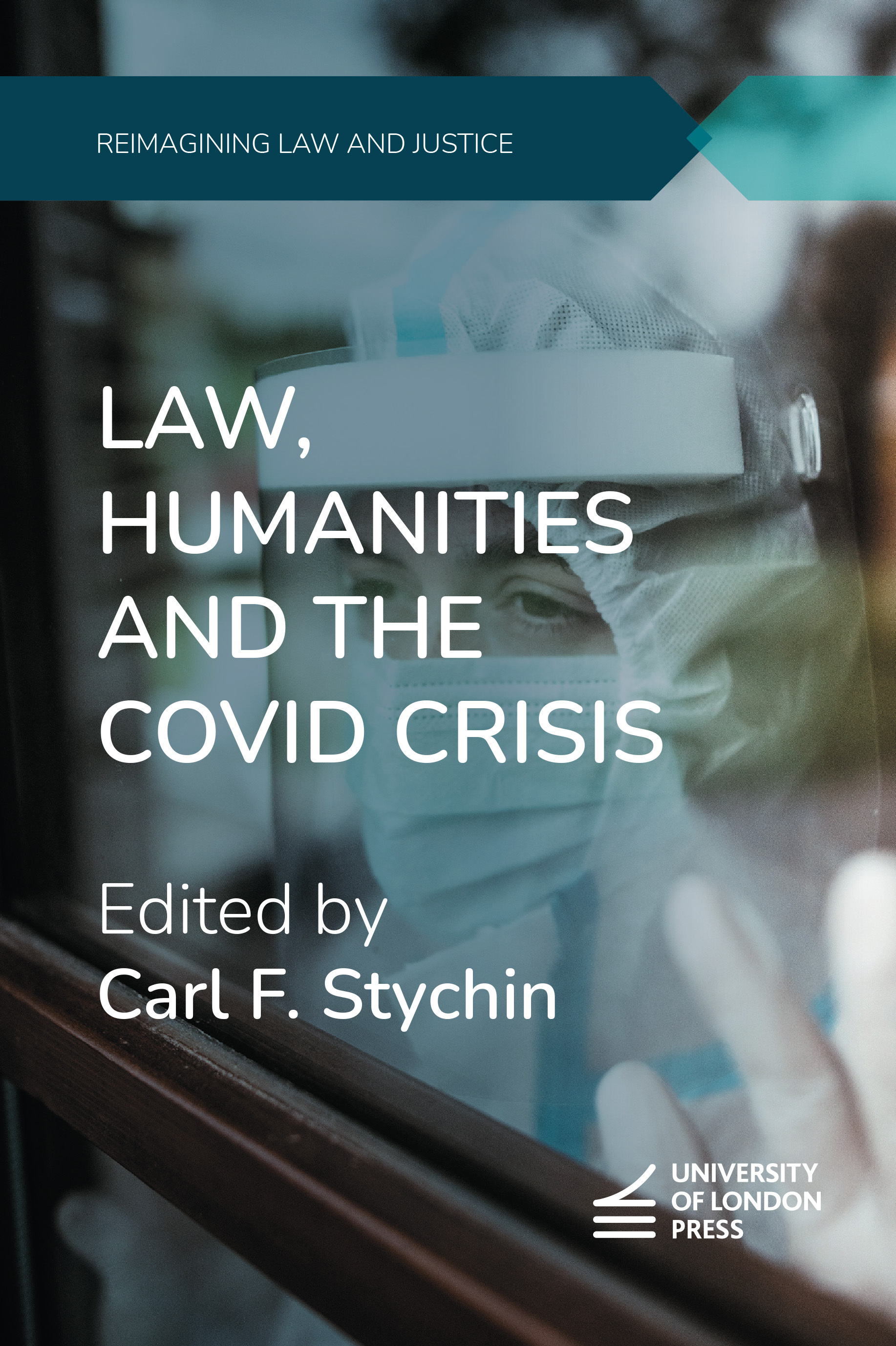
While there has been an abundance of scientific works on the COVID-19 crisis, there has been relatively little research to date from the humanities. This striking new book seeks to address the immediacy of COVID-19 by focusing on the implications of the virus in a wider interdisciplinary context – through the lens of the law, history, ethics, technology, economics and gender studies.
From Europe to South America, Asia and beyond, Law, Humanities and the COVID Crisis sets out a framework for understanding the COVID-19 virus beyond its epidemiological constraints, asking us to question the very definition of what it means to be human. Researchers from around the world offer their critical reflections on the past, present, and future of this period of sociocultural upheaval and the tremendous suffering that has laid bare fundamental imbalances in our society. Featuring essays on public welfare versus private interest, violence against women, mask compliance, conspiracy theories and national security laws, this book is a significant contribution to understanding our new 'post-COVID' landscape, and the future yet to come.
Chapters
| Chapter | Author | Institution at publication |
|---|---|---|
| Introduction | Carl F. Stychin | University of London |
| Counting the dead during a pandemic | Marc Trabsky | La Trobe University |
| COVID, commodification and conspiracism | David Seymour | City, University of London |
| COVID-19 and the legal regulation of working families | Nicole Busby, Grace James | University of Glasgow; University of Reading |
| Law, everyday spaces and objects, and being human | Jill Marshall | Royal Holloway University of London |
| Pandemic, humanities and the legal imagination of the disaster | Valerio Nitrato Izzo | University of Naples Federico II |
| Penal response and biopolitics in the time of the COVID-19 pandemic | Harison Citrawan, Sabrina Nadilla | National Research and Innovation Agency; Pennsylvania State University |
| Prospects for recovery in Brazil | Frederic R. Kellogg, George Browne Rego, Pedro Spíndola B. Alves | Universidade Católica de Pernambuco; Universidade Federal de Pernambuco |
| Public interest or social need? | Dimitrios Kivotidis | Durham University |
| The law and the limits of the dressed body | Mark De Vitis, David J. Carter | The University of Sydney; University of Technology Sydney |
| The pandemic and two ships | Renisa Mawani, Mikki Stelder | University of British Columbia; University of Amsterdam; Utrecht University |
| Walls and bridges | David Gurnham | University of Southampton |
| Women, violence and protest in times of COVID-19 | Kim Barker, Olga Jurasz | The Open University |
Where its authors and editors are based
Countries of the institutions the book's authors, editors and chapter authors were affiliated to when it was published.
- AUTHORS / EDITORS
- CITATIONS Phase 2
- USAGE Phase 3
| Country | Authors / editors |
|---|---|
| United Kingdom | 9 |
| Australia | 3 |
| Brazil | 1 |
| Canada | 1 |
| Indonesia | 1 |
| Italy | 1 |
| The Netherlands | 1 |
| United States | 1 |
About this data
These figures cover 14 works. Each value comes from the most trusted source that has it; a correction made by OBC staff outranks every source.
| Source | Confidence | Works |
|---|---|---|
| Thoth | 90 / 100 | 14 |
| Works with a publication date | 100% |
|---|---|
| Works with a DOI | 7% |
| Works with a funder recorded | 0% |
| Authors with an affiliation | 86% |
| Affiliations matched to an institution (ROR) | 100% |
| Affiliations with a country | 100% |
Countries come from the institution each author was affiliated to when they published, as recorded in ROR. A country is never guessed, so authors without a matched institution are not counted on the maps.
Funders come from OpenAlex for articles and Thoth for books, where publishers recorded them. Most works record none, so a funder's figures show what is recorded, not everything it funded.
Chapters count as works: their authors and editors, and the countries of their institutions, are in every figure where Thoth records an affiliation for them.
Citations (Phase 2) and usage (Phase 3) are not collected yet.