
Book view
Designed for Play: Children’s Playgrounds and the Politics of Urban Space, 1840–2010
By Jon Winder
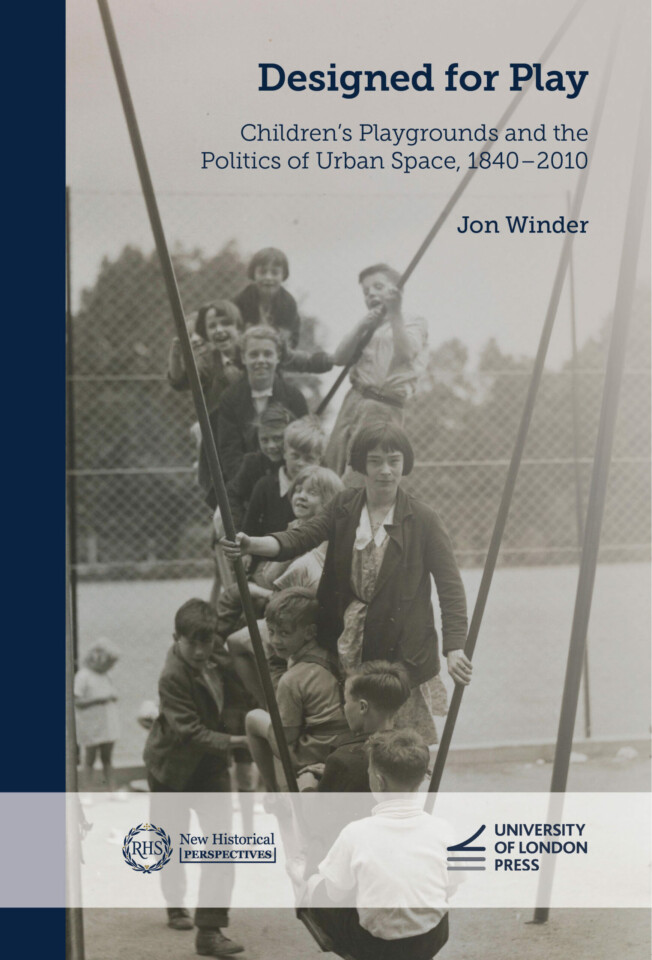
Book information
- Publisher
- University of London Press
- Publication
- Published 11 July 2024
- Place
- London, GB
- Catalogue record
- View in the catalogue
Abstract
Children’s playgrounds are commonly understood as the obvious place for children to play: safe, natural and out of the way. But these expectations hide a convoluted and overlooked history of children’s place in public space – one shaped by implicit social, political and environmental values, and by government intervention in spaces and lives across the nineteenth and twentieth centuries. This book is the first empirically grounded historical account of the modern playground, drawing on the archival materials of social reformers, park superintendents, equipment manufacturers and architects in Britain and beyond to chart the playground’s journey from marginal obscurity to popular ubiquity. In exploring the evolution of play space design, the book shows that the ideal playground has long represented a space where changing conceptions of nature, health, childhood, commerce and technology have all been played out. It covers the development of garden gymnasiums in the 1890s, the influence of Charles Wicksteed, increasing standardisation in the interwar period, the impact of progressive education, pioneering female designers and the adventure playground movement in the twentieth century, and more recent challenges to the playground’s status as a site of health, nature and safety.
Designed for Play is an original and accessible contribution to modern British history, urban and environmental history, and histories and geographies of childhood.
Where its authors and editors are based
Countries of the institutions the book's authors, editors and chapter authors were affiliated to when it was published.
- AUTHORS / EDITORS
- CITATIONS Phase 2
- USAGE Phase 3
No affiliations with a known country in these years yet.
About this data
These figures cover 1 work. Each value comes from the most trusted source that has it; a correction made by OBC staff outranks every source.
| Source | Confidence | Works |
|---|---|---|
| Thoth | 90 / 100 | 1 |
| Works with a publication date | 100% |
|---|---|
| Works with a DOI | 100% |
| Works with a funder recorded | 0% |
| Authors with an affiliation | 0% |
Countries come from the institution each author was affiliated to when they published, as recorded in ROR. A country is never guessed, so authors without a matched institution are not counted on the maps.
Funders come from OpenAlex for articles and Thoth for books, where publishers recorded them. Most works record none, so a funder's figures show what is recorded, not everything it funded.
Chapters count as works: their authors and editors, and the countries of their institutions, are in every figure where Thoth records an affiliation for them.
Citations (Phase 2) and usage (Phase 3) are not collected yet.