
Book view
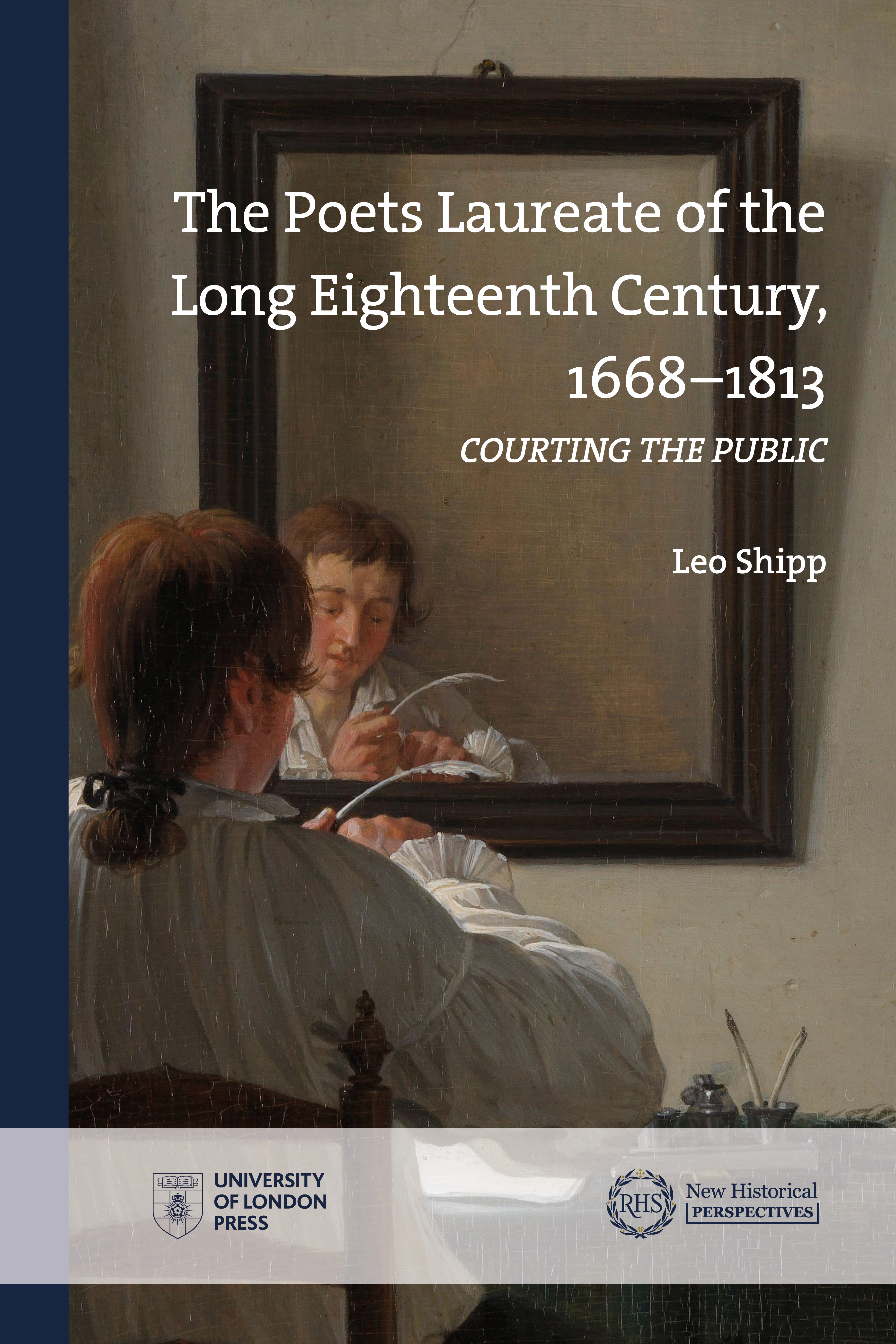
The Poets Laureate of the Long Eighteenth Century, 1668–1813
Courting the Public
By Leo Shipp
Book information
- Publisher
- University of London Press
- Publication
- Published 31 August 2022
- Place
- London, GB
- Catalogue record
- View in the catalogue
Abstract
The office of the poet laureate of Britain was a highly prominent, relevant and respectable institution throughout the long eighteenth century. First instituted for John Dryden in 1668, the laureateship developed from an honorific into a functionary office with a settled position in court (c.1689–1715), and was bestowed upon Robert Southey in 1813, whose tenure eventually transformed the office. Taking an interdisciplinary approach, this book examines the office’s institutional changes and public reception, the mechanics of each laureate’s appointment, and the works produced by the laureates before and after their appointments. It argues that the laureateship played a key part in some of the most vital trends in eighteenth-century culture.
The conclusion is arrived at by employing a new research paradigm that it calls the conceptual geography of culture. It shows that Britons routinely used spatial concepts to understand culture throughout the period, which became increasingly abstract over time. As part of this, the court evolved from a concrete space in London to an abstract space capable of hosting the entire British public. The laureateship was a dynamic office positioned at the interface of court and public, evolving in line with its audiences. An important intervention in eighteenth-century historiography, this book presents a nuanced understanding of eighteenth-century culture and society, in which the laureateship exemplified the enduring centrality of the court to the British conceptual geography of culture.
Where its authors and editors are based
Countries of the institutions the book's authors, editors and chapter authors were affiliated to when it was published.
- AUTHORS / EDITORS
- CITATIONS Phase 2
- USAGE Phase 3
No affiliations with a known country in these years yet.
About this data
These figures cover 1 work. Each value comes from the most trusted source that has it; a correction made by OBC staff outranks every source.
| Source | Confidence | Works |
|---|---|---|
| Thoth | 90 / 100 | 1 |
| Works with a publication date | 100% |
|---|---|
| Works with a DOI | 100% |
| Works with a funder recorded | 0% |
| Authors with an affiliation | 0% |
Countries come from the institution each author was affiliated to when they published, as recorded in ROR. A country is never guessed, so authors without a matched institution are not counted on the maps.
Funders come from OpenAlex for articles and Thoth for books, where publishers recorded them. Most works record none, so a funder's figures show what is recorded, not everything it funded.
Chapters count as works: their authors and editors, and the countries of their institutions, are in every figure where Thoth records an affiliation for them.
Citations (Phase 2) and usage (Phase 3) are not collected yet.