
Book view
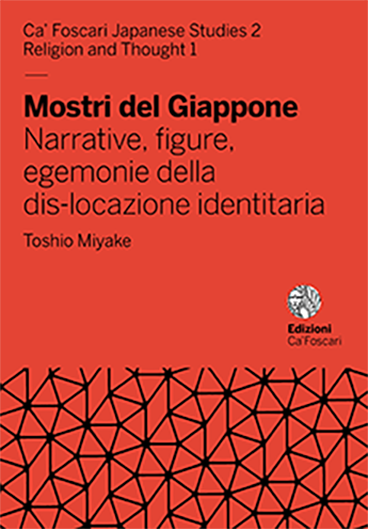
Monsters of Japan
Narratives, Figures and Hegemonies of Identity Dis-Location
Edited by Toshio Miyake
Book information
- Publisher
- Edizioni Ca' Foscari
- Publication
- Published 29 October 2014
- Place
- Venice, Italy
- Series
- Ca’ Foscari Japanese Studies
- Catalogue record
- View in the catalogue
Abstract
The book presents a transcultural theory of monsters with a multidisciplinary approach inspired by monster studies, employing methods ranging from literary criticism to postcolonial studies, anthropology, sociology and cultural history. Particular attention is paid to the emergence of some of Japan’s most popular monsters, both past and present: the tengu (divine mountain demon), the kappa (water monster), Miyazaki Hayao’s hybrid monsters, and finally the broader trans/national process of monstrosity in globalised Japan.
Where its authors and editors are based
Countries of the institutions the book's authors, editors and chapter authors were affiliated to when it was published.
- AUTHORS / EDITORS
- CITATIONS Phase 2
- USAGE Phase 3
| Country | Authors / editors |
|---|---|
| Italy | 1 |
About this data
These figures cover 1 work. Each value comes from the most trusted source that has it; a correction made by OBC staff outranks every source.
| Source | Confidence | Works |
|---|---|---|
| Thoth | 90 / 100 | 1 |
| Works with a publication date | 100% |
|---|---|
| Works with a DOI | 100% |
| Works with a funder recorded | 0% |
| Authors with an affiliation | 100% |
| Affiliations matched to an institution (ROR) | 100% |
| Affiliations with a country | 100% |
Countries come from the institution each author was affiliated to when they published, as recorded in ROR. A country is never guessed, so authors without a matched institution are not counted on the maps.
Funders come from OpenAlex for articles and Thoth for books, where publishers recorded them. Most works record none, so a funder's figures show what is recorded, not everything it funded.
Chapters count as works: their authors and editors, and the countries of their institutions, are in every figure where Thoth records an affiliation for them.
Citations (Phase 2) and usage (Phase 3) are not collected yet.