
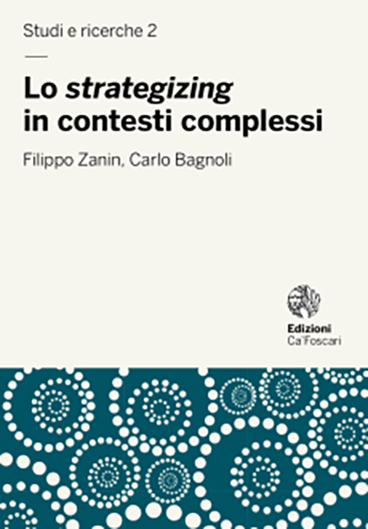
Book information
- Publisher
- Edizioni Ca' Foscari
- Publication
- Published 3 November 2016
- Place
- Venice, Italy
- Series
- Studi e ricerche
- Catalogue record
- View in the catalogue
Abstract
Strategy-making takes place in webs of socio-material practices, where agency is mediated by artifacts and actors continuously reframe the way on which they give sense to their actions and objectives. Despite agency still depends on human actors, material artifacts can play a critical role in these ensembles of practices making strategizing always open to transformation. The practices associated with the strategy formation encompass conflicting people mental models, distributed knowledge and materiality for the development of a systematic, coherent and coordinated strategic process. The activities that qualify strategy-making are multifaceted and include a more or less deliberative and routinized individual decision-making and the conscious or unconscious exploration of emerging patterns. According to a cognitive approach to strategy-making, what strategists decide is largely influenced by their different perceptual filters, which are unique, as they were formed through the specific ways of engaging with the world, and by the construction of shared meanings. This consideration puts scholars to elaborate about the use of visual artifacts to frame strategic thinking and conceptualize a shared strategic orientation. The unfolding character of strategizing process stimulates to better understand the knowledge production process that explains the epistemic nature of the process itself. In particular, it has been demonstrated that the use of visual representations supports the knowledge production during the innovation processes as it facilitate the abstraction and the concretization of innovation practices. The potential benefits of using visual representations for fostering strategizing process have not yet been analysed extensively. Few case studies reflecting on the crucial role of visual representation in the strategy process and decisions in complex setting. This study aims to fill these gaps and explores how strategy maps shape the strategic practices within Ca’ Foscari University of Venice. The Italian University setting is a complex research field as it is a multivoiced domain and a rapidly changing one. A recent reform is stimulating a radical change in the management policies making the strategy processes a pluralistic and uncertain work.
Where its authors and editors are based
Countries of the institutions the book's authors, editors and chapter authors were affiliated to when it was published.
- AUTHORS / EDITORS
- CITATIONS Phase 2
- USAGE Phase 3
| Country | Authors / editors |
|---|---|
| Italy | 2 |
About this data
These figures cover 1 work. Each value comes from the most trusted source that has it; a correction made by OBC staff outranks every source.
| Source | Confidence | Works |
|---|---|---|
| Thoth | 90 / 100 | 1 |
| Works with a publication date | 100% |
|---|---|
| Works with a DOI | 100% |
| Works with a funder recorded | 0% |
| Authors with an affiliation | 100% |
| Affiliations matched to an institution (ROR) | 100% |
| Affiliations with a country | 100% |
Countries come from the institution each author was affiliated to when they published, as recorded in ROR. A country is never guessed, so authors without a matched institution are not counted on the maps.
Funders come from OpenAlex for articles and Thoth for books, where publishers recorded them. Most works record none, so a funder's figures show what is recorded, not everything it funded.
Chapters count as works: their authors and editors, and the countries of their institutions, are in every figure where Thoth records an affiliation for them.
Citations (Phase 2) and usage (Phase 3) are not collected yet.