
Book information
- Publisher
- Edizioni Ca' Foscari
- Publication
- Published 30 December 2015
- Place
- Venice, Italy
- Series
- Antiquity Studies
- Catalogue record
- View in the catalogue
Abstract
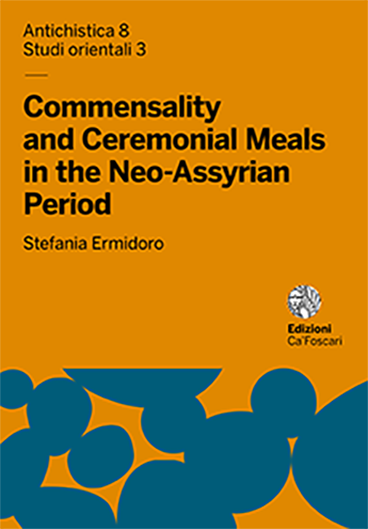
Like a language, food is a witness to the tradition and to the identity of a human group, reflecting self-representation and social interaction. Assyrians developed a particular consciousness of commensality as a vehicle for cultural messages. This book investigates institutional banquets and ritualized meals in the Neo-Assyrian period. Through a philological analysis on commensality, integrated with historical and iconographic data, it offers a new perspective on the Mesopotamian society of the first millennium BCE.
Where its authors and editors are based
Countries of the institutions the book's authors, editors and chapter authors were affiliated to when it was published.
- AUTHORS / EDITORS
- CITATIONS Phase 2
- USAGE Phase 3
| Country | Authors / editors |
|---|---|
| Italy | 1 |
About this data
These figures cover 1 work. Each value comes from the most trusted source that has it; a correction made by OBC staff outranks every source.
| Source | Confidence | Works |
|---|---|---|
| Thoth | 90 / 100 | 1 |
| Works with a publication date | 100% |
|---|---|
| Works with a DOI | 100% |
| Works with a funder recorded | 0% |
| Authors with an affiliation | 100% |
| Affiliations matched to an institution (ROR) | 100% |
| Affiliations with a country | 100% |
Countries come from the institution each author was affiliated to when they published, as recorded in ROR. A country is never guessed, so authors without a matched institution are not counted on the maps.
Funders come from OpenAlex for articles and Thoth for books, where publishers recorded them. Most works record none, so a funder's figures show what is recorded, not everything it funded.
Chapters count as works: their authors and editors, and the countries of their institutions, are in every figure where Thoth records an affiliation for them.
Citations (Phase 2) and usage (Phase 3) are not collected yet.