
Book view
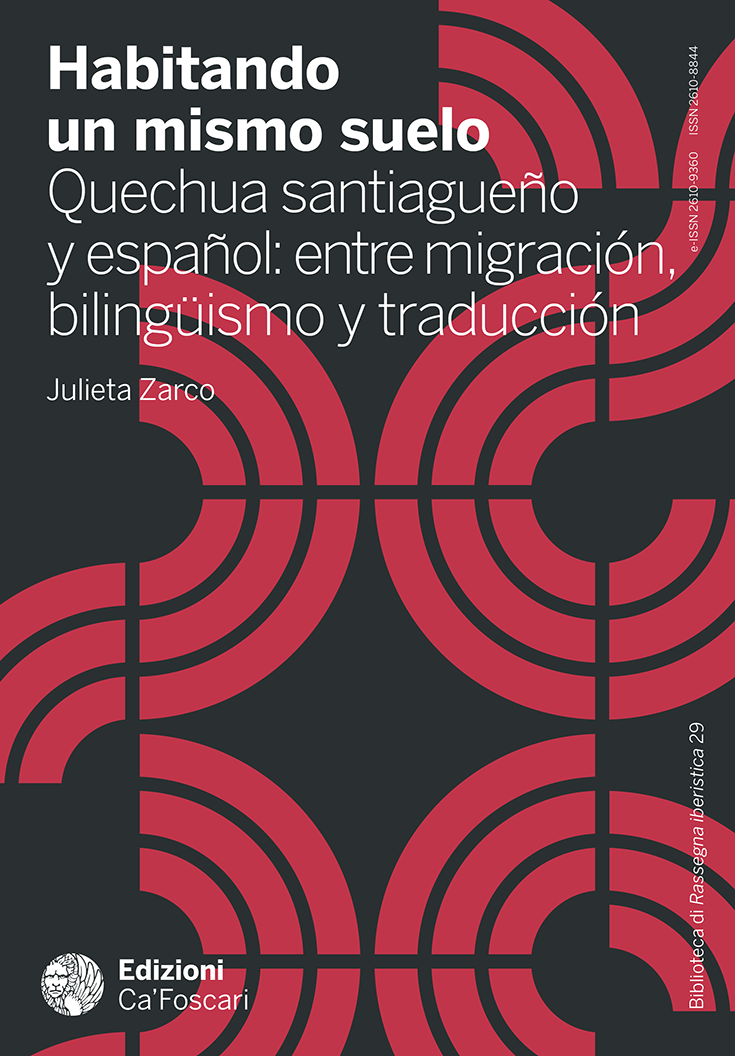
Inhabiting the Same Soil
Santiago del Estero Quechua and Spanish: between Migration, Bilingualism and Translation
Book information
- Publisher
- Edizioni Ca' Foscari
- Publication
- Published 17 April 2023
- Place
- Venice, Italy
- Series
- Library of <i>Rassegna iberistica</i>
- Catalogue record
- View in the catalogue
Abstract
The essay focuses on the linguistic contact between Quechua from Santiago del Estero and Spanish, as well as sociolinguistic aspects about the current situation and the survival of this language, an aspect that for many authors continues to be a “linguistic enigma” (Courthès 2007). The theory of James Crawford (2000) is taken into consideration, who maintains that the phenomena of geographic dislocation, social dislocation and cultural dislocation would forcefully lead a language to disappear. This is the opposite of what happens in the so-called “linguistic island” of Santiago del Estero, where the language remains in force and is used daily by its inhabitants both inside and outside that area. In this sense, a field work has been carried out in which a sample of interviews with bilingual speakers from the “linguistic island” living in the urban areas of Buenos Aires is analyzed. In all cases, these are inhabitants who are in a situation of linguistic contact between the Quechua of Santiago del Estero and Spanish. Based on an intersemiotic and interlinguistic analysis of the novel Shunko (1949) by Jorge W. Ábalos and its homonymous film adaptation (1960) by Lautaro Murúa, the contact between Quechua and Spanish is addressed, since it is presented as a fundamental part of the linguistic and metalinguistic elements that account for the clash between the teacher’s voice and the children’s voices (Aguilar 2005). In this sense, attitudes and language use are also observed in order to trace the relationships between code-switching and code-mixing (Poplack 1980) as well as aspects proxemics that contribute to the sociolinguistic realism of the characters in both the novel and the film.Bilingualism. Interlinguistic Translation. Intersemiotic Translation. Migration. Santiago del Estero Quechua and Spanish.
Where its authors and editors are based
Countries of the institutions the book's authors, editors and chapter authors were affiliated to when it was published.
- AUTHORS / EDITORS
- CITATIONS Phase 2
- USAGE Phase 3
| Country | Authors / editors |
|---|---|
| Italy | 1 |
About this data
These figures cover 1 work. Each value comes from the most trusted source that has it; a correction made by OBC staff outranks every source.
| Source | Confidence | Works |
|---|---|---|
| Thoth | 90 / 100 | 1 |
| Works with a publication date | 100% |
|---|---|
| Works with a DOI | 100% |
| Works with a funder recorded | 0% |
| Authors with an affiliation | 100% |
| Affiliations matched to an institution (ROR) | 100% |
| Affiliations with a country | 100% |
Countries come from the institution each author was affiliated to when they published, as recorded in ROR. A country is never guessed, so authors without a matched institution are not counted on the maps.
Funders come from OpenAlex for articles and Thoth for books, where publishers recorded them. Most works record none, so a funder's figures show what is recorded, not everything it funded.
Chapters count as works: their authors and editors, and the countries of their institutions, are in every figure where Thoth records an affiliation for them.
Citations (Phase 2) and usage (Phase 3) are not collected yet.