
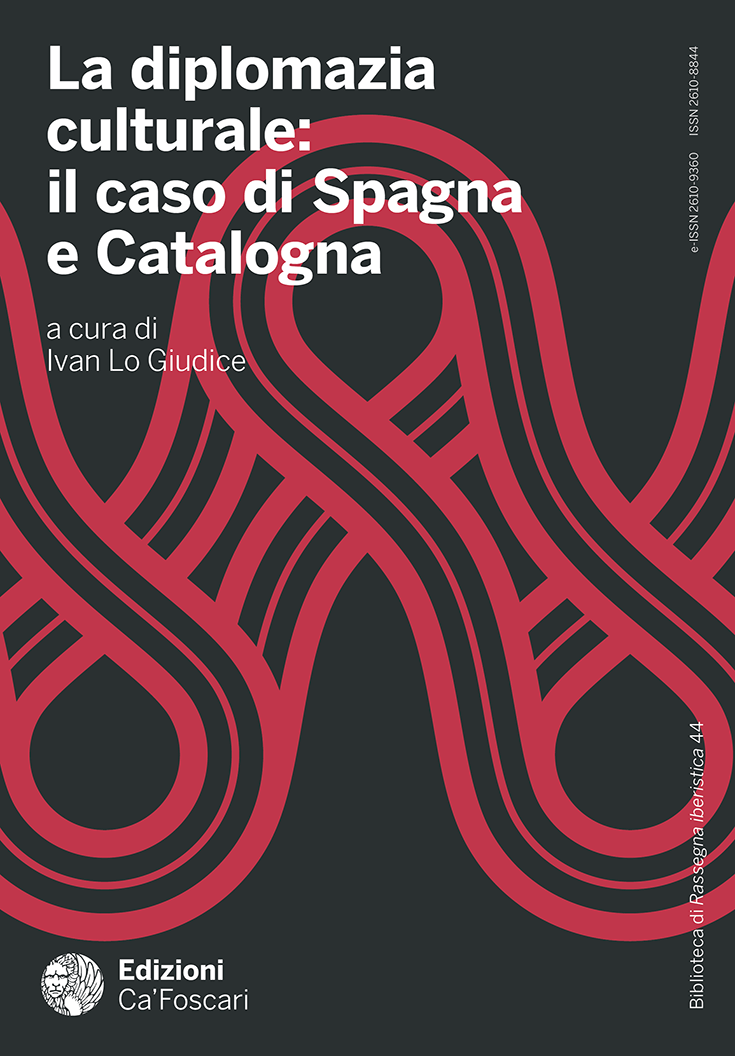
Book information
- Publisher
- Edizioni Ca' Foscari
- Publication
- Published 27 October 2025
- Place
- Venice, Italy
- Series
- Library of <i>Rassegna iberistica</i>
- Catalogue record
- View in the catalogue
Abstract
The anthology highlights the pivotal role of literature and culture in twentieth-century Spain and Catalonia. The authors present five case studies that allow readers to observe cultural diplomacy in action during one of the most dramatic periods in recent Spanish history: the Civil War from 1936 to 1939; Franco’s dictatorship, which resulted in countless casualties and disappeared individuals; and the persecution of languages and cultural minorities within the country. In the first chapter, Enric Bou discusses Josep Carner, a prominent Catalan poet who spent most of his life abroad. Carner began his career in the Spanish diplomatic corps in 1921 but later abandoned it to remain faithful to the Republican cause. Chapter two focuses on Joan Estelrich Artigues, a Majorcan cultural mediator who promoted Catalan literature and culture abroad. Chapter three introduces Ernesto Dethorey, a translator and journalist based in Sweden who supported the Spanish Republic and dedicated his life to denouncing Franco’s crimes in the media. In Stockholm, Dethorey came into contact with members of the Swedish Academy. In the fourth chapter, Patrizio Rigobon discusses the Italian translator Cesare Giardini, focusing especially on his translations of two Catalan works and their political implications in Fascist Italy: La Nacionalitat Catalana by Enric Prat de la Riba and Entorn del feixisme italià: Meditacions i commentaris sobre problemes de política contemporània by Francesc Cambó. In the final chapter, Giovanni Cattini analyzes progressive Catalan Catholics and three specific events: the Montserrat festivals (1947), the 35th Eucharistic Week (1952), and the Mediterranean colloquiums. The chapter recalls Giorgio La Pira, who was a prominent figure in Italian politics at that time.
Where its authors and editors are based
Countries of the institutions the book's authors, editors and chapter authors were affiliated to when it was published.
- AUTHORS / EDITORS
- CITATIONS Phase 2
- USAGE Phase 3
| Country | Authors / editors |
|---|---|
| Spain | 1 |
About this data
These figures cover 1 work. Each value comes from the most trusted source that has it; a correction made by OBC staff outranks every source.
| Source | Confidence | Works |
|---|---|---|
| Thoth | 90 / 100 | 1 |
| Works with a publication date | 100% |
|---|---|
| Works with a DOI | 100% |
| Works with a funder recorded | 0% |
| Authors with an affiliation | 100% |
| Affiliations matched to an institution (ROR) | 100% |
| Affiliations with a country | 100% |
Countries come from the institution each author was affiliated to when they published, as recorded in ROR. A country is never guessed, so authors without a matched institution are not counted on the maps.
Funders come from OpenAlex for articles and Thoth for books, where publishers recorded them. Most works record none, so a funder's figures show what is recorded, not everything it funded.
Chapters count as works: their authors and editors, and the countries of their institutions, are in every figure where Thoth records an affiliation for them.
Citations (Phase 2) and usage (Phase 3) are not collected yet.