
Book information
- Publisher
- Edizioni Ca' Foscari
- Publication
- Published 19 July 2018
- Place
- Venice, Italy
- Series
- I grandi libri della letteratura araba
- Catalogue record
- View in the catalogue
Abstract
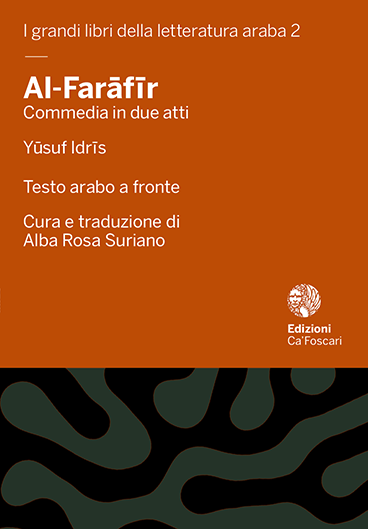
Based on the Hegelian dialectic of the servant-master, this comedy represents, with the sarcasm and irony typical of its author, a profound reflection on the relationships between human beings. Starting from the local, with a pungent criticism on the social and political condition of Egypt in the Sixties, the two protagonists Farfūr and the Master guide and involve the spectator in a consideration on humanity and on the meaning of life that reaches universality. Divided into two acts, the comedy has no precise indications about time and space, which is confused with the time of representation, also thanks to the involvement of actors who are among the spectators. Discussing each other on names, trades and interpersonal relationships, the two protagonists criticise corruption, poor management of public health, social inequalities, but also the intellectual class that fails to give answers to people’s practical needs. The division in two of human society is even more evident with the second act, when the author’s reflection moves towards the existing organisational and economic systems, dismantling the complexity and reducing them again to a mere servant-master relationship. The other characters of the play are functional to the discourse of Idrīs: wives and children, spectators-actors and especially the figure of the author, who gradually disappears and abandons his own creatures to their fate.
Where its authors and editors are based
Countries of the institutions the book's authors, editors and chapter authors were affiliated to when it was published.
- AUTHORS / EDITORS
- CITATIONS Phase 2
- USAGE Phase 3
| Country | Authors / editors |
|---|---|
| Italy | 1 |
About this data
These figures cover 1 work. Each value comes from the most trusted source that has it; a correction made by OBC staff outranks every source.
| Source | Confidence | Works |
|---|---|---|
| Thoth | 90 / 100 | 1 |
| Works with a publication date | 100% |
|---|---|
| Works with a DOI | 100% |
| Works with a funder recorded | 0% |
| Authors with an affiliation | 50% |
| Affiliations matched to an institution (ROR) | 100% |
| Affiliations with a country | 100% |
Countries come from the institution each author was affiliated to when they published, as recorded in ROR. A country is never guessed, so authors without a matched institution are not counted on the maps.
Funders come from OpenAlex for articles and Thoth for books, where publishers recorded them. Most works record none, so a funder's figures show what is recorded, not everything it funded.
Chapters count as works: their authors and editors, and the countries of their institutions, are in every figure where Thoth records an affiliation for them.
Citations (Phase 2) and usage (Phase 3) are not collected yet.