
Book view
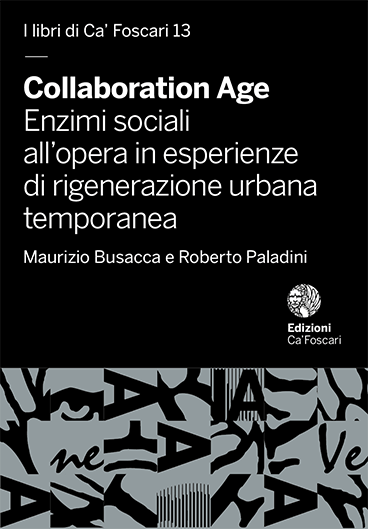
Collaboration Age
Enzimi sociali all’opera in esperienze di rigenerazione urbana temporanea
Book information
- Publisher
- Edizioni Ca' Foscari
- Publication
- Published 30 June 2020
- Place
- Venice, Italy
- Series
- I libri di Ca’ Foscari
- Catalogue record
- View in the catalogue
Abstract
Recently, public policies of urban regeneration have intensified and multiplied. They are being promoted with the aim to start social and economic dynamics within the local context which is subject to intervention. From the empirical analysis, we realise that such activities are mainly implemented by three subjects or by mixed coalitions (public institutions, actors of the third sector and companies). Within them, each player is moved by a multiplicity of interests and goals that go beyond their own nature – public interest, market and mutualism – and tend to redefine themselves, thus becoming hybrid forms of production of value (social, economic, cultural). By studying a number Italian and Catalan cases, this essay deals with the theory that, under specific conditions and configurations, a collaborative direction – of organization, production and design – would give life to successful procedures, even without the identification of a one-best-way. The collaboration is not simply a choice of operation, but a real production method which mobilises social resources to create hybrid solutions – between state, market and society – to complex issues that could not be faced solely with the use of the rationale of action of one among the three actors. In this framework, the systems of relations and interactions between players and shared capital become an essential condition for the success of every initiative of urban redevelopment, or failure thereof. Such initiatives are brought to life by the strategic role of individuals who foster connections as well as the dissemination of non-redundant information between social networks, and collective and individual actors which would otherwise be separated and barely able to communicate and collaborate with each other. In addition to the functions carried out by knowledge brokers, that have been extensively described in organisational studies and economic sociology, the aforementioned figures act as real social enzymes, that is to say, they handle the available information and function as catalysts of social processes of production of knowledge. Moreover, they increase the reaction speed, working on mechanisms which control the spontaneity.
Where its authors and editors are based
Countries of the institutions the book's authors, editors and chapter authors were affiliated to when it was published.
- AUTHORS / EDITORS
- CITATIONS Phase 2
- USAGE Phase 3
| Country | Authors / editors |
|---|---|
| Italy | 2 |
About this data
These figures cover 1 work. Each value comes from the most trusted source that has it; a correction made by OBC staff outranks every source.
| Source | Confidence | Works |
|---|---|---|
| Thoth | 90 / 100 | 1 |
| Works with a publication date | 100% |
|---|---|
| Works with a DOI | 100% |
| Works with a funder recorded | 0% |
| Authors with an affiliation | 100% |
| Affiliations matched to an institution (ROR) | 100% |
| Affiliations with a country | 100% |
Countries come from the institution each author was affiliated to when they published, as recorded in ROR. A country is never guessed, so authors without a matched institution are not counted on the maps.
Funders come from OpenAlex for articles and Thoth for books, where publishers recorded them. Most works record none, so a funder's figures show what is recorded, not everything it funded.
Chapters count as works: their authors and editors, and the countries of their institutions, are in every figure where Thoth records an affiliation for them.
Citations (Phase 2) and usage (Phase 3) are not collected yet.