
Book information
- Publisher
- Edizioni Ca' Foscari
- Publication
- Published 14 May 2020
- Place
- Venice, Italy
- Series
- Ca’ Foscari Japanese Studies
- Catalogue record
- View in the catalogue
Abstract
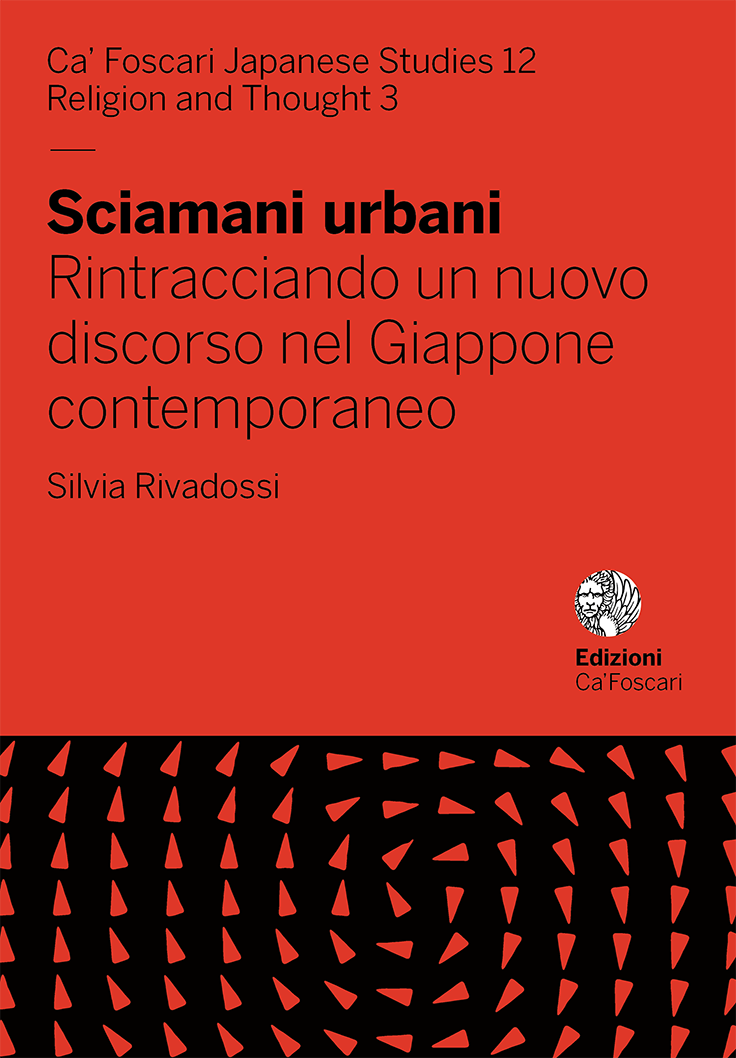
What does it mean to be a ‘shaman’ in present-day Tokyo? In what way(s) is the role of the shamanic practitioner represented at a popular level? Are certain characteristics emphasised and others downplayed? This book offers an answer to these questions through the analysis of a specific discourse on shamans that emerged in the Japanese metropolitan context between the late 20th century and the first decade of the 21st century, a discourse that the more ‘traditional’ approaches to the study on shamanism do not take into account. In order to better contextualise this specific discourse, the volume opens with a brief historical account of the formation of the academic discourse on shamans. Within the theoretical framework offered by critical discourse analysis and by means of multi-sited ethnographic research, it then weaves together different case studies: three novels by Taguchi Randy, a manga, a TV series and the case of an urban shaman who is mostly active in Tokyo. The main elements emerging from these case studies are explored by situating them in the precise historical and social context within which the discourse has been developed. This shows that the new discourse analysed shares several characteristics with the more ‘traditional’ and accepted discourses on shamanism, while at the same time differing in certain respects. In this work, particular attention is given to how the category and term ‘shaman’ is defined, used and re-negotiated in the Japanese metropolitan context. Through this approach, the book aims to further problematize the categories of ‘shaman’ and ‘shamanism’, by highlighting certain aspects that are not yet accepted by many scholars, even though they constitute a discourse that is relevant and effective.
Where its authors and editors are based
Countries of the institutions the book's authors, editors and chapter authors were affiliated to when it was published.
- AUTHORS / EDITORS
- CITATIONS Phase 2
- USAGE Phase 3
| Country | Authors / editors |
|---|---|
| Italy | 1 |
About this data
These figures cover 1 work. Each value comes from the most trusted source that has it; a correction made by OBC staff outranks every source.
| Source | Confidence | Works |
|---|---|---|
| Thoth | 90 / 100 | 1 |
| Works with a publication date | 100% |
|---|---|
| Works with a DOI | 100% |
| Works with a funder recorded | 0% |
| Authors with an affiliation | 100% |
| Affiliations matched to an institution (ROR) | 100% |
| Affiliations with a country | 100% |
Countries come from the institution each author was affiliated to when they published, as recorded in ROR. A country is never guessed, so authors without a matched institution are not counted on the maps.
Funders come from OpenAlex for articles and Thoth for books, where publishers recorded them. Most works record none, so a funder's figures show what is recorded, not everything it funded.
Chapters count as works: their authors and editors, and the countries of their institutions, are in every figure where Thoth records an affiliation for them.
Citations (Phase 2) and usage (Phase 3) are not collected yet.