
Book view
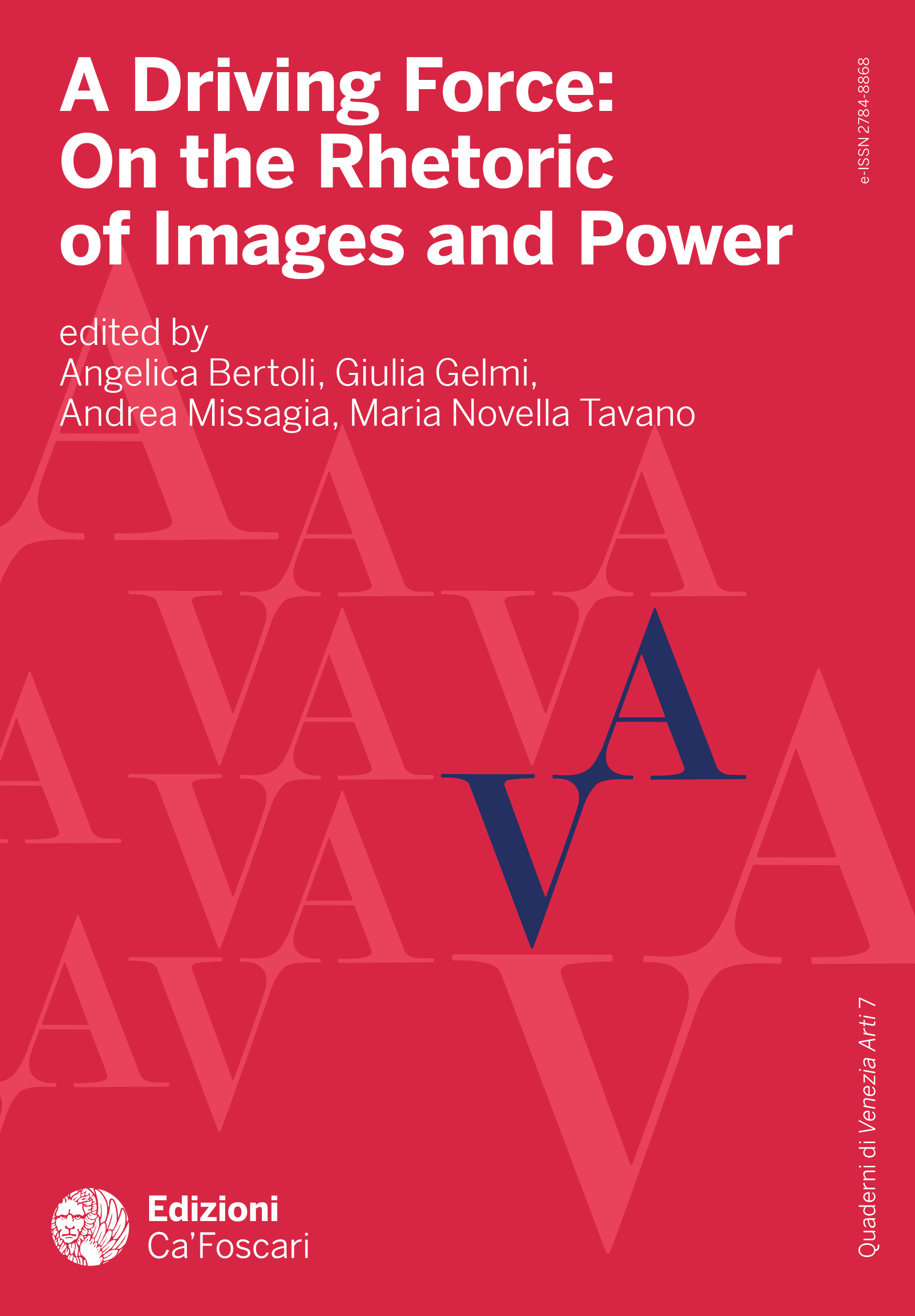
A Driving Force
On the Rhetoric of Images and Power
Edited by Angelica Bertoli, Giulia Gelmi, Andrea Missagia, Maria Novella Tavano
Book information
- Publisher
- Edizioni Ca' Foscari
- Publication
- Published 22 December 2023
- Place
- Venice, Italy
- Series
- Quaderni di <i>Venezia Arti</i>
- Catalogue record
- View in the catalogue
Abstract
The volume comprises a selection of papers presented at the 5th Postgraduate International Conference organized by the Department of Philosophy and Cultural Heritage of Ca’ Foscari University of Venice (Venice, 4-6 October 2023): A Driving Force. On the Rhetoric of Images and Power. In the introduction to his well-known The Power of Images (1989), David Freedberg claims not only that images hold power over us, but they are also, inevitably, related to ‘power’ itself. Art is therefore a powerful and non-neutral tool. Its forms and expressions influence and manipulate the realm of the real. Throughout human history, the artist’s creative power gave form, substance, and meaning to otherwise inert matter. This process turned the artist into a demiurge. Furthermore, once images are given their final form, they circulate and live a life of their own. The 5th Postgraduate International Conference was aimed at investigating the rhetorical nature of the intersection between image and power. In 1979 Yuri Lotman claimed that “rhetoric” is the displacement of the structural principles of a given semiotic sphere into another semiotic sphere. The Tartu semiologist’s approach implies that the “correlation with different semiotic systems gives rise to a rhetorical situation in which a powerful source of elaboration of new meanings is contained”. In exploring these meanings from a multidisciplinary perspective, this volume investigates two main themes: the power of the image, as an autonomous device, endowed with a pervasive and persuasive character; the image as a form for representing power which addresses questions concerning the sense of authority, and its negation, namely a sense of dissidence and counter-narrations.
Where its authors and editors are based
Countries of the institutions the book's authors, editors and chapter authors were affiliated to when it was published.
- AUTHORS / EDITORS
- CITATIONS Phase 2
- USAGE Phase 3
| Country | Authors / editors |
|---|---|
| Italy | 4 |
About this data
These figures cover 1 work. Each value comes from the most trusted source that has it; a correction made by OBC staff outranks every source.
| Source | Confidence | Works |
|---|---|---|
| Thoth | 90 / 100 | 1 |
| Works with a publication date | 100% |
|---|---|
| Works with a DOI | 100% |
| Works with a funder recorded | 0% |
| Authors with an affiliation | 100% |
| Affiliations matched to an institution (ROR) | 100% |
| Affiliations with a country | 100% |
Countries come from the institution each author was affiliated to when they published, as recorded in ROR. A country is never guessed, so authors without a matched institution are not counted on the maps.
Funders come from OpenAlex for articles and Thoth for books, where publishers recorded them. Most works record none, so a funder's figures show what is recorded, not everything it funded.
Chapters count as works: their authors and editors, and the countries of their institutions, are in every figure where Thoth records an affiliation for them.
Citations (Phase 2) and usage (Phase 3) are not collected yet.