
Book view
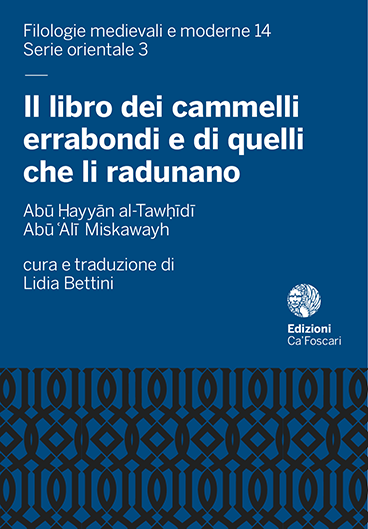
The Book of the Wandering Camels and Those Who Herd Them
Edited by Lidia Bettini; by Abū Ḥayyān Al-Tawḥīdī, Abū ՙAlī Miskawayh
Book information
- Publisher
- Edizioni Ca' Foscari
- Publication
- Published 18 September 2017
- Place
- Venice, Italy
- Series
- Medieval and Modern Philologies
- Catalogue record
- View in the catalogue
Abstract
This book presents the first unabridged translation of Kitāb al-hawāmil wa-al-šawāmil – a work containing 175 questions asked by Abū Ḥayyān al-Tawḥīdī and the related answers given by Abū ʿAlī Miskawayh – into a European language. It was composed at the end of the tenth century and belongs to the period of the complex acclimatisation of the philosophical and scientific Greek tradition within the Muslim Arabic milieu. The questions – which broach philological, literary, ethical, philosophical and scientific themes, together with those related to custom – possess the eclectic nature and literary style of the adab, whereas the answers lie within the technical domain of the falsafa, in its double dimension of ethics and logics. The dialogue takes place between peers: then, given the relative brevity of the answers and the wide variety of the themes, the peculiar nature of the work is the network of intertextual relations and references, which are quite often only allusive, to the heritage that was common to the intellectuals of the time, i.e. Artistotle’s, Plotinus’, Galen’s or Plato’s revised thought, in a milieu in which cultivating medicine, mathematics, astronomy, music, and perhaps even alchemy, together – and, above all these sciences, philosophy – was normal. Miskawayh was not an original philosopher and the book is not a philosophical treatise but, if we go through its interconnections, not only do we grasp its scattered allusions, but we also understand how an organic system of interpretation of the universe – which is, for example, comparable to Fārābī’s –, although not clarified, is always an implied point of reference. The considerable apparatus of footnotes tries, as much as possible, to provide the references, which were made anonymously or summarily by the two authors, with a context, in the belief that, in order to have an idea of the cultural depth of a work, it is necessary to know what it refers to and how it does it.
Where its authors and editors are based
Countries of the institutions the book's authors, editors and chapter authors were affiliated to when it was published.
- AUTHORS / EDITORS
- CITATIONS Phase 2
- USAGE Phase 3
| Country | Authors / editors |
|---|---|
| Italy | 1 |
About this data
These figures cover 1 work. Each value comes from the most trusted source that has it; a correction made by OBC staff outranks every source.
| Source | Confidence | Works |
|---|---|---|
| Thoth | 90 / 100 | 1 |
| Works with a publication date | 100% |
|---|---|
| Works with a DOI | 100% |
| Works with a funder recorded | 0% |
| Authors with an affiliation | 33% |
| Affiliations matched to an institution (ROR) | 100% |
| Affiliations with a country | 100% |
Countries come from the institution each author was affiliated to when they published, as recorded in ROR. A country is never guessed, so authors without a matched institution are not counted on the maps.
Funders come from OpenAlex for articles and Thoth for books, where publishers recorded them. Most works record none, so a funder's figures show what is recorded, not everything it funded.
Chapters count as works: their authors and editors, and the countries of their institutions, are in every figure where Thoth records an affiliation for them.
Citations (Phase 2) and usage (Phase 3) are not collected yet.