
Book information
- Publisher
- punctum books
- Publication
- Published 6 April 2021
- Place
- Earth, Milky Way
- Catalogue record
- View in the catalogue
Abstract
Come As You Are, After Eve Kosofsky Sedgwick brings together two pieces of writing. In the first, “After Eve Kosofsky Sedgwick,” Jonathan Goldberg assesses Sedgwick’s legacy, prompted mainly by writing about Sedgwick’s work that has appeared in the years since her death in April 2009. Writings by Lauren Berlant, Jane Gallop, Katy Hawkins, Scott Herring, Lana Lin, and Philomina Tsoukala are among those considered as Goldberg explores questions of queer temporality and the breaching of ontological divides. Primary concerns include the relationship of Sedgwick’s later work on Proust, fiber, and Buddhism to her fundamental contribution to queer theory, and the axes of identification across difference that motivated her work and attachment to it.
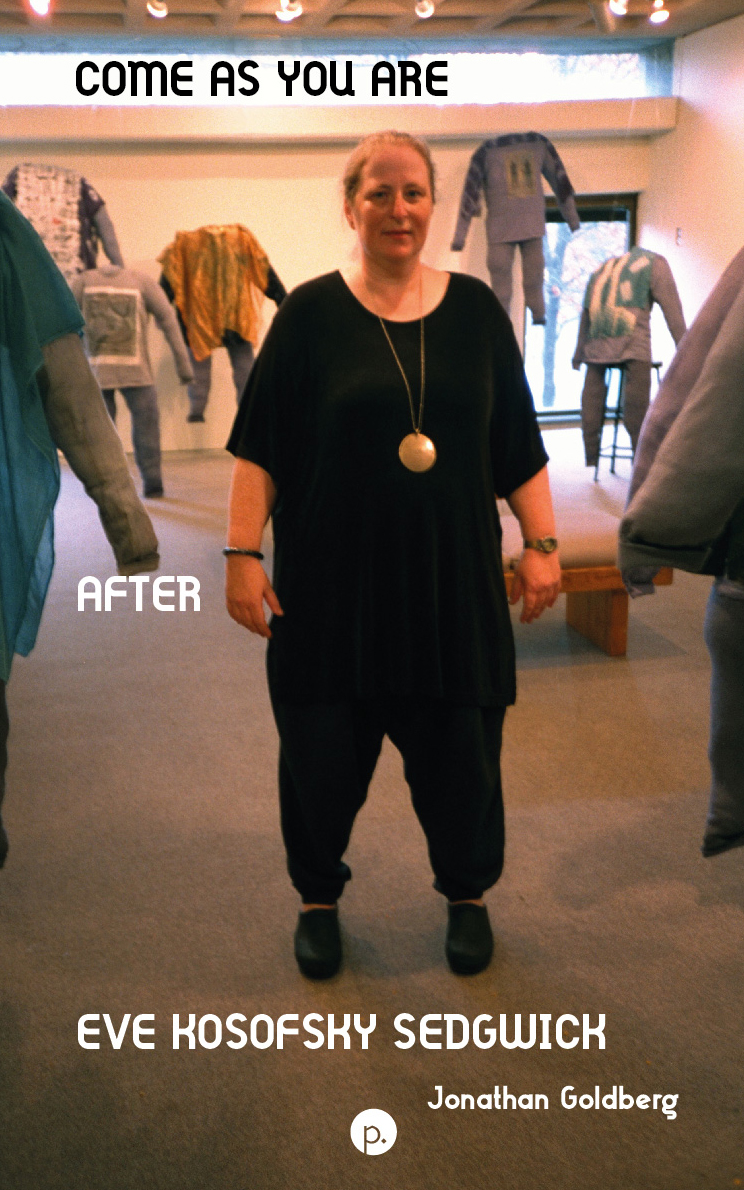
“Come As You Are,” the second piece of writing, is a previously unpublished talk Sedgwick gave in 1999–2000. It represents a significant bridge between her earlier and later work, sharing with her book Tendencies the ambition to discover the “something” that makes queer inextinguishable. In this piece, Sedgwick does that via a contemplation of her own mortality alongside her creative engagement with Buddhist thought, especially the in-between states named bardos and her newfound energy for making things. These were represented in a show of her fabric art, “Floating Columns/In the Bardo,” that accompanied her talk, a number of images of which are included in this book. They feature floating figures suspended in the realization of death. They are objects produced by Sedgwick, made of fabric; they come from her, yet are discontinuous with her, occupying a mode of existence that exceeds the span of human life and the confines of individual identity. They could be put beside the queer transitive identifications across difference that Goldberg’s essay explores.
Where its authors and editors are based
Countries of the institutions the book's authors, editors and chapter authors were affiliated to when it was published.
- AUTHORS / EDITORS
- CITATIONS Phase 2
- USAGE Phase 3
| Country | Authors / editors |
|---|---|
| United States | 2 |
About this data
These figures cover 1 work. Each value comes from the most trusted source that has it; a correction made by OBC staff outranks every source.
| Source | Confidence | Works |
|---|---|---|
| Thoth | 90 / 100 | 1 |
| Works with a publication date | 100% |
|---|---|
| Works with a DOI | 100% |
| Works with a funder recorded | 0% |
| Authors with an affiliation | 100% |
| Affiliations matched to an institution (ROR) | 100% |
| Affiliations with a country | 100% |
Countries come from the institution each author was affiliated to when they published, as recorded in ROR. A country is never guessed, so authors without a matched institution are not counted on the maps.
Funders come from OpenAlex for articles and Thoth for books, where publishers recorded them. Most works record none, so a funder's figures show what is recorded, not everything it funded.
Chapters count as works: their authors and editors, and the countries of their institutions, are in every figure where Thoth records an affiliation for them.
Citations (Phase 2) and usage (Phase 3) are not collected yet.