
Book information
- Publisher
- punctum books
- Publication
- Published 16 December 2016
- Place
- Earth, Milky Way
- Catalogue record
- View in the catalogue
Abstract
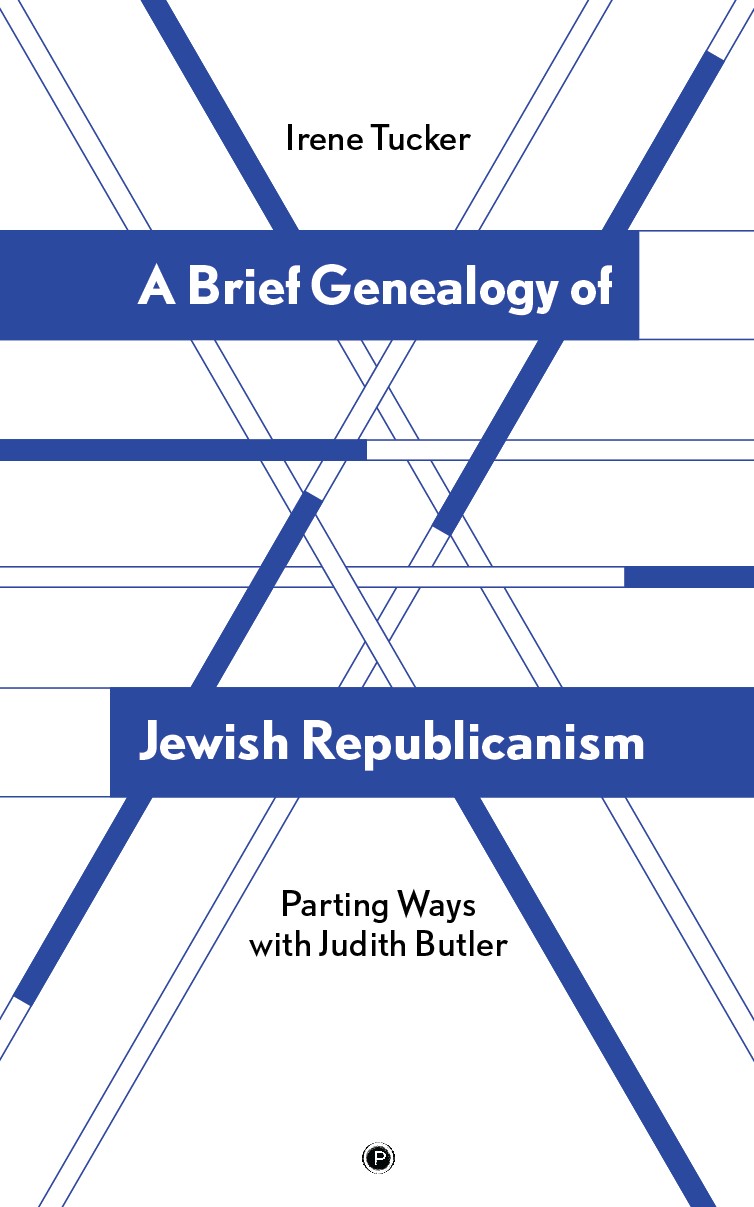
A Brief Genealogy of Jewish Republicanism: Parting Ways with Judith Butler uses the chance synchronicity of the 2013 Israeli parliamentary elections and literary theorist Judith Butler’s controversial Brooklyn College address calling for the boycotting of Israeli academic, cultural, and economic institutions as an occasion for examining possible relations between Jewishness and state-centered forms of self-governance. In an extended analysis of Butler’s Parting Ways: Jewishness and the Critique of Zionism, Tucker shows how the alignment of certain authors’ identities and ideas undergirding Butler’s analytical framework draws upon a pointedly Christian conception of belief. This Christian conception of belief structures the most familiar understandings of modern secularism, articulated most famously by John Locke in his “Letter Concerning Toleration.” Tucker reads Locke’s “Letter”’ alongside Jewish philosopher/rabbi Moses Mendelssohn’s 1783 critique of Locke, Jerusalem: Or On Religious Power and Judaism, and the Jewish tradition of the minyan, making a case for the existence of an alternative history of publicness borrowing from Jewish conceptions of communal life and the proper relations of actions and ideas.
In throwing light on a genealogy of Jewish practices aimed at the deliberate creation of collectives constituted by their grappling with contingent, historical time, Tucker argues for the existence of a Jewish tradition of republicanism, of democracy. Within such a context, the Jewishness of Israel can be seen to lie first and foremost in its methods of generating a civil collective out of a diverse citizenry rather than in the identities of its individual citizens. The tradition Tucker has in mind explicitly uses an idea of ritual or “ceremonial law” to sustain within itself a tension between a heterogeneity of perspectives and interests constitutive of democratic process and the forms of unity and agreement often understood to be the desired outcome of that process. By setting forth a framework in which heterogeneity and agreement are conceived as coincident modes of political being rather than steps in a linear process, this “Jewish republicanism” frames law-making, implementation and following as forms of a single structure of ritual practice. Such a framework might provide the inspiration and authority for reconceiving some of the fundamental relations of the Zionist project.
Where its authors and editors are based
Countries of the institutions the book's authors, editors and chapter authors were affiliated to when it was published.
- AUTHORS / EDITORS
- CITATIONS Phase 2
- USAGE Phase 3
| Country | Authors / editors |
|---|---|
| United States | 1 |
About this data
These figures cover 1 work. Each value comes from the most trusted source that has it; a correction made by OBC staff outranks every source.
| Source | Confidence | Works |
|---|---|---|
| Thoth | 90 / 100 | 1 |
| Works with a publication date | 100% |
|---|---|
| Works with a DOI | 100% |
| Works with a funder recorded | 0% |
| Authors with an affiliation | 100% |
| Affiliations matched to an institution (ROR) | 100% |
| Affiliations with a country | 100% |
Countries come from the institution each author was affiliated to when they published, as recorded in ROR. A country is never guessed, so authors without a matched institution are not counted on the maps.
Funders come from OpenAlex for articles and Thoth for books, where publishers recorded them. Most works record none, so a funder's figures show what is recorded, not everything it funded.
Chapters count as works: their authors and editors, and the countries of their institutions, are in every figure where Thoth records an affiliation for them.
Citations (Phase 2) and usage (Phase 3) are not collected yet.