
Book view
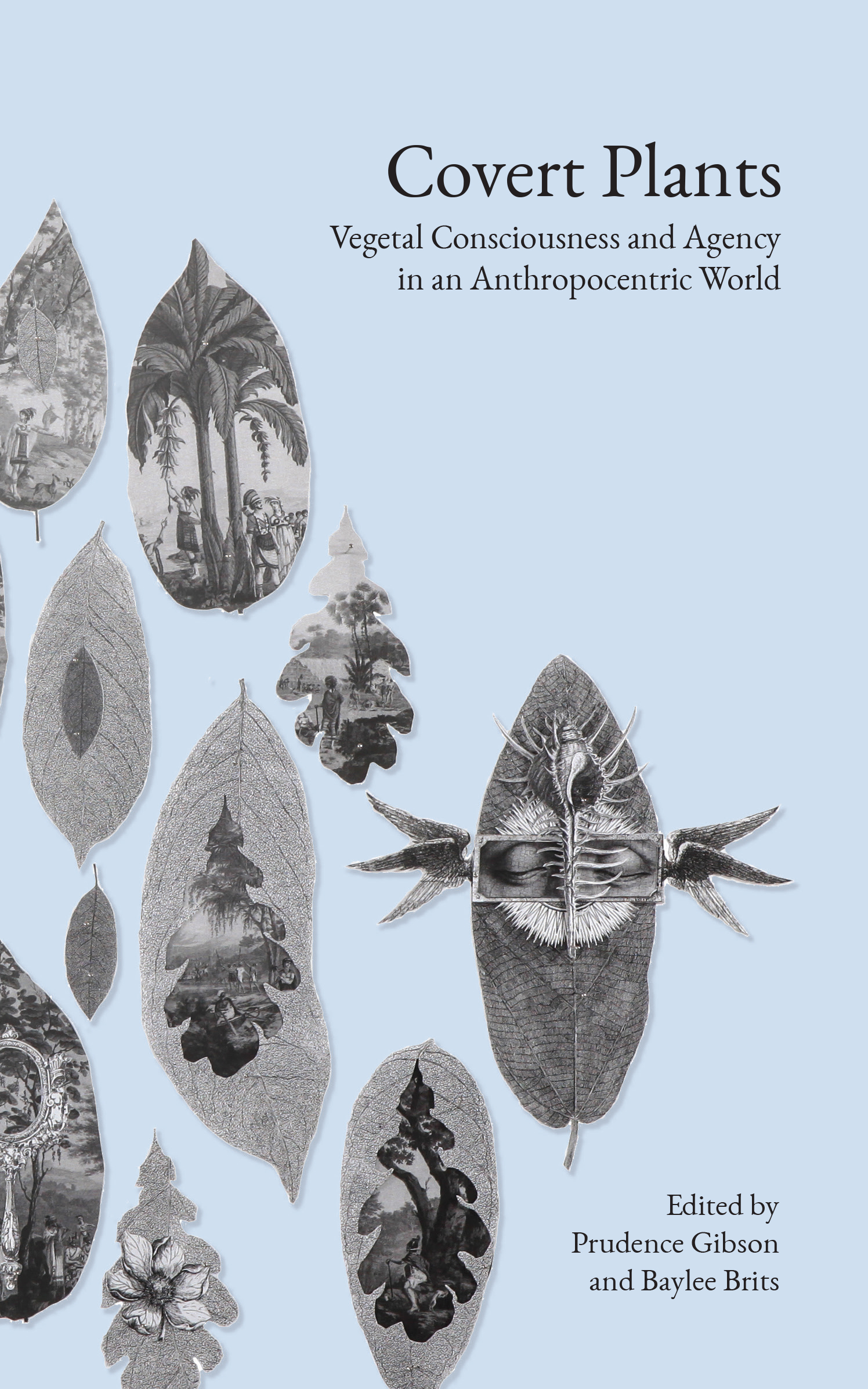
Covert Plants
Vegetal Consciousness and Agency in an Anthropocentric World
Edited by Prudence Gibson, Brits Baylee
Book information
- Publisher
- punctum books
- Publication
- Published 11 September 2018
- Place
- Earth, Milky Way
- Catalogue record
- View in the catalogue
Abstract
Covert Plants contributes to newly emerging discourses on the implications of vegetal life for the arts and culture. This stretches to changes in our perception of ‘nature’ and to the adapting roles of botany, evolutionary ecology, and environmental aesthetics in the humanities. Its editors and contributors seek various expressions of vegetal life rather than the mere representation of such, and they proceed from the conviction that a rigorous approach to thinking with and through vegetal life must be interdisciplinary. At a time when urgent calls for restorative care and reparative action have been sounded for the environment, this essay volume presents a range of academic and creative perspectives, from evolutionary biology to literary theory, philosophy to poetry, which respond to the perplexing problems and paradoxes of vegetal thinking.
Representations of vegetal life often include plant analogies and plant imagery. These representations have at times obscured the diversity of plant behavior and experience. Covert Plants probes the implications of vegetal life for thought and how new plant science is changing our perception of the vegetal — around us and in us. How can we think, speak, and write about plant life without falling into human-nature dyads, or without tumbling into reductive theoretical notions about the always complex relations between cognition and action, identity and value, subject and object?
A full view of this shifting perspective requires a ‘stereoscopic’ lens through which to view plants, but also simultaneously to alter our human-centered viewpoint. Plants are no longer the passive object of contemplation, but are increasingly resembling ‘subjects,’ ‘stakeholders,’ or ‘actors.’ As such, the plant now makes unprecedented demands upon the nature of contemplation itself. Moreover, the aesthetic, political, and legal implications of new knowledge regarding plants’ ability to communicate, sense, and learn require intensive, cross-disciplinary investigation. By doing this, we can intervene into current attitudes to climate change and sustainability, and hopefully revise, for the better, human philosophies, ethics, and aesthetics that touch upon plant life.
Chapters
Where its authors and editors are based
Countries of the institutions the book's authors, editors and chapter authors were affiliated to when it was published.
- AUTHORS / EDITORS
- CITATIONS Phase 2
- USAGE Phase 3
About this data
These figures cover 21 works. Each value comes from the most trusted source that has it; a correction made by OBC staff outranks every source.
| Source | Confidence | Works |
|---|---|---|
| Thoth | 90 / 100 | 21 |
| Works with a publication date | 100% |
|---|---|
| Works with a DOI | 100% |
| Works with a funder recorded | 0% |
| Authors with an affiliation | 88% |
| Affiliations matched to an institution (ROR) | 100% |
| Affiliations with a country | 100% |
Countries come from the institution each author was affiliated to when they published, as recorded in ROR. A country is never guessed, so authors without a matched institution are not counted on the maps.
Funders come from OpenAlex for articles and Thoth for books, where publishers recorded them. Most works record none, so a funder's figures show what is recorded, not everything it funded.
Chapters count as works: their authors and editors, and the countries of their institutions, are in every figure where Thoth records an affiliation for them.
Citations (Phase 2) and usage (Phase 3) are not collected yet.