
Book view
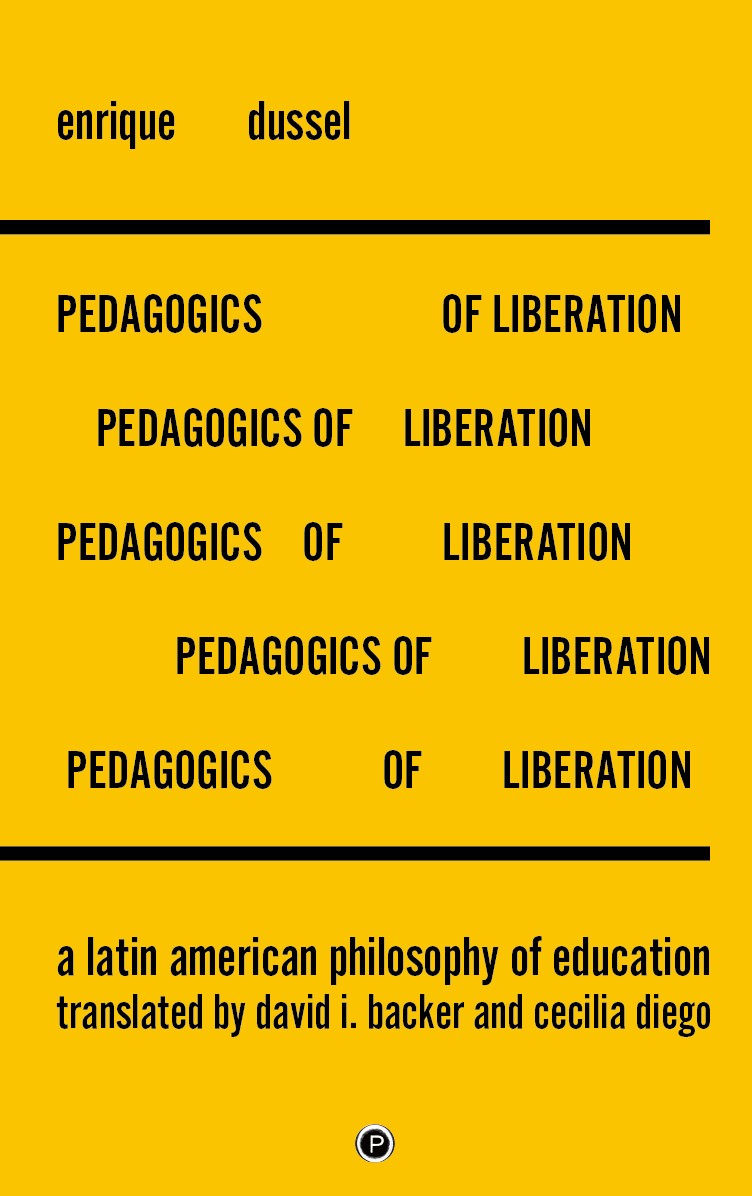
Pedagogics of Liberation
A Latin American Philosophy of Education
By Enrique Dussel, David I. Backer, Cecilia Diego, Linda Martín Alcoff
Book information
- Publisher
- punctum books
- Publication
- Published 20 August 2019
- Place
- Earth, Milky Way
- Catalogue record
- View in the catalogue
Abstract
Enrique Dussel is considered one of the founding philosophers of liberation in the Latin American tradition, an influential arm of what is now called decoloniality. While he is astoundingly prolific, relatively few of his works can be found in English translation — and none of these focus specifically on education. Founding members of the Latin American Philosophy of Education Society David I. Backer and Cecilia Diego bring to us Dussel’s The Pedagogics of Liberation: A Latin American Philosophy of Education, the first English translation of Dussel’s thinking on education, and also the first translation of any part of his landmark multi-volume work Towards an Ethics of Latin American Liberation.
Dussel’s ouevre is an impressive intellectual mosaic that uses Europeans to disrupt European thinking. This mosaic has at its center French philosopher Emmanuel Levinas, but also includes Ancient Greek philosophy, Thomist theology, modern Enlightenment philosophy, analytic philosophy of language, Marxism, psychoanalysis (Freud, Klein, evolutionary psychology, neuroscience), phenomenology (Sartre, Heidegger, Husserl, Hegel), critical theory (Frankfurt School, Habermas), and linguistics. Dussel joins these traditions to Latin American history, literature, and philosophy, specifically the work of Octavio Paz, Ivan Illich, and the philosophers of liberation whom Dussel studied with in Argentina before his exile to Mexico in the late 1970s.
Drawing heavily from the ethics of Levinas, Dussel examines the dominating and liberating features of intimate, concrete, and observable interactions between different kinds of people who might sit down and have face-to-face encounters, specifically where there may be an inequality of knowledge and a responsibility to guide, teach, learn, care, or study: teacher–student, politician–citizen, doctor–patient, philosopher–nonphilosopher, and so on. Those occupying the superior position of these face-to-face encounters (teachers, politicians, doctors, philosophers) have a clear choice for Dussel when it comes to their pedagogics. They are either open to hearing the voice of the Other, disrupting their sense of what is and should be by a newness beyond what they know; or, following the dominant pedagogics, they can try to communicate and instruct their sense of what is and should be (which Dussel, in a Latin American context, associates with dominant cultures) to the (supposed) tabula rasas in their charge. Dussel calls that sense of what is and should be “lo Mismo.” [The French in Levinas is “le Même,” and Backer and Diego have translated Dussel’s “lo Mismo” as “the Same.”]
This groundbreaking translation makes possible a face-to-face encounter between an Anglo Philosophy of Education and Latin American Pedagogics. “Pedagogics” should be considered as a type of philosophical inquiry alongside ethics, economics, and politics. Dussel’s pedagogics is a decolonizing pedagogics, one rooted in the philosophy of liberation he has spent his epic career articulating. With an Introduction by renowned philosopher Linda Martín Alcoff, this book adds an essential voice to our conversations about teaching, learning, and studying, as well as critical theory in general.
Where its authors and editors are based
Countries of the institutions the book's authors, editors and chapter authors were affiliated to when it was published.
- AUTHORS / EDITORS
- CITATIONS Phase 2
- USAGE Phase 3
| Country | Authors / editors |
|---|---|
| United States | 3 |
| Mexico | 1 |
About this data
These figures cover 1 work. Each value comes from the most trusted source that has it; a correction made by OBC staff outranks every source.
| Source | Confidence | Works |
|---|---|---|
| Thoth | 90 / 100 | 1 |
| Works with a publication date | 100% |
|---|---|
| Works with a DOI | 100% |
| Works with a funder recorded | 100% |
| Authors with an affiliation | 100% |
| Affiliations matched to an institution (ROR) | 100% |
| Affiliations with a country | 100% |
Countries come from the institution each author was affiliated to when they published, as recorded in ROR. A country is never guessed, so authors without a matched institution are not counted on the maps.
Funders come from OpenAlex for articles and Thoth for books, where publishers recorded them. Not every work records one, so a funder's figures show what is recorded, not everything it funded.
Chapters count as works: their authors and editors, and the countries of their institutions, are in every figure where Thoth records an affiliation for them.
Citations (Phase 2) and usage (Phase 3) are not collected yet.