
Book information
- Publisher
- punctum books
- Publication
- Published 6 December 2013
- Place
- Brooklyn, NY
- Catalogue record
- View in the catalogue
Abstract
Scholarship in medieval studies of the past 20 or so years has offered some provocative experiments in, and elegant exempla of, style. Scholars such as Anne Clark Bartlett, Kathleen Biddick, Catherine Brown, Brantley Bryant, Michael Camille, Jeffrey Jerome Cohen, Carolyn Dinshaw, James Earl, L.O. Aranye Fradenburg, Roberta Frank, Amy Hollywood, Cary Howie, C. Stephen Jaeger, Eileen Joy, Anna Klosowska, Nicola Masciandaro, Peggy McCracken, Paul Strohm, David Wallace, and Paul Zumthor, among others, have blended the conventions of academic writing with those of fiction, drama, memoir, comedy, polemic, and lyricism, and/or have developed what some would describe as elegant, and arresting (and in some cases, deliciously difficult) prose styles. As these registers merge, they can produce what has been called a queer historiographical encounter (or in queer theorist Elizabeth Freeman’s terms, “an erotohistoriography”), a “poetics of intensification,” and even a “new aestheticism.” The work of these scholars has also opened up debates (some rancorous) that often install what the editors of this volume feel are false binaries between form and content, feeling and thinking, affect and rigor, poetry and history, attachment and critical distance, enjoyment and discipline, style and substance. As Anna Klosowska writes in her contribution to this volume,
"The question of style, as it applies to medieval studies, is precisely the overcoming of that dichotomy between Nature and Man: a third element. And when the critique proceeds through the denunciation of the inimitability of someone’s style, as if it were the third sex, ungenerative, queer, sterile, sodomitic, lesbian, etc., the critic unconsciously puts his finger on exactly what style is; but that critic is mistaken about the style’s supposedly non-generative powers. In fact, style, neither fact nor theory but facilitating the transition between the two, is […] the generative principle itself."
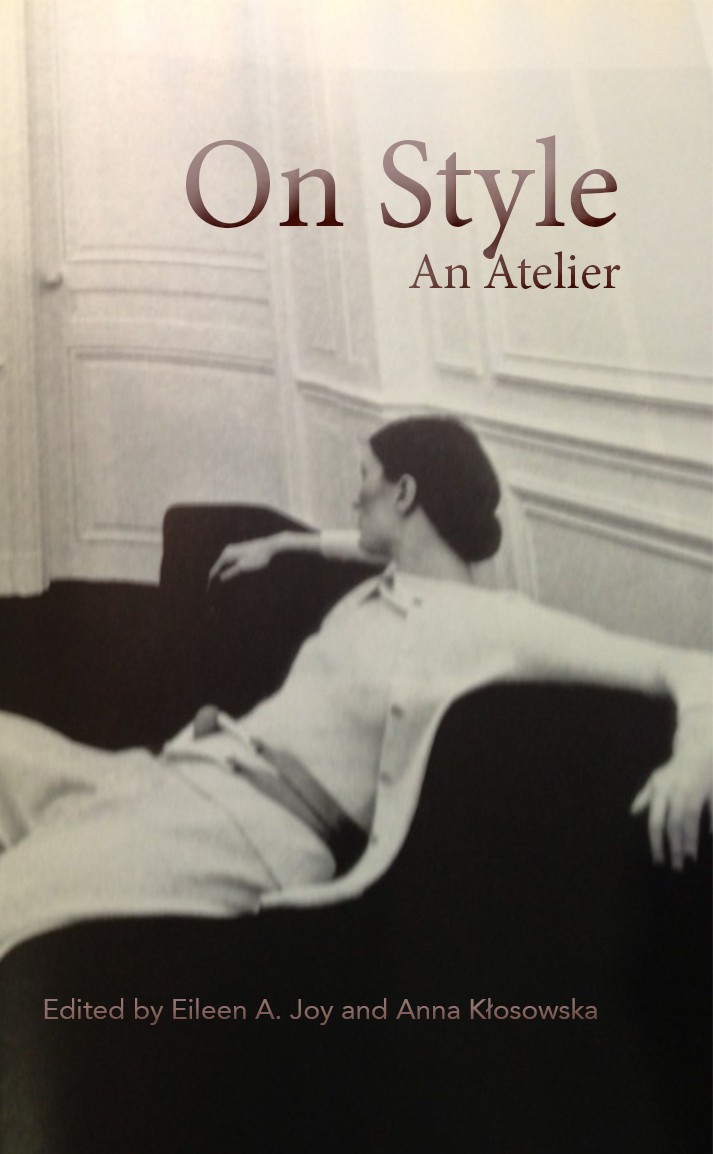
What can be said about the “style” of academic discourse at the present time, especially in relation to historical method, theory, and reading literary and historical texts? Is style merely supplemental to scholarly substance? As scholars, are we “subjects” of style? And what is the relationship between style and theory? Is style an object, a method, or something else? These were the questions that guided two conference sessions organized by the BABEL Working Group in 2010 (in Kalamazoo, Michigan and Austin, Texas), out of which this volume was developed. On Style: An Atelier gathers together medievalists and early modernists, as well as a poet and a novelist, in order to offer ruminations upon style in scholarship and theoretical writing (Roland Barthes, Carolyn Dinshaw, Lee Edelman, Bracha Ettinger, Charles Fourier, L.O. Aranye Fradenburg, Heidegger, Lacan, Ignatius of Loyola, and the Marquis de Sade, among others), as well as upon various trajectories of fashionable representation and self-representation in literature, sculpture, psychoanalysis, philosophy, religious history, rhetoric, and global politics.
Chapters
| Chapter | Author | Institution at publication |
|---|---|---|
| Always Accessorize | Christine Neufeld | Eastern Michigan University |
| Backmatter | Eileen A. Joy, Anna Kłosowska | Miami University |
| Daniel's Smile | Kathleen Biddick | Temple University |
| Frontmatter | Eileen A. Joy, Anna Kłosowska | Miami University |
| Lacan's belles-lettres | Ruth Evans | Saint Louis University |
| On Style | Anna Kłosowska | Miami University |
| Renegade Style | Jessica Roberts Frazier | George Washington University |
| Style as Third Element | Anna Kłosowska | Miami University |
| The Aesthetics of Style and the Politics of Identity Formation | Gila Aloni | |
| The Unceasing Call of Style | Valerie Vogrin | Southern Illinois University Edwardsville |
| To Peach or Not to Peach | Michael D. Snediker | University of Houston |
| Without Style | Valerie Allen | John Jay College of Criminal Justice |
Where its authors and editors are based
Countries of the institutions the book's authors, editors and chapter authors were affiliated to when it was published.
- AUTHORS / EDITORS
- CITATIONS Phase 2
- USAGE Phase 3
| Country | Authors / editors |
|---|---|
| United States | 8 |
| Philippines | 1 |
About this data
These figures cover 13 works. Each value comes from the most trusted source that has it; a correction made by OBC staff outranks every source.
| Source | Confidence | Works |
|---|---|---|
| Thoth | 90 / 100 | 13 |
| Works with a publication date | 100% |
|---|---|
| Works with a DOI | 100% |
| Works with a funder recorded | 0% |
| Authors with an affiliation | 81% |
| Affiliations matched to an institution (ROR) | 100% |
| Affiliations with a country | 100% |
Countries come from the institution each author was affiliated to when they published, as recorded in ROR. A country is never guessed, so authors without a matched institution are not counted on the maps.
Funders come from OpenAlex for articles and Thoth for books, where publishers recorded them. Most works record none, so a funder's figures show what is recorded, not everything it funded.
Chapters count as works: their authors and editors, and the countries of their institutions, are in every figure where Thoth records an affiliation for them.
Citations (Phase 2) and usage (Phase 3) are not collected yet.