
Book view
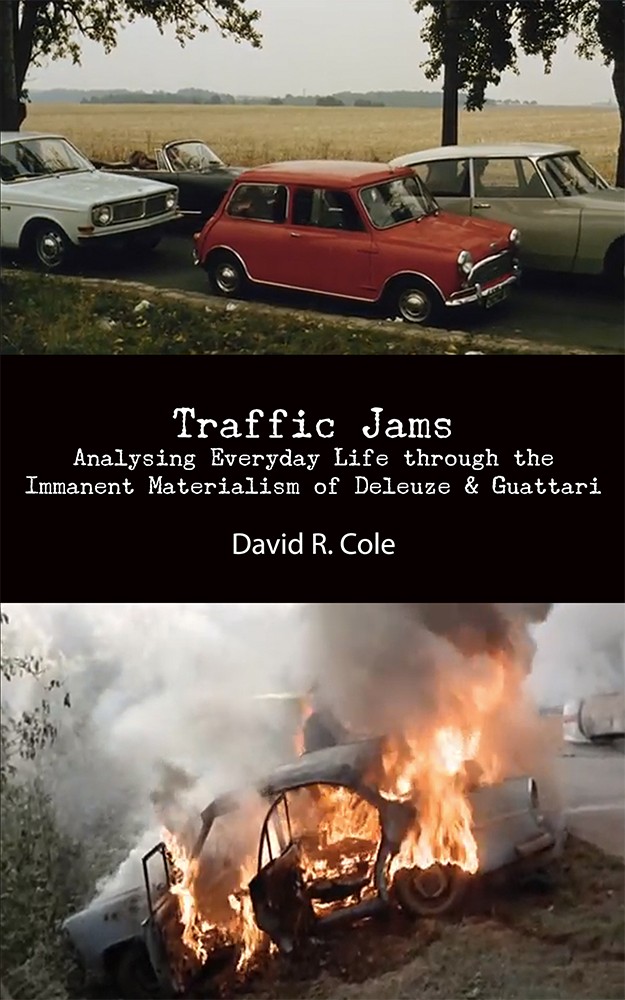
Traffic Jams
Analysing Everyday Life through the Immanent Materialism of Deleuze & Guattari
Book information
- Publisher
- punctum books
- Publication
- Published 13 February 2013
- Place
- Brooklyn, NY
- Catalogue record
- View in the catalogue
Abstract
This dead letter presents an exploration of the immanent materialism of Deleuze & Guattari as theorised in A Thousand Plateaus as a means to analysing everyday life. The evidence consists of art, film and objects from life that relate to and suggest the complex ways in which we are affected by traffic jams. Reciprocating substrata of everyday life build upon the unconscious, and show how the abstract turbulence of everyday life forms eddies and flows that may be followed and understood. The immanent materialism of Deleuze & Guattari is a philosophical construction that leads to the formation of ‘plateaus’ as they were executed in A Thousand Plateaus. The plateau of this dead letter is [21 October 2011: the Petro-Citizen] and is populated with traffic jams, car crashes, global environmental concerns and the psychological and sociological contingencies that accompany the petro-citizen. Connections between the strata that make up the plateau of the petro-citizen will deliberately be left as open-ended and speculative to show how the petro-citizen functions as a flagrant construct in everyday life, which includes the desire for petrol and explains the resulting panpsychic petro-political landscape. The double-articulation of the plateau depends upon the ways in which the petro-citizen and petro-politics create reciprocating realms of motivation and drive that tend towards contemporary double-articulation, paradox and contradiction with respect to the usages of oil. This double-articulation results in a multiple chequered flag or illusionary global end-game that designates the current human relationships with oil.
Where its authors and editors are based
Countries of the institutions the book's authors, editors and chapter authors were affiliated to when it was published.
- AUTHORS / EDITORS
- CITATIONS Phase 2
- USAGE Phase 3
| Country | Authors / editors |
|---|---|
| Australia | 1 |
About this data
These figures cover 1 work. Each value comes from the most trusted source that has it; a correction made by OBC staff outranks every source.
| Source | Confidence | Works |
|---|---|---|
| Thoth | 90 / 100 | 1 |
| Works with a publication date | 100% |
|---|---|
| Works with a DOI | 100% |
| Works with a funder recorded | 0% |
| Authors with an affiliation | 100% |
| Affiliations matched to an institution (ROR) | 100% |
| Affiliations with a country | 100% |
Countries come from the institution each author was affiliated to when they published, as recorded in ROR. A country is never guessed, so authors without a matched institution are not counted on the maps.
Funders come from OpenAlex for articles and Thoth for books, where publishers recorded them. Most works record none, so a funder's figures show what is recorded, not everything it funded.
Chapters count as works: their authors and editors, and the countries of their institutions, are in every figure where Thoth records an affiliation for them.
Citations (Phase 2) and usage (Phase 3) are not collected yet.