
Book information
- Publisher
- punctum books
- Publication
- Published 21 May 2020
- Place
- Earth, Milky Way
- Catalogue record
- View in the catalogue
Abstract
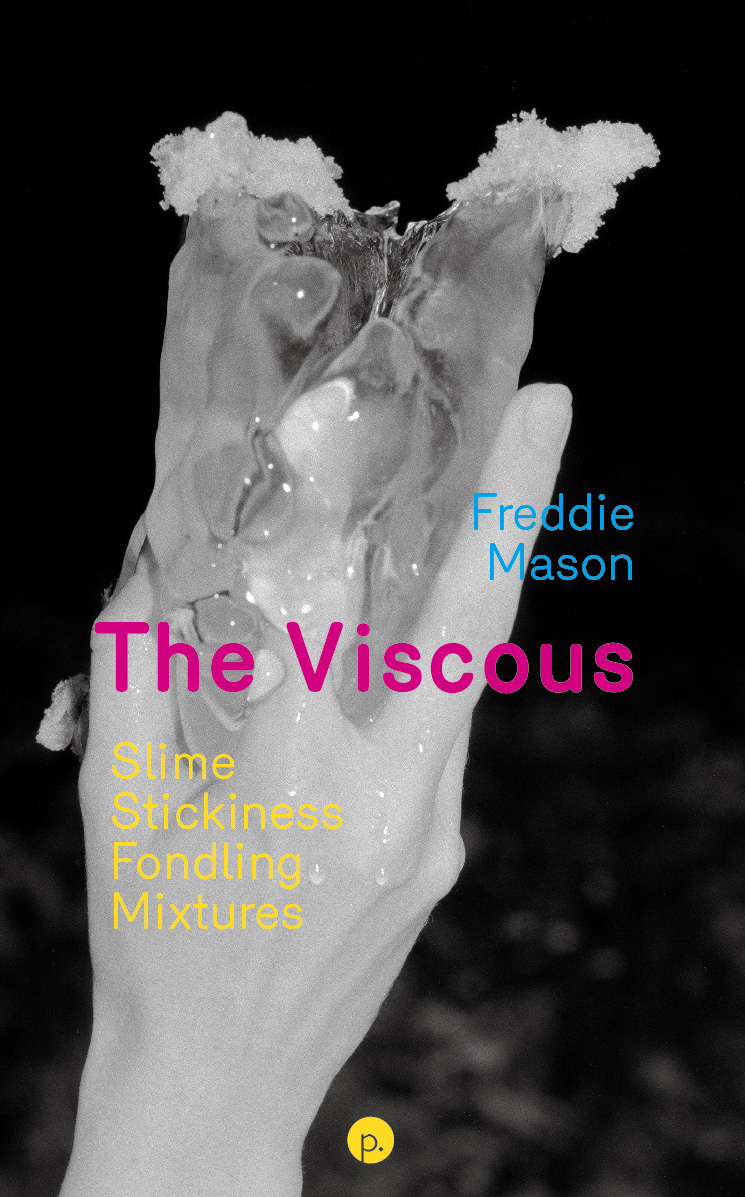
Slime, goo, gunge, gloop, gels, sols, globules, jellies, emulsions, greases, soaps, syrups, glues, lubricants, liquid crystals, moulds, plasmas, and protoplasms – the viscous is not one thing, but rather a quality of resistance and flow, of stickiness and slipperiness. It is a state of matter that oozes into the gaps of our everyday existence, across age groups, between cultures and disciplines.
Since the large-scale extraction of petroleum in the 19th century, the viscous has witnessed a proliferation in the variety of its forms. Mechanized industry required lubricants and oil distillation produced waste products that were refined to form Vaseline. From this age, new viscous forms and technologies emerged: products from plastic (and plastic explosives) to cosmetics, glycerine, asphalt, sexual lubrication, hydro- and aero-gels, and even anti-climb paint.
Based on unique and wide-ranging research, The Viscous is the first major investigation of encounters with and possibilities of the viscous over the course of the last century, not simply as a material state, but also as an imaginative event. We enter into a story of matter at its most wayward, deviant, hesitant, and resistant.
From asphalt lakes to industrial molasses tanks, from liquid crystals squirming in our screens to milk fetishes, The Viscous discloses gooeyness as a peculiarly modern phase of matter. “Everything oozes,” as Beckett’s Estragon famously proclaims in Waiting for Godot. Viscous dynamics are exposed as not only hugely various in a post-industrial age, but particularly useful ways of thinking, feeling, writing, and making in a time of ecological anxiety.
Where its authors and editors are based
Countries of the institutions the book's authors, editors and chapter authors were affiliated to when it was published.
- AUTHORS / EDITORS
- CITATIONS Phase 2
- USAGE Phase 3
No affiliations with a known country in these years yet.
About this data
These figures cover 1 work. Each value comes from the most trusted source that has it; a correction made by OBC staff outranks every source.
| Source | Confidence | Works |
|---|---|---|
| Thoth | 90 / 100 | 1 |
| Works with a publication date | 100% |
|---|---|
| Works with a DOI | 100% |
| Works with a funder recorded | 0% |
| Authors with an affiliation | 0% |
Countries come from the institution each author was affiliated to when they published, as recorded in ROR. A country is never guessed, so authors without a matched institution are not counted on the maps.
Funders come from OpenAlex for articles and Thoth for books, where publishers recorded them. Most works record none, so a funder's figures show what is recorded, not everything it funded.
Chapters count as works: their authors and editors, and the countries of their institutions, are in every figure where Thoth records an affiliation for them.
Citations (Phase 2) and usage (Phase 3) are not collected yet.