
Book view
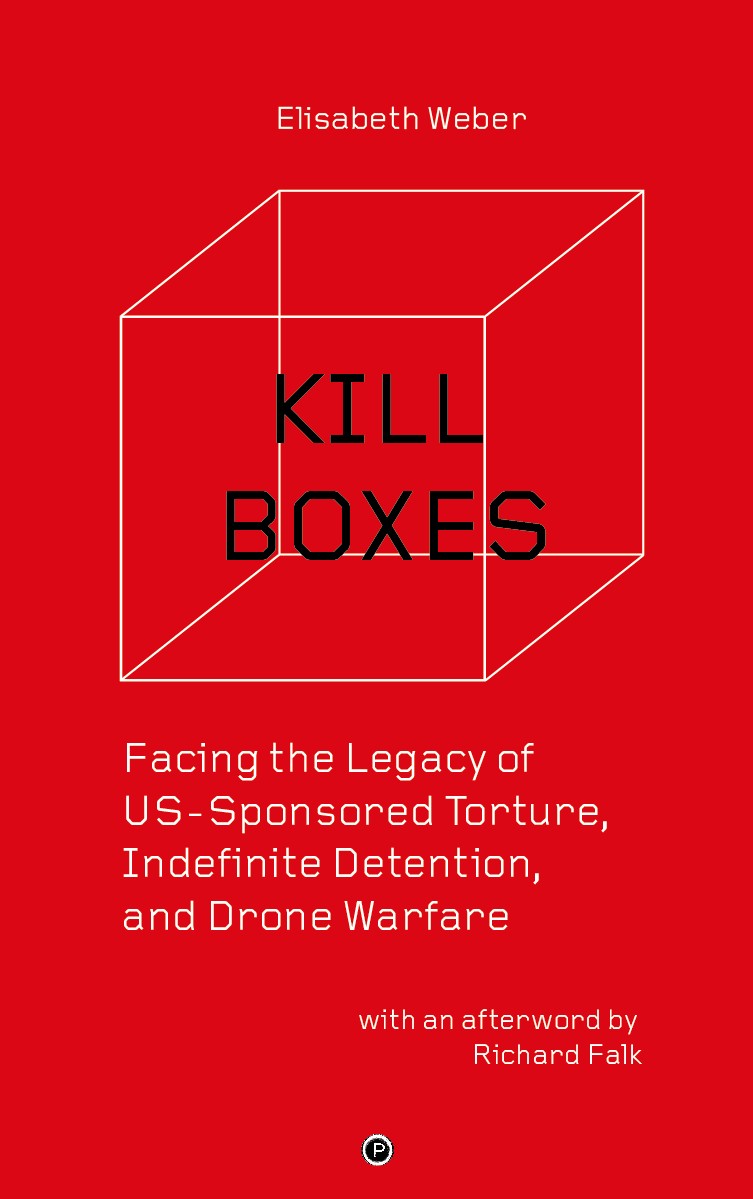
Kill Boxes
Facing the Legacy of US-Sponsored Torture, Indefinite Detention, and Drone Warfare
Book information
- Publisher
- punctum books
- Publication
- Published 2 March 2017
- Place
- Earth, Milky Way
- Catalogue record
- View in the catalogue
Abstract
Kill Boxes addresses the legacy of US-sponsored torture, indefinite detention, and drone warfare by deciphering the shocks of recognition that humanistic and artistic responses to violence bring to consciousness if readers and viewers have eyes to face them.
Beginning with an analysis of the ways in which the hooded man from Abu Ghraib became iconic, subsequent chapters take up less culturally visible scenes of massive violations of human rights to bring us face to face with these shocks and the forms of recognition that they enable and disavow. We are addressed in the photo of the hooded man, all the more so as he was brutally prevented, in our name, from returning the camera’s and thus our gaze. We are addressed in the screams that turn a person, tortured in our name, into howling flesh. We are addressed in poems written in the Guantánamo Prison camp, however much American authorities try to censor them, in our name. We are addressed by the victims of the US drone wars, however little American citizens may have heard the names of the places obliterated by the bombs for which their taxes pay. And we know that we are addressed in spite of a number of strategies of brutal refusal of heeding those calls.
Providing intensive readings of philosophical texts by Jean Améry, Jacques Derrida, and Christian Thomasius, with poetic texts by Franz Kafka, Paul Muldoon, and the poet-detainees of Guantánamo Bay Prison Camp, and with artistic creations by Sallah Edine Sallat, the American artist collective Forkscrew and an international artist collective from Pakistan, France and the US, Kill Boxes demonstrates the complexity of humanistic responses to crimes committed in the name of national security. The conscious or unconscious knowledge that we are addressed by the victims of these crimes is a critical factor in discussions on torture, on indefinite detention without trial, as practiced in Guantánamo, and in debates on the strategies to circumvent the latter altogether, as practiced in drone warfare and its extrajudicial assassination program.
Where its authors and editors are based
Countries of the institutions the book's authors, editors and chapter authors were affiliated to when it was published.
- AUTHORS / EDITORS
- CITATIONS Phase 2
- USAGE Phase 3
| Country | Authors / editors |
|---|---|
| United States | 2 |
About this data
These figures cover 1 work. Each value comes from the most trusted source that has it; a correction made by OBC staff outranks every source.
| Source | Confidence | Works |
|---|---|---|
| Thoth | 90 / 100 | 1 |
| Works with a publication date | 100% |
|---|---|
| Works with a DOI | 100% |
| Works with a funder recorded | 0% |
| Authors with an affiliation | 100% |
| Affiliations matched to an institution (ROR) | 100% |
| Affiliations with a country | 100% |
Countries come from the institution each author was affiliated to when they published, as recorded in ROR. A country is never guessed, so authors without a matched institution are not counted on the maps.
Funders come from OpenAlex for articles and Thoth for books, where publishers recorded them. Most works record none, so a funder's figures show what is recorded, not everything it funded.
Chapters count as works: their authors and editors, and the countries of their institutions, are in every figure where Thoth records an affiliation for them.
Citations (Phase 2) and usage (Phase 3) are not collected yet.