
Book information
- Publisher
- punctum books
- Publication
- Forthcoming 1 May 2028
- Catalogue record
- View in the catalogue
Abstract
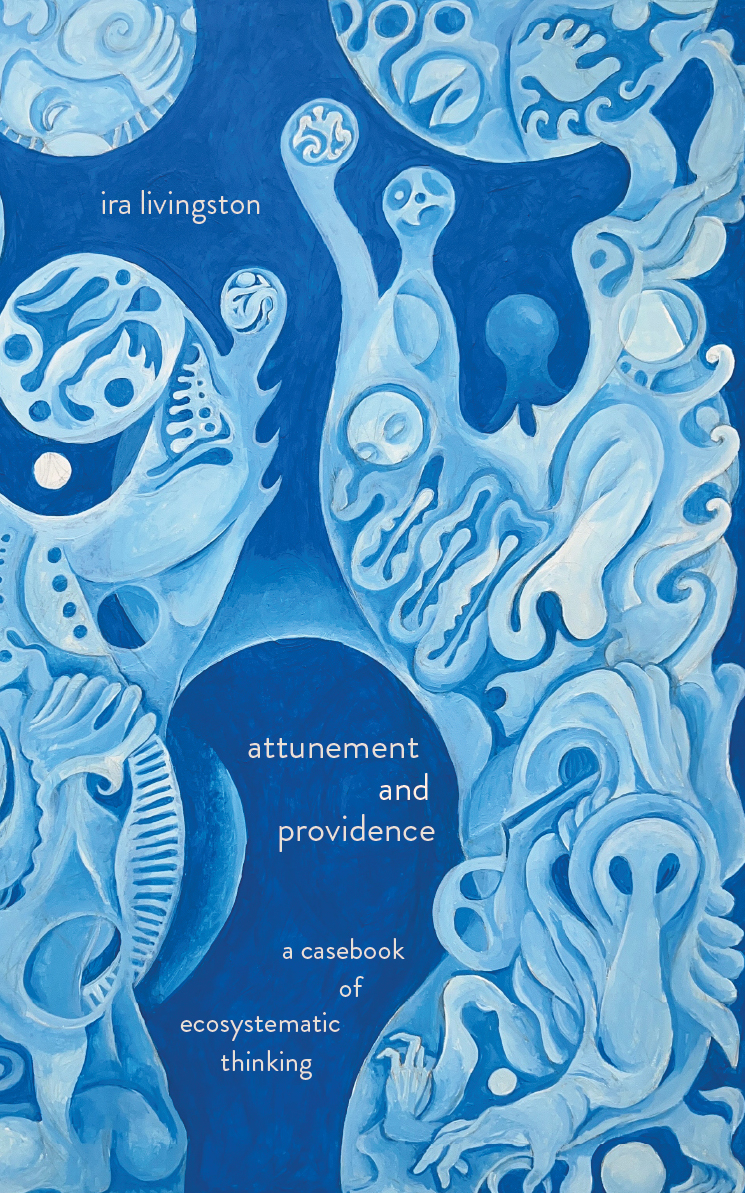
With vivid examples throughout, Attunement and Providence cultivates ecosystematic thinking across the science/culture divide. Examples and case studies drawn from cosmology, evolution, mathematics, physics, literature, visual art and the writing process help build the deep conceptual groundwork for political anti-nihilism and radical democracy.
Starting with the idea that complexity is primordial, residing in the nonlinear loops by which systems and their environments shape and are shaped by each other, the book explores the kinship of systems and how meaning inheres in the way things matter to each other—as opposed to being something humans make in an otherwise meaningless universe. Conscious meaning-making participates in a world already held together by meaning.
To understand systems involves attributing agency more democratically by practicing the Down Style (understanding entities as concatenations of impersonal forces) along with the Up Style (recognizing the livingthinglikeness of all systems) and by engaging ecologies as entities and vice versa. We are ill-served by the loaded metaphor of “laws of nature”: physics is better understood as how the universe is attuned. The leading feature of the evolved ensemble of attunements (aka. laws of nature) is not inviolable rigidity but ongoing and open generativity in enabling new forms of complex order (such as biology, sentience, language) to emerge. The concept of providence recognizes our sustainably attuned and generative universe as one in which we are at home. Attunement and Providence works to weave what is most fundamental to our ongoing existence—ecosystematicity—through our knowledges, worldviews, and religions.
Where its authors and editors are based
Countries of the institutions the book's authors, editors and chapter authors were affiliated to when it was published.
- AUTHORS / EDITORS
- CITATIONS Phase 2
- USAGE Phase 3
| Country | Authors / editors |
|---|---|
| United States | 1 |
About this data
These figures cover 1 work. Each value comes from the most trusted source that has it; a correction made by OBC staff outranks every source.
| Source | Confidence | Works |
|---|---|---|
| Thoth | 90 / 100 | 1 |
| Works with a publication date | 100% |
|---|---|
| Works with a DOI | 100% |
| Works with a funder recorded | 0% |
| Authors with an affiliation | 100% |
| Affiliations matched to an institution (ROR) | 100% |
| Affiliations with a country | 100% |
Countries come from the institution each author was affiliated to when they published, as recorded in ROR. A country is never guessed, so authors without a matched institution are not counted on the maps.
Funders come from OpenAlex for articles and Thoth for books, where publishers recorded them. Most works record none, so a funder's figures show what is recorded, not everything it funded.
Chapters count as works: their authors and editors, and the countries of their institutions, are in every figure where Thoth records an affiliation for them.
Citations (Phase 2) and usage (Phase 3) are not collected yet.