
Book information
- Publisher
- punctum books
- Publication
- Published 21 November 2025
- Place
- Earth, Milky Way
- Catalogue record
- View in the catalogue
Abstract
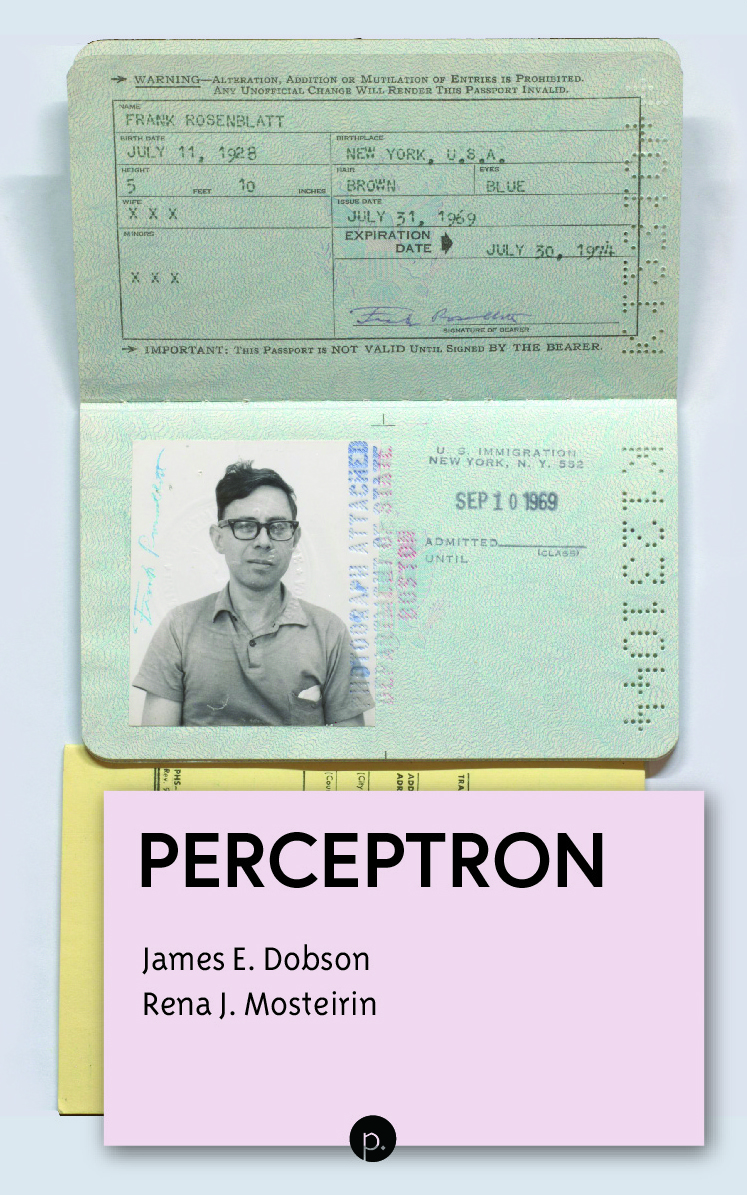
Perceptron is a work of experimental poetry and a critical biographical reading of Frank Rosenblatt (1928–1971) and his 1957 invention, the Perceptron. The Perceptron was the first widely publicized and used machine learning device and the origin of much contemporary neural network technology. Rosenblatt was a psychologist, a computer engineer, a musician, an amateur astronomer, a sailor, and a poet. The Perceptron was born from an interdisciplinary mix of ideas and was so far ahead of its time that it was widely misunderstood by other scientists and the public.
This mechanical invention, imagined as an alternative to general purpose digital computers, and its algorithmic implementation as a simulation of the device was deeply rooted in mid-twentieth-century neuroscience and psychological theories of behavior. Introduced to the world by one newspaper under the headline “Shades of Frankenstein!” in 1958, following a public demonstration in Maryland sponsored by the US Navy, the Perceptron was a radical new approach to designing computer systems. What made it different was its design as a simplified model of animal vision systems. The Perceptron could perform pattern recognition and matching from a collection of simple visual objects. It was innovative and impressive, but it was also constantly oversold by its financial supporters, the press, and by its inventor.
Perceptron traces, contextualizes, and celebrates the ideas that would become embedded in this early thinking machine and that animated the excitement and promise that would eventually turn to frustration and failure during Rosenblatt’s tragically short lifetime.
Where its authors and editors are based
Countries of the institutions the book's authors, editors and chapter authors were affiliated to when it was published.
- AUTHORS / EDITORS
- CITATIONS Phase 2
- USAGE Phase 3
| Country | Authors / editors |
|---|---|
| United States | 2 |
About this data
These figures cover 1 work. Each value comes from the most trusted source that has it; a correction made by OBC staff outranks every source.
| Source | Confidence | Works |
|---|---|---|
| Thoth | 90 / 100 | 1 |
| Works with a publication date | 100% |
|---|---|
| Works with a DOI | 100% |
| Works with a funder recorded | 100% |
| Authors with an affiliation | 100% |
| Affiliations matched to an institution (ROR) | 100% |
| Affiliations with a country | 100% |
Countries come from the institution each author was affiliated to when they published, as recorded in ROR. A country is never guessed, so authors without a matched institution are not counted on the maps.
Funders come from OpenAlex for articles and Thoth for books, where publishers recorded them. Not every work records one, so a funder's figures show what is recorded, not everything it funded.
Chapters count as works: their authors and editors, and the countries of their institutions, are in every figure where Thoth records an affiliation for them.
Citations (Phase 2) and usage (Phase 3) are not collected yet.