
Book view
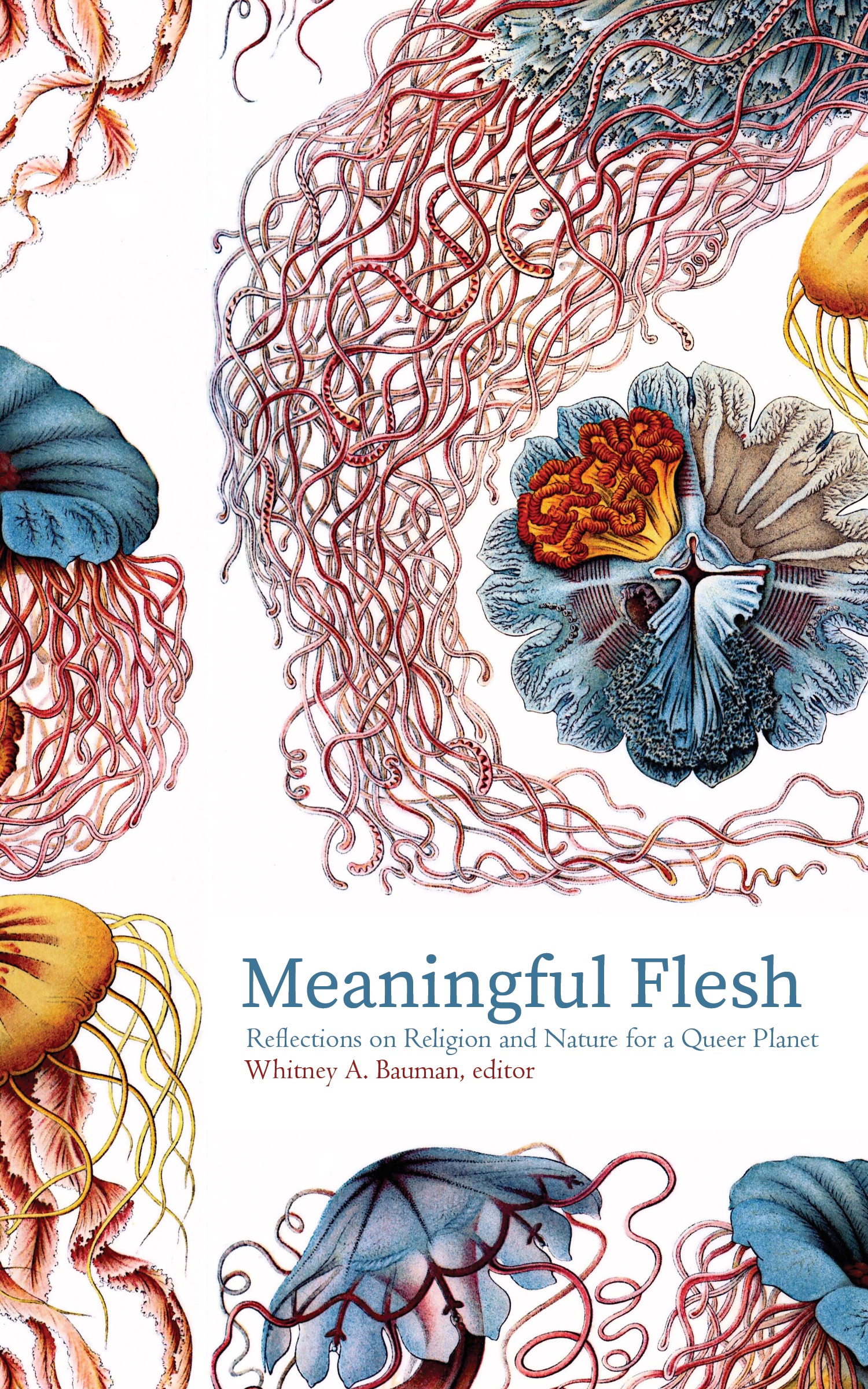
Meaningful Flesh
Reflections on Religion and Nature for a Queer Planet
Edited by Whitney A. Bauman
Book information
- Publisher
- punctum books
- Publication
- Published 16 January 2018
- Place
- Earth, Milky Way
- Catalogue record
- View in the catalogue
Abstract
Religion is much queerer than we ever imagined. Nature is as well. These are the two basic insights that have led to this volume: the authors included here hope to queerly go where no thinkers have gone before. The combination of queer theory and religion has been happening for at least 25 years. People such as John Boswell began to examine the history of religious traditions with a queer eye, and soon after we had the indecent theology of Marcella Althaus Ried. Jay Johnston, one of the authors in this issue, is among those who have used the queer eye to interrogate authority within Christian theological traditions. At the same time, there have been many queer interrogations of “nature,” perhaps most notably in the works of Joan Roughgarden and Ann Fausto-Sterling, and more recently in the works of Catriona Sandilands and Timothy Morton (an author in this volume). However, the intersections of religion, nature, and queer theory have been largely left untouched. With the exception of Dan Spencer, who writes the introduction for this volume and is one of the early pioneers in this realm of thought with his book Gay and Gaia (Pilgrim Press, 1996), and the work of Greta Gaard in developing a queer ecofeminist thought, religion and nature, or religion and ecology, have largely ignored the realm of queer theory.
In part, the blinders to queer theory on the part of eco-thinkers (religious or otherwise) are similar to the blinders eco-thinkers have when it comes to postmodern thought in general: namely, if there are no absolute foundations, how does one create an environmental ethic and a “nature” to save? For this reason and many others, this volume on religion, nature, and queer theory is groundbreaking. Though these essays span many different disciplines and themes, they are all held together by the triple focus on religion, nature, and queer theory.
Each of these essays offers a unique contribution to the intersection of religion, nature, and queer theory, and all of them challenge strict boundaries proposed in religious rhetoric and many discourses surrounding “nature.” Carol Wayne White’s essay draws from a queer reading of James Baldwin to develop an African American religious naturalism, which highlights humans as polyamorous bastards. Jacob Erickson’s essay examines Isabella Rossellini’s “Green Porno” and Martin Luther’s work to develop an irreverent theology. Jay Johnson draws from personal relationships with his late dog, and Master/Pup fetish-play, to blur the boundaries between humans and other animals, specifically within ethical and theological discourse. Whitney Bauman reflects on how the very processes of globalization and climate change queer our identities and call for a queer and versatile planetary ethic. Finally, Timothy Morton leads us through a reflection on queer green sex toys to challenge the ontology of agrologistics. Each of these essays in their own way is concerned with fleshing out more meaningful encounters with the planetary community. Without being too ambitious, we hope that these sets of essays will help to open up a new trajectory of conversations at the intersection of religion, nature, and queer theory.
Chapters
| Chapter | Author | Institution at publication |
|---|---|---|
| Introduction | Daniel T. Spencer | Calvin University |
| Preface | Whitney A. Bauman | Florida International University |
| Backmatter | Whitney A. Bauman | Florida International University |
| Frontmatter | Whitney A. Bauman | Florida International University |
| Irreverent Technology | Jacob J. Erickson | Trinity College Dublin |
| Liverating Compassion | Jay Emerson Johnson | Graduate Theological Union |
| Polyamorous Bastards | Carol Wayne White | Bucknell University |
| Queer Green Sex Toys | Timothy Morton | Rice University |
| Queer Values for a Queer Climate | Whitney A. Bauman | Florida International University |
Where its authors and editors are based
Countries of the institutions the book's authors, editors and chapter authors were affiliated to when it was published.
- AUTHORS / EDITORS
- CITATIONS Phase 2
- USAGE Phase 3
| Country | Authors / editors |
|---|---|
| United States | 5 |
| Ireland | 1 |
About this data
These figures cover 10 works. Each value comes from the most trusted source that has it; a correction made by OBC staff outranks every source.
| Source | Confidence | Works |
|---|---|---|
| Thoth | 90 / 100 | 10 |
| Works with a publication date | 100% |
|---|---|
| Works with a DOI | 100% |
| Works with a funder recorded | 0% |
| Authors with an affiliation | 100% |
| Affiliations matched to an institution (ROR) | 100% |
| Affiliations with a country | 100% |
Countries come from the institution each author was affiliated to when they published, as recorded in ROR. A country is never guessed, so authors without a matched institution are not counted on the maps.
Funders come from OpenAlex for articles and Thoth for books, where publishers recorded them. Most works record none, so a funder's figures show what is recorded, not everything it funded.
Chapters count as works: their authors and editors, and the countries of their institutions, are in every figure where Thoth records an affiliation for them.
Citations (Phase 2) and usage (Phase 3) are not collected yet.