
Book information
- Publisher
- punctum books
- Publication
- Published 4 December 2018
- Place
- Earth, Milky Way
- Catalogue record
- View in the catalogue
Abstract
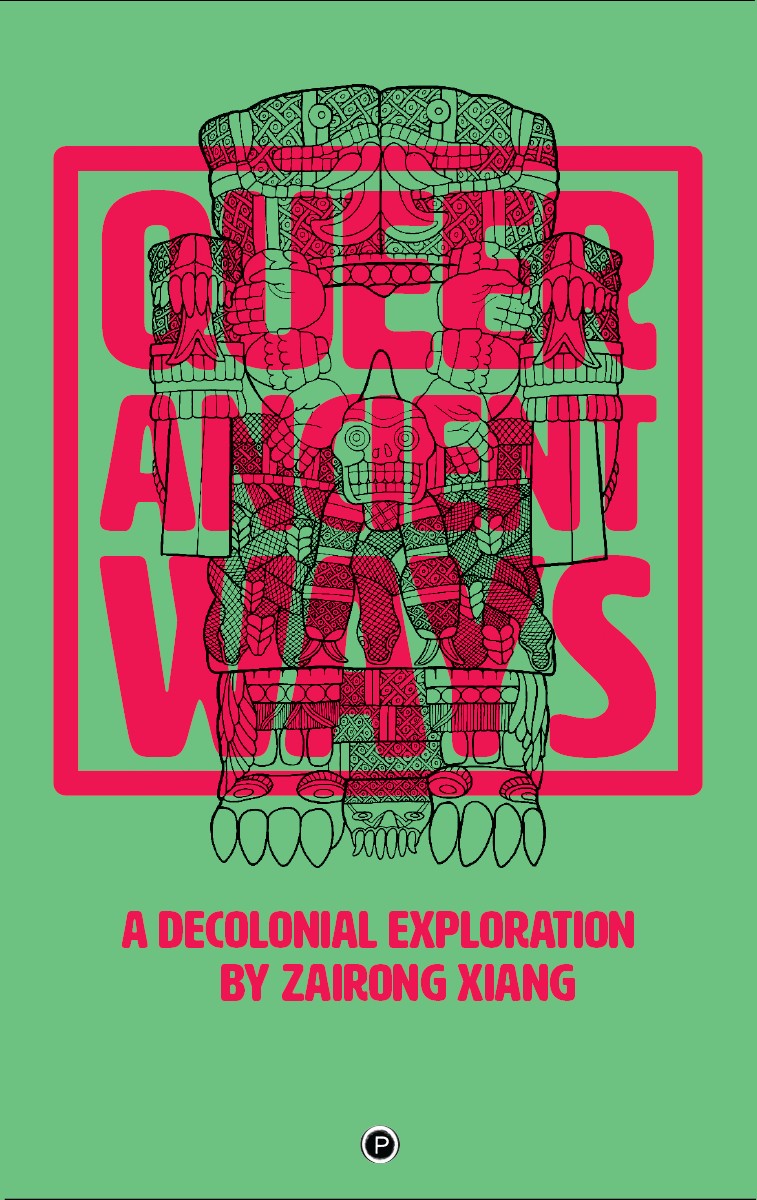
Queer Ancient Ways advocates a profound unlearning of colonial/modern categories as a pathway to the discovery of new forms and theories of queerness in the most ancient of sources (thereby also unlearning queer theory as it has been understood in contemporary, primarily Anglo-American and western European contexts). In this radically unconventional work, Zairong Xiang investigates scholarly receptions of mythological figures in Babylonian and Nahua creation myths, exposing the ways they have consistently been gendered as feminine in a manner that is not supported, and in some cases actively discouraged, by the texts themselves. An exercise in decolonial learning-to-learn from non-Western and non-modern cosmologies, Xiang’s work uncovers a rich queer imaginary that has been all-but-lost to modern thought, in the process critically revealing the operations of modern/colonial systems of gender/sexuality and knowledge-formation that have functioned, from the Conquista de America in the sixteenth century to the present, to keep these systems in obscurity.
At the heart of Xiang’s argument is an account of the way the unfounded feminization of figures such as the Babylonian (co)creatrix Tiamat, and the Nahua creator-figures Tlaltecuhtli and Coatlicue, is complicit with their monstrification. This complicity tells us less about the mythologies themselves than about the dualistic system of gender and sexuality within which they have been studied, underpinned by a consistent tendency in modern/colonial thought to insist on unbridgeable categorical differences.
By contextualizing these deities in their respective mythological, linguistic, and cultural environments, through a unique combination of methodologies and critical traditions in English, Spanish, French, Chinese, and Nahuatl, Xiang departs from the over-reliance of much contemporary queer theory on European (post)modern thought. Much more than a queering of the non-Western and non-modern, Queer Ancient Ways thus constitutes a decolonial and transdisciplinary engagement with ancient cosmologies and ways of thought which are in the process themselves revealed as theoretical sources of and for the queer imagination.
Where its authors and editors are based
Countries of the institutions the book's authors, editors and chapter authors were affiliated to when it was published.
- AUTHORS / EDITORS
- CITATIONS Phase 2
- USAGE Phase 3
| Country | Authors / editors |
|---|---|
| Germany | 1 |
| United States | 1 |
About this data
These figures cover 1 work. Each value comes from the most trusted source that has it; a correction made by OBC staff outranks every source.
| Source | Confidence | Works |
|---|---|---|
| Thoth | 90 / 100 | 1 |
| Works with a publication date | 100% |
|---|---|
| Works with a DOI | 100% |
| Works with a funder recorded | 0% |
| Authors with an affiliation | 100% |
| Affiliations matched to an institution (ROR) | 100% |
| Affiliations with a country | 100% |
Countries come from the institution each author was affiliated to when they published, as recorded in ROR. A country is never guessed, so authors without a matched institution are not counted on the maps.
Funders come from OpenAlex for articles and Thoth for books, where publishers recorded them. Most works record none, so a funder's figures show what is recorded, not everything it funded.
Chapters count as works: their authors and editors, and the countries of their institutions, are in every figure where Thoth records an affiliation for them.
Citations (Phase 2) and usage (Phase 3) are not collected yet.