
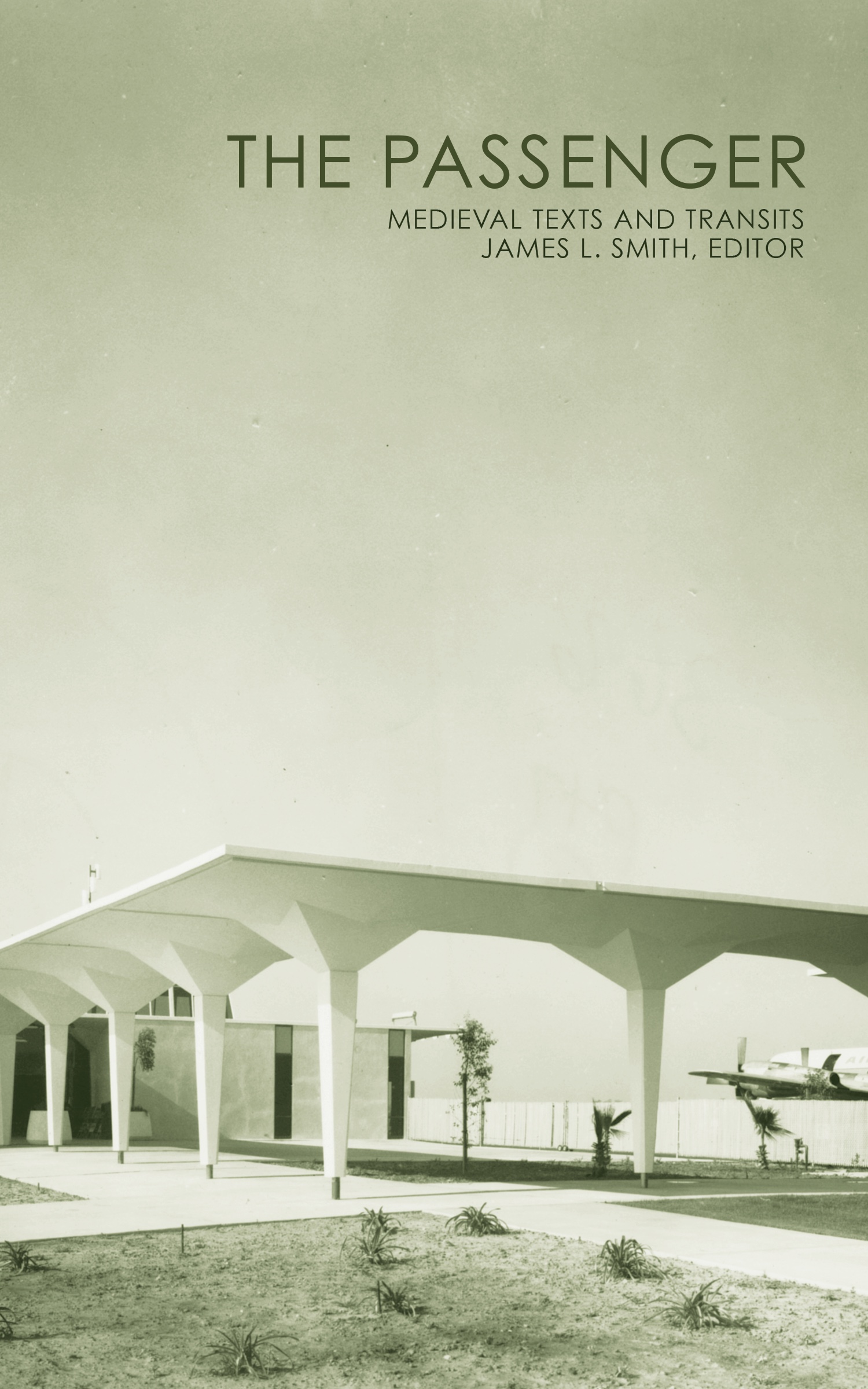
Book information
- Publisher
- punctum books
- Publication
- Published 8 December 2017
- Place
- Earth, Milky Way
- Catalogue record
- View in the catalogue
Abstract
What strange transactions take place in the mobile spaces between loci? How does the flow of forces between fixed points enliven texts, suggest new connections, and map out the dizzying motion of myriad interactions? The essays in this volume were first presented at the 2014 New Chaucer Society Congress in Reykjavik, Iceland where a meeting of minds in a shared intermediate space initiated dialogue from diverse perspectives and wended its way through the invisible spaces between concrete categories, objects, and entities.
The resulting volume asks a core question: what can we learn by tarrying at the nexus points and hubs through which things move in and out of texts, attempting to trace not the things themselves or their supposedly stable significations, but rather their forms of emergence and retreat, of disorder and disequilibrium? The answer is complex and intermediate, for we ourselves are emerging and retreating within our own systems of transit and experiencing our own disequilibrium. Scholarship, like transit, is never complete and yet never congeals into inertia.
Through the manifold explorations of the dynamic transit, transports, scapes, and flows found within literary—and Chaucerian—thought-worlds, new vistas of motion and motivation emerge. Following John Urry’s mobile sociology, the volume advances the notion that we can no longer view either social worlds or textual worlds as uniform surfaces upon which one can trace or write a history of the horizontal movements of humans and human mentalities; rather, everything is in constant motion: objects, images, information/ideas, and mobility is thus also vertical, involving human and non-human actants.
Ranging from the “black box” of human corporeality to the peregrinations of traveling hearts to literary physics, animal vehicles, didactic eagles, liquid landscapes, and beyond, the essays in this volume consider how medieval texts and objects rewarp time and space by the means of sophisticated transit and transport structures, where medieval cultural objects themselves emerge as transit systems in which we can glimpse the mobility of objects, figures, mentalities, tropes, and other “matter” in vibrant intermediate networks. Motive entities within literature twist and turn, interact and collide, and destabilise predictable trajectories with unpredictable vigor.
Chapters
| Chapter | Author | Institution at publication |
|---|---|---|
| Introduction: Transport, Scape, Flow: Medieval Transport Systems | James L. Smith | University of York |
| Animal Vehicles | Carolynn Van Dyke | Lafayette College |
| Backmatter | James L. Smith | |
| Bios in the Prik of Conscience | Christopher Roman | Kent State University |
| Building Bridges to Canterbury | Sarah Breckenridge Wright | Duquesne University |
| Chaucer's Physics | Thomas R. Schneider | California Baptist University |
| Concordia Discors | Jennie Friedrich | University of California, Riverside |
| Frontmatter | James L. Smith | Trinity College Dublin |
| Whan I schal passyn hens | Robert Stanton | Boston College |
Where its authors and editors are based
Countries of the institutions the book's authors, editors and chapter authors were affiliated to when it was published.
- AUTHORS / EDITORS
- CITATIONS Phase 2
- USAGE Phase 3
| Country | Authors / editors |
|---|---|
| United States | 6 |
| Ireland | 1 |
| United Kingdom | 1 |
About this data
These figures cover 10 works. Each value comes from the most trusted source that has it; a correction made by OBC staff outranks every source.
| Source | Confidence | Works |
|---|---|---|
| Thoth | 90 / 100 | 10 |
| Works with a publication date | 100% |
|---|---|
| Works with a DOI | 100% |
| Works with a funder recorded | 0% |
| Authors with an affiliation | 90% |
| Affiliations matched to an institution (ROR) | 100% |
| Affiliations with a country | 100% |
Countries come from the institution each author was affiliated to when they published, as recorded in ROR. A country is never guessed, so authors without a matched institution are not counted on the maps.
Funders come from OpenAlex for articles and Thoth for books, where publishers recorded them. Most works record none, so a funder's figures show what is recorded, not everything it funded.
Chapters count as works: their authors and editors, and the countries of their institutions, are in every figure where Thoth records an affiliation for them.
Citations (Phase 2) and usage (Phase 3) are not collected yet.