
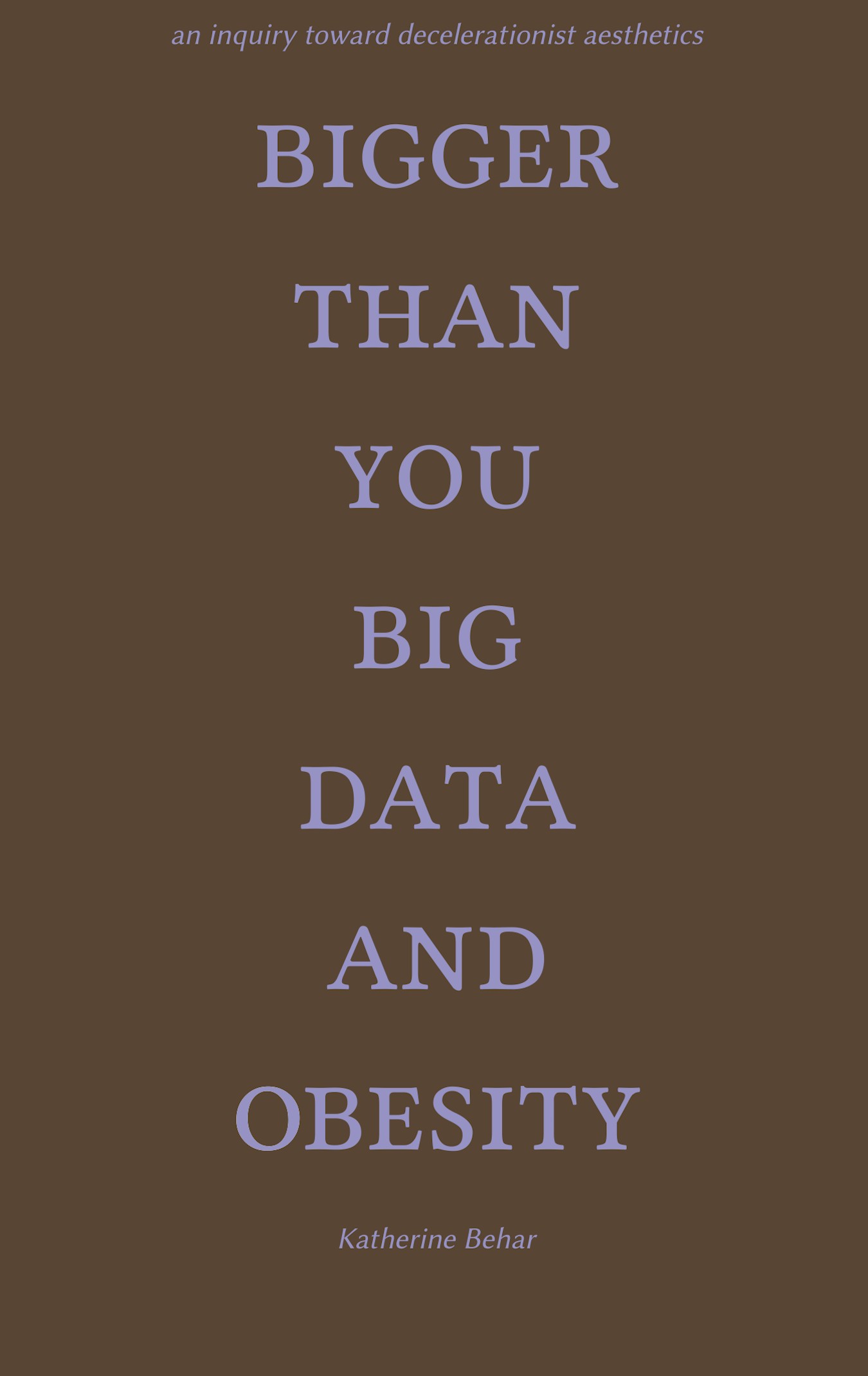
Book information
- Publisher
- punctum books
- Publication
- Published 3 March 2016
- Place
- Earth, Milky Way
- Catalogue record
- View in the catalogue
Abstract
In her first inquiry toward a decelerationist aesthetics, Katherine Behar explores in this essay chapbook the rise of two “big deal” contemporary phenomena, big data and obesity. In both, scale rearticulates the human as a diffuse informational pattern, causing important shifts in political form as well as aesthetic form. Bigness redraws relationships between the singular and the collective. Understood as informational patterns, collectives can be radically inclusive, even incorporating nonhumans. As a result, the political subject is slowly becoming a new object. This social and informational body belongs to no single individual, but is shared in solidarity with something “bigger than you.”
In decelerationist aesthetics, the aesthetic properties, proclivities, and performances of objects come to defy the accelerationist imperative to be nimbly individuated. Decelerationist aesthetics rejects atomistic, liberal, humanist subjects; this unit of self is too consonant with capitalist relations and functions. Instead, decelerationist aesthetics favors transhuman sociality embodied in particulate, mattered objects; the aesthetic form of such objects resists capitalist speed and immediacy by taking back and taking up space and time. In just this way, big data calls into question the conventions by which humans are defined as discrete entities, and individual scales of agency are made to form central binding pillars of social existence through which bodies are drawn into relations of power and pathos.
Where its authors and editors are based
Countries of the institutions the book's authors, editors and chapter authors were affiliated to when it was published.
- AUTHORS / EDITORS
- CITATIONS Phase 2
- USAGE Phase 3
| Country | Authors / editors |
|---|---|
| United States | 1 |
About this data
These figures cover 1 work. Each value comes from the most trusted source that has it; a correction made by OBC staff outranks every source.
| Source | Confidence | Works |
|---|---|---|
| Thoth | 90 / 100 | 1 |
| Works with a publication date | 100% |
|---|---|
| Works with a DOI | 100% |
| Works with a funder recorded | 0% |
| Authors with an affiliation | 100% |
| Affiliations matched to an institution (ROR) | 100% |
| Affiliations with a country | 100% |
Countries come from the institution each author was affiliated to when they published, as recorded in ROR. A country is never guessed, so authors without a matched institution are not counted on the maps.
Funders come from OpenAlex for articles and Thoth for books, where publishers recorded them. Most works record none, so a funder's figures show what is recorded, not everything it funded.
Chapters count as works: their authors and editors, and the countries of their institutions, are in every figure where Thoth records an affiliation for them.
Citations (Phase 2) and usage (Phase 3) are not collected yet.