
Book view
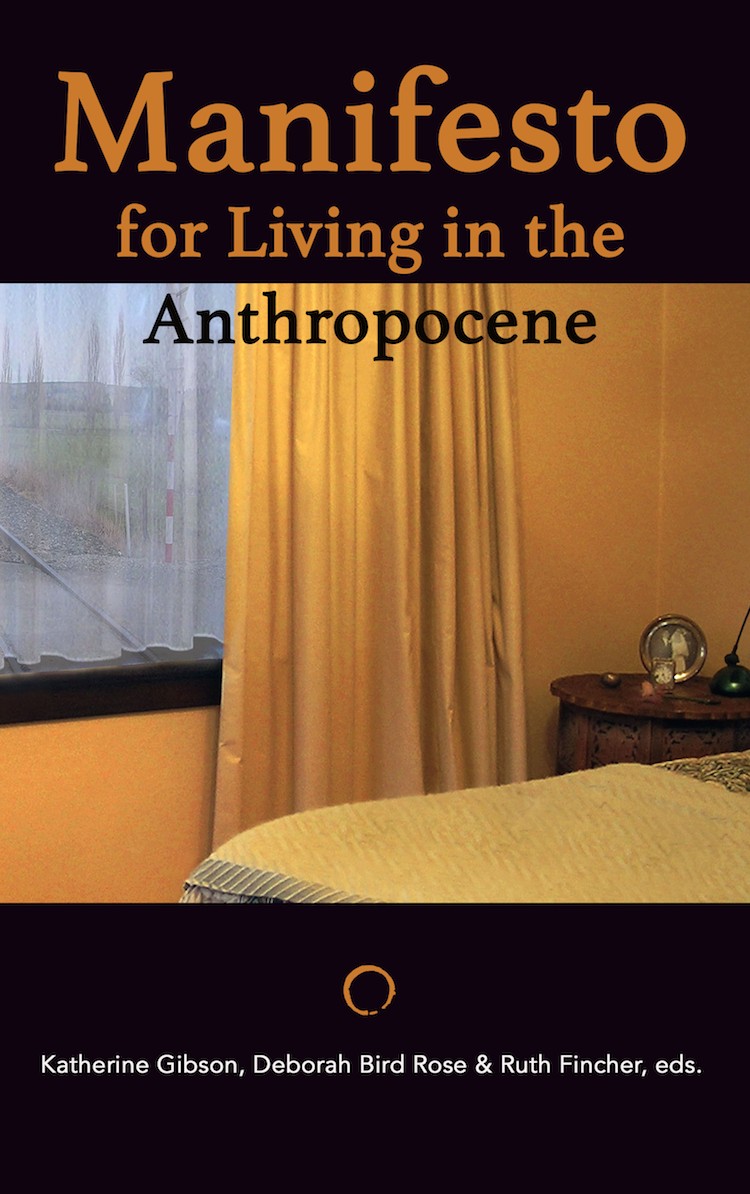
Manifesto for Living in the Anthropocene
Edited by Katherine Gibson, Deborah Bird Rose, Ruth Fincher
Book information
- Publisher
- punctum books
- Publication
- Published 14 April 2015
- Place
- Brooklyn, NY
- Catalogue record
- View in the catalogue
Abstract
The recent 10,000 year history of climatic stability on Earth that enabled the rise of agriculture and domestication, the growth of cities, numerous technological revolutions, and the emergence of modernity is now over. We accept that in the latest phase of this era, modernity is unmaking the stability that enabled its emergence. Over the 21st century severe and numerous weather disasters, scarcity of key resources, major changes in environments, enormous rates of extinction, and other forces that threaten life are set to increase. But we are deeply worried that current responses to these challenges are focused on market-driven solutions and thus have the potential to further endanger our collective commons. Today public debate is polarized. On one hand we are confronted with the immobilizing effects of knowing “the facts” about climate change. On the other we see a powerful will to ignorance and the effects of a pernicious collaboration between climate change skeptics and industry stakeholders. Clearly, to us, the current crisis calls for new ways of thinking and producing knowledge. Our collective inclination has been to go on in an experimental and exploratory mode, in which we refuse to foreclose on options or jump too quickly to “solutions.”
In this spirit we feel the need to acknowledge the tragedy of anthropogenic climate change. It is important to tap into the emotional richness of grief about extinction and loss without getting stuck on the “blame game.” Our research must allow for the expression of grief and mourning for what has been and is daily being lost. But it is important to adopt a reparative rather than a purely critical stance toward knowing. Might it be possible to welcome the pain of “knowing” if it led to different ways of working with non-human others, recognizing a confluence of desire across the human/non-human divide and the vital rhythms that animate the world? Our discussions have focused on new types of ecological economic thinking and ethical practices of living. We are interested in:
Starting from the recognition that there is no “one size fits all” response to climate change, we are concerned to develop an ethics of place that appreciates the specificity and richness of loss and potentiality. While connection to earth others might be an overarching goal, it will be to certain ecologies, species, atmospheres and materialities that we actually connect. We could see ourselves as part of country, accepting the responsibility not forgotten by Indigenous people all over the world, of “singing” country into health. This might mean cultivating the capacity for deep listening to each other, to the land, to other species and thereby learning to be affected and transformed by the body-world we are part of; seeing the body as a center of animation but not the ground of a separate self; renouncing the narcissistic defense of omnipotence and an equally narcissistic descent into despair.
We think that we can work against singular and global representations of “the problem” in the face of which any small, multiple, place-based action is rendered hopeless. We can choose to read for difference rather than dominance; think connectivity rather than hyper-separation; look for multiplicity — multiple climate changes, multiple ways of living with earth others. We can find ways forward in what is already being done in the here and now; attend to the performative effects of any analysis; tell stories in a hopeful and open way — allowing for the possibility that life is dormant rather than dead. We can use our critical capacities to recover our rich traditions of counter-culture and theorize them outside the mainstream/alternative binary. All these ways of thinking and researching give rise to new strategies for going forward. Think of the chapters of this book as tentative hoverings, as the fluttering of butterfly wings, scattering germs of ideas that can take root and grow.
Chapters
| Chapter | Author | Institution at publication |
|---|---|---|
| Preface | Katherine Gibson, Deborah Bird Rose, Ruth Fincher | Western Sydney University; UNSW Sydney; Academy of the Social Sciences in Australia; The University of Melbourne |
| Backmatter | Katherine Gibson, Deborah Bird Rose, Ruth Fincher | Western Sydney University; UNSW Sydney; Academy of the Social Sciences in Australia; The University of Melbourne |
| Contact Improvisation | Kate Rigby | Monash University |
| Conviviality as an Ethic of Care in the City | Ruth Fincher, Kurt Iveson | The University of Melbourne; The University of Sydney |
| Deep Mapping Connections to Country | Margaret Somerville | Western Sydney University |
| Dialogue | Deborah Bird Rose | UNSW Sydney; Academy of the Social Sciences in Australia |
| Earth as Ethic | Freya Mathews | La Trobe University |
| Economy as Ecological Livelihood | J.K. Gibson-Graham, Ethan Miller | University of Massachusetts Amherst; Western Sydney University |
| Flying Foxes in Sydney | Deborah Bird Rose | UNSW Sydney; Academy of the Social Sciences in Australia |
| Food Conect(s) | Jenny Cameron, Robert Pekin | Newcastle University |
| Frontmatter | Katherine Gibson, Deborah Bird Rose, Ruth Fincher | Western Sydney University; UNSW Sydney; Academy of the Social Sciences in Australia; The University of Melbourne |
| Graffiti Is Life | Kurt Iveson | The University of Sydney |
| Learning to be Affected by Earth Others | Gerda Roelvink | Western Sydney University |
| Listening | Kumi Kato | Wakayama University; The University of Queensland |
| Lives in Connection | Jessica K. Weir | Western Sydney University |
| Manifesto for Living in the Anthropocene | Katherine Gibson, Deborah Bird Rose, Ruth Fincher | Western Sydney University; UNSW Sydney; Academy of the Social Sciences in Australia; The University of Melbourne |
| On Experimentation | Jenny Cameron | University of Newcastle Australia |
| Reading for Difference | J.K. Gibson-Graham | University of Massachusetts Amherst; Western Sydney University |
| Risking Attachment in the Anthropocene | Lesley Instone | University of Newcastle Australia |
| Strategia | Freya Mathews | La Trobe University |
| The Ecological Humanities | Deborah Bird Rose | UNSW Sydney; Academy of the Social Sciences in Australia |
| The Human Condition in the Anthropocene | Anna Yeatman | Western Sydney University |
| The Waterhold Project | George Main | National Museum of Australia |
| Vulture Stories | Thom van Dooren | UNSW Sydney |
| Walking as Respectful Wayfinding in an Uncertain Age | Lesley Instone | University of Newcastle Australia |
Where its authors and editors are based
Countries of the institutions the book's authors, editors and chapter authors were affiliated to when it was published.
- AUTHORS / EDITORS
- CITATIONS Phase 2
- USAGE Phase 3
| Country | Authors / editors |
|---|---|
| Australia | 17 |
| Japan | 1 |
| United Kingdom | 1 |
| United States | 1 |
About this data
These figures cover 26 works. Each value comes from the most trusted source that has it; a correction made by OBC staff outranks every source.
| Source | Confidence | Works |
|---|---|---|
| Thoth | 90 / 100 | 26 |
| Works with a publication date | 100% |
|---|---|
| Works with a DOI | 100% |
| Works with a funder recorded | 0% |
| Authors with an affiliation | 97% |
| Affiliations matched to an institution (ROR) | 100% |
| Affiliations with a country | 100% |
Countries come from the institution each author was affiliated to when they published, as recorded in ROR. A country is never guessed, so authors without a matched institution are not counted on the maps.
Funders come from OpenAlex for articles and Thoth for books, where publishers recorded them. Most works record none, so a funder's figures show what is recorded, not everything it funded.
Chapters count as works: their authors and editors, and the countries of their institutions, are in every figure where Thoth records an affiliation for them.
Citations (Phase 2) and usage (Phase 3) are not collected yet.