
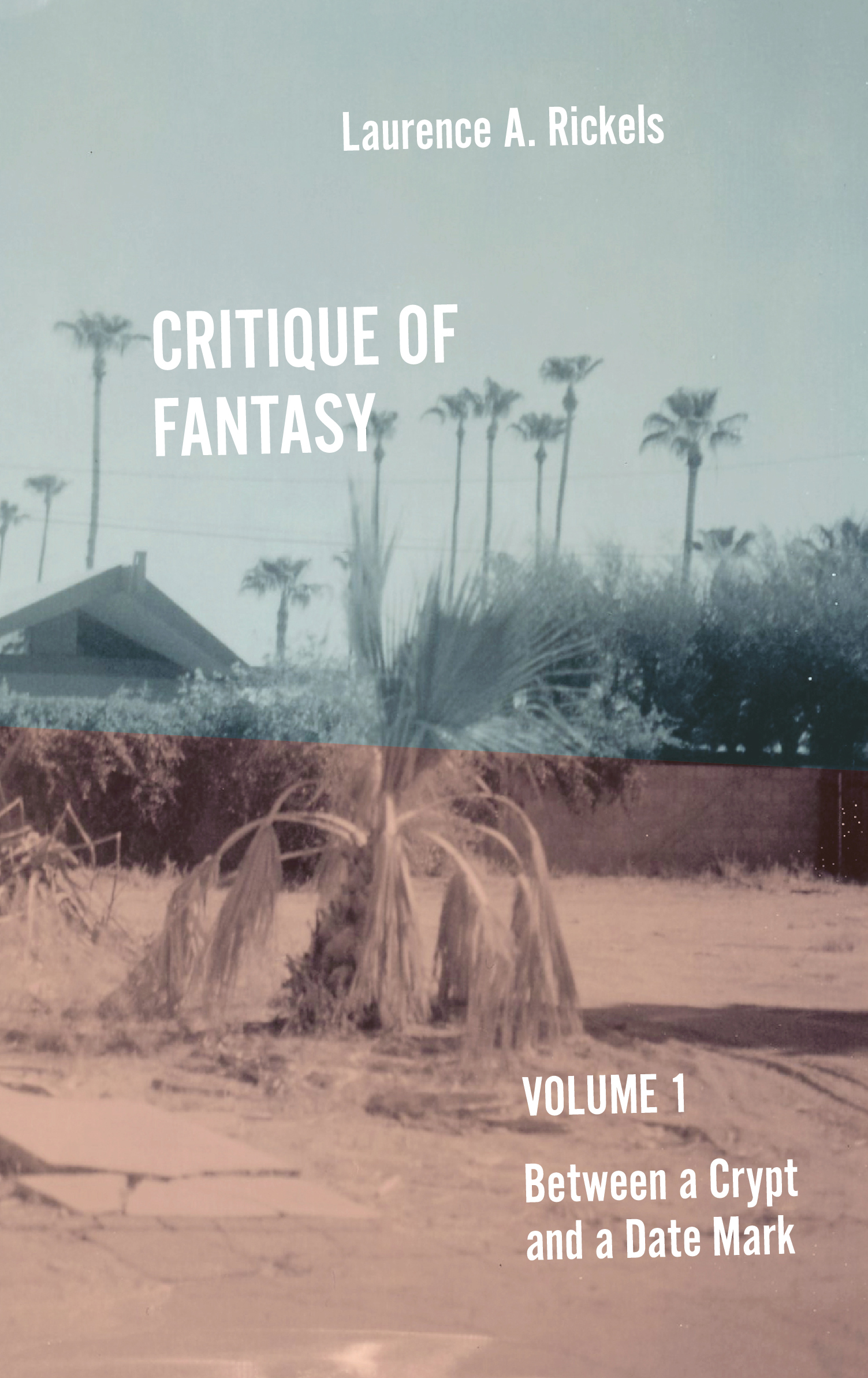
Book information
- Publisher
- punctum books
- Publication
- Published 25 June 2020
- Place
- Earth, Milky Way
- Catalogue record
- View in the catalogue
Abstract
Critique of Fantasy, Vol. 1: Between a Crypt and a Datemark addresses both the style or genre of fantasy and the mental faculty, long the hot property of philosophical ethics. Freud passed it along in his 1907 essay on the poetics of daydreaming when he addressed omnipotent wish fantasy as the source and resource of the aspirations and resolutions of art, which, however, the artwork can never look back at or acknowledge. By grounding his genre in the one fantasy that is true, the Gospel, J.R.R. Tolkien obviated and made obvious the ethical mandate of fantasy’s restraining order.
With George Lucas’s Star Wars we entered the borderlands of the fantasy and science fiction genres, a zone resulting from and staggering a contest, which Tolkien inaugurated in the 1930s. The history of this contested borderland marks changes that arose in expectation of what the new media held in store, changes realized (but outside the box of what had been projected) upon the arrival of the unanticipated digital relation, which at last seemed to award the fantasy genre the contest prize.
Freud’s notion of the Zeitmarke (datemark), the indelible impress of the present moment that triggered the daydream that denies it, already introduced the import of fantasy’s historicization. Science fiction won a second prize that keeps it in the running. No longer bound to projecting the future, the former calling which in light of digitization it flunked, science fiction becomes allegorical and reading in the ruins of its failed predictions illuminates all the date marks and crypts hiding out in the borderlands it traverses with fantasy. To motivate the import of an evolving science fiction genre, Critique of Fantasy makes Gotthard Günther’s reflections in the 1950s on American science fiction – as heralding a new metaphysics and a new planetary going on interstellar civilization – a mainstay of its cultural anthropology with B-genres.
Where its authors and editors are based
Countries of the institutions the book's authors, editors and chapter authors were affiliated to when it was published.
- AUTHORS / EDITORS
- CITATIONS Phase 2
- USAGE Phase 3
| Country | Authors / editors |
|---|---|
| Germany | 1 |
| Switzerland | 1 |
About this data
These figures cover 1 work. Each value comes from the most trusted source that has it; a correction made by OBC staff outranks every source.
| Source | Confidence | Works |
|---|---|---|
| Thoth | 90 / 100 | 1 |
| Works with a publication date | 100% |
|---|---|
| Works with a DOI | 100% |
| Works with a funder recorded | 0% |
| Authors with an affiliation | 100% |
| Affiliations matched to an institution (ROR) | 100% |
| Affiliations with a country | 100% |
Countries come from the institution each author was affiliated to when they published, as recorded in ROR. A country is never guessed, so authors without a matched institution are not counted on the maps.
Funders come from OpenAlex for articles and Thoth for books, where publishers recorded them. Most works record none, so a funder's figures show what is recorded, not everything it funded.
Chapters count as works: their authors and editors, and the countries of their institutions, are in every figure where Thoth records an affiliation for them.
Citations (Phase 2) and usage (Phase 3) are not collected yet.