
Book information
- Publisher
- punctum books
- Publication
- Published 4 September 2018
- Place
- Earth, Milky Way
- Catalogue record
- View in the catalogue
Abstract
Hack The Experience will reframe your perspective on how your audience engages your work. This will happen as you learn how to control attention through spatial and time-based techniques that you can harness as you build immersive installations or as you think about how to best arrange your work in an exhibition. You’ll learn things about the senses and how they interface with attention so that you can build in visceral forms of interactivity, engage people’s empathetic responses, and frame their moods. This book is a dense bouillon-cube of techniques that you can adapt and apply to your personal practice, and it’s a book that will walk you step-by-step through skill sets from ethnography, cognitive science, and multi-modal metaphors.
The core argument of this book is that art is a form of cognitive engineering and that the physical environment (or objects in the physical environment) can be shaped to maximize emotional and sensory experience. Many types of art will benefit from this handbook (because cognition is pervasive in our experience of art), but it is particularly relevant to immersive experiential works such as installations, participatory/interactive environments, performance art, curatorial practice, architecture and landscape architecture, complex durational works, and works requiring new models of documentation. These types of work benefit from the empirical findings of cognitive science because intentionally leveraging basic human cognition in artworks can give participants new ways of seeing the world that are cognitively relevant. This leveraging process provides a new layer in the construction of conceptually grounded works.
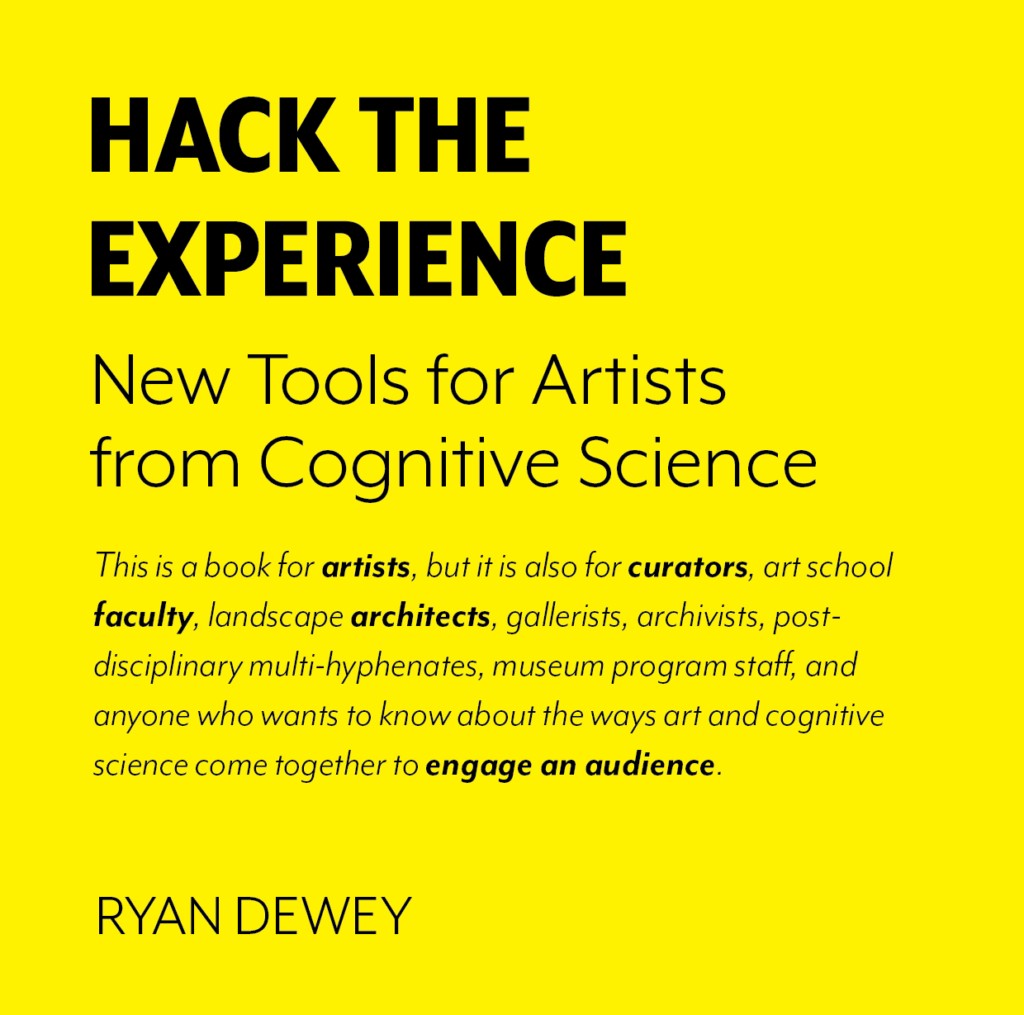
This is a book for artists, but it is also for curators, art school faculty, landscape architects, gallerists, archivists, post-disciplinary multi-hyphenates, museum program staff, and anyone who wants to know about the ways art and cognitive science come together to engage an audience.
Where its authors and editors are based
Countries of the institutions the book's authors, editors and chapter authors were affiliated to when it was published.
- AUTHORS / EDITORS
- CITATIONS Phase 2
- USAGE Phase 3
| Country | Authors / editors |
|---|---|
| United States | 1 |
About this data
These figures cover 1 work. Each value comes from the most trusted source that has it; a correction made by OBC staff outranks every source.
| Source | Confidence | Works |
|---|---|---|
| Thoth | 90 / 100 | 1 |
| Works with a publication date | 100% |
|---|---|
| Works with a DOI | 100% |
| Works with a funder recorded | 0% |
| Authors with an affiliation | 100% |
| Affiliations matched to an institution (ROR) | 100% |
| Affiliations with a country | 100% |
Countries come from the institution each author was affiliated to when they published, as recorded in ROR. A country is never guessed, so authors without a matched institution are not counted on the maps.
Funders come from OpenAlex for articles and Thoth for books, where publishers recorded them. Most works record none, so a funder's figures show what is recorded, not everything it funded.
Chapters count as works: their authors and editors, and the countries of their institutions, are in every figure where Thoth records an affiliation for them.
Citations (Phase 2) and usage (Phase 3) are not collected yet.