
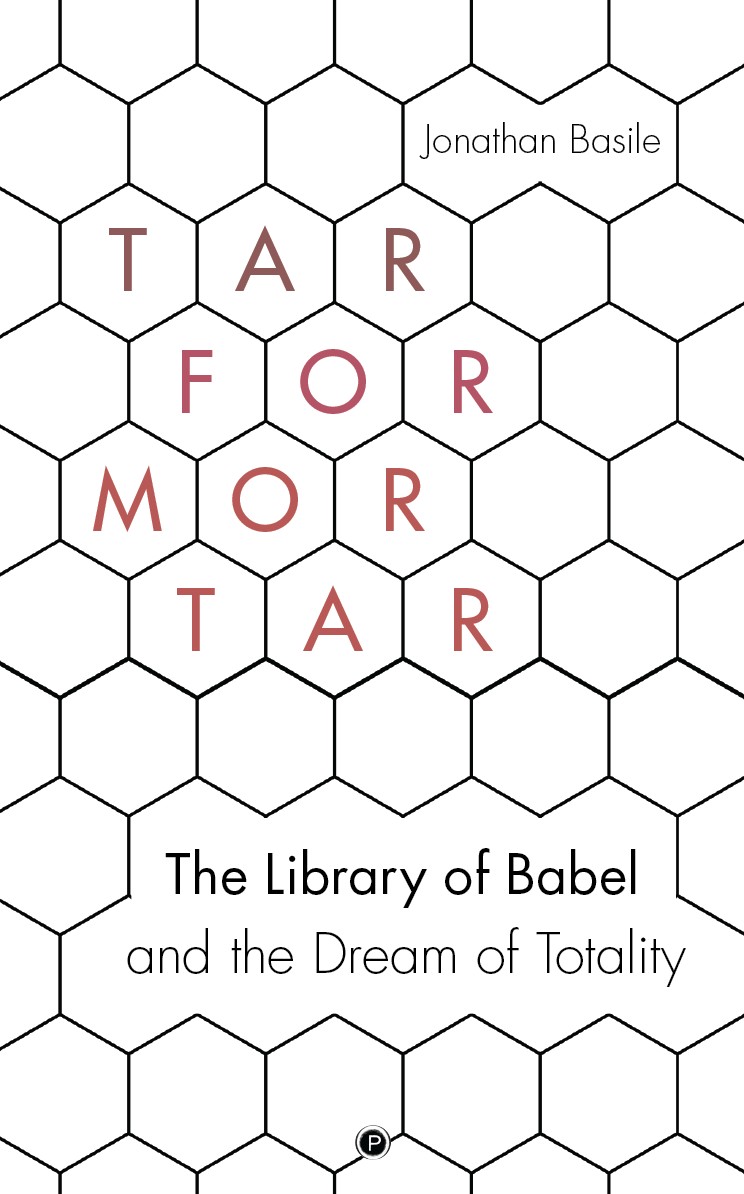
Book information
- Publisher
- punctum books
- Publication
- Published 15 March 2018
- Place
- Earth, Milky Way
- Catalogue record
- View in the catalogue
Abstract
Tar for Mortar offers an in-depth exploration of one of literature’s greatest tricksters, Jorge Luis Borges. His short story “The Library of Babel” is a signature examplar of this playfulness, though not merely for the inverted world it imagines, where a library thought to contain all possible permutations of all letters and words and books is plumbed by pious librarians looking for divinely pre-fabricated truths. One must grapple as well with the irony of Borges’s narration, which undermines at every turn its narrator’s claims of the library’s universality, including the very possibility of exhausting meaning through combinatory processing.
Borges directed readers to his non-fiction to discover the true author of the idea of the universal library. But his supposedly historical essays are notoriously riddled with false references and self-contradictions. Whether in truth or in fiction, Borges never reaches a stable conclusion about the atomic premises of the universal library — is it possible to find a character set capable of expressing all possible meaning, or do these letters, like his stories and essays, divide from themselves in a restless incompletion?
While many readers of Borges see him as presaging our digital technologies, they often give too much credit to our inventions in doing so. Those who elide the necessary incompletion of the Library of Babel compare it to the Internet on the assumption that both are total archives of all possible thought and expression. Though Borges’s imaginings lend themselves to digital creativity (libraryofbabel.info is certainly evidence of this), they do so by showing the necessary incompleteness of every totalizing project, no matter how technologically refined. Ultimately, Basile nudges readers toward the idea that a fictional/imaginary exposition can hold a certain power over technology.
Where its authors and editors are based
Countries of the institutions the book's authors, editors and chapter authors were affiliated to when it was published.
- AUTHORS / EDITORS
- CITATIONS Phase 2
- USAGE Phase 3
| Country | Authors / editors |
|---|---|
| United States | 1 |
About this data
These figures cover 1 work. Each value comes from the most trusted source that has it; a correction made by OBC staff outranks every source.
| Source | Confidence | Works |
|---|---|---|
| Thoth | 90 / 100 | 1 |
| Works with a publication date | 100% |
|---|---|
| Works with a DOI | 100% |
| Works with a funder recorded | 100% |
| Authors with an affiliation | 100% |
| Affiliations matched to an institution (ROR) | 100% |
| Affiliations with a country | 100% |
Countries come from the institution each author was affiliated to when they published, as recorded in ROR. A country is never guessed, so authors without a matched institution are not counted on the maps.
Funders come from OpenAlex for articles and Thoth for books, where publishers recorded them. Not every work records one, so a funder's figures show what is recorded, not everything it funded.
Chapters count as works: their authors and editors, and the countries of their institutions, are in every figure where Thoth records an affiliation for them.
Citations (Phase 2) and usage (Phase 3) are not collected yet.