
Book information
- Publisher
- punctum books
- Publication
- Published 26 February 2016
- Place
- Earth, Milky Way
- Catalogue record
- View in the catalogue
Abstract
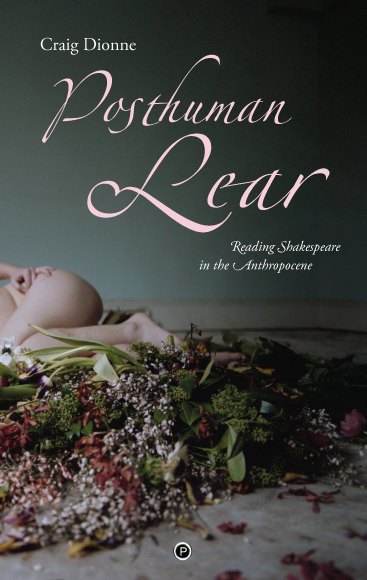
Approaching King Lear from an eco-materialist perspective, Posthuman Lear examines how the shift in Shakespeare’s tragedy from court to stormy heath activates a different sense of language as tool-being — from that of participating in the flourish of aristocratic prodigality and circumstance, to that of survival and pondering one’s interdependence with a denuded world. Dionne frames the thematic arc of Shakespeare’s tragedy about the fall of a king as a tableaux of our post-sustainable condition. For Dionne, Lear’s progress on the heath works as a parable of flat ontology.
At the center of Dionne’s analysis of rhetoric and prodigality in the tragedy is the argument that adages and proverbs, working as embodied forms of speech, offer insight into a nonhuman, fragmentary mode of consciousness. The Renaissance fascination with memory and proverbs provides an opportunity to reflect on the human as an instance of such enmeshed being where the habit of articulating memorized patterns of speech works on a somatic level. Dionne theorizes how mnemonic memory functions as a potentially empowering mode of consciousness inherited by our evolutionary history as a species, revealing how our minds work as imprinted machines to recall past prohibitions and useful affective scripts to aid in our interaction with the environment. The proverb is that linguistic inscription that defines the equivalent of human-animal imprinting, where the past is etched upon collective memory within ‘adagential” being that lives on through the generations as autonomic cues for survival.
Dionne’s reimagining of this tragedy is important in the way it places Shakespeare’s central existential questions — the meaning of familial love, commitments to friends, our place in a secular world — in a new relation to the main question of surviving within fixed environmental limits. Along the way, Dionne reflects on the larger theoretical implications of recycling the old historicism of early modern culture to speak to an eco-materialism, and why the modernist textual aesthetics of the self-distancing text seems inadequate when considering the uncertainty and trauma that underscores life in a post-sustainable culture. Dionne’s final appeal is to “repurpose” our fatalism in the face of ecological disaster.
Where its authors and editors are based
Countries of the institutions the book's authors, editors and chapter authors were affiliated to when it was published.
- AUTHORS / EDITORS
- CITATIONS Phase 2
- USAGE Phase 3
| Country | Authors / editors |
|---|---|
| United States | 1 |
About this data
These figures cover 1 work. Each value comes from the most trusted source that has it; a correction made by OBC staff outranks every source.
| Source | Confidence | Works |
|---|---|---|
| Thoth | 90 / 100 | 1 |
| Works with a publication date | 100% |
|---|---|
| Works with a DOI | 100% |
| Works with a funder recorded | 0% |
| Authors with an affiliation | 100% |
| Affiliations matched to an institution (ROR) | 100% |
| Affiliations with a country | 100% |
Countries come from the institution each author was affiliated to when they published, as recorded in ROR. A country is never guessed, so authors without a matched institution are not counted on the maps.
Funders come from OpenAlex for articles and Thoth for books, where publishers recorded them. Most works record none, so a funder's figures show what is recorded, not everything it funded.
Chapters count as works: their authors and editors, and the countries of their institutions, are in every figure where Thoth records an affiliation for them.
Citations (Phase 2) and usage (Phase 3) are not collected yet.