
Book view
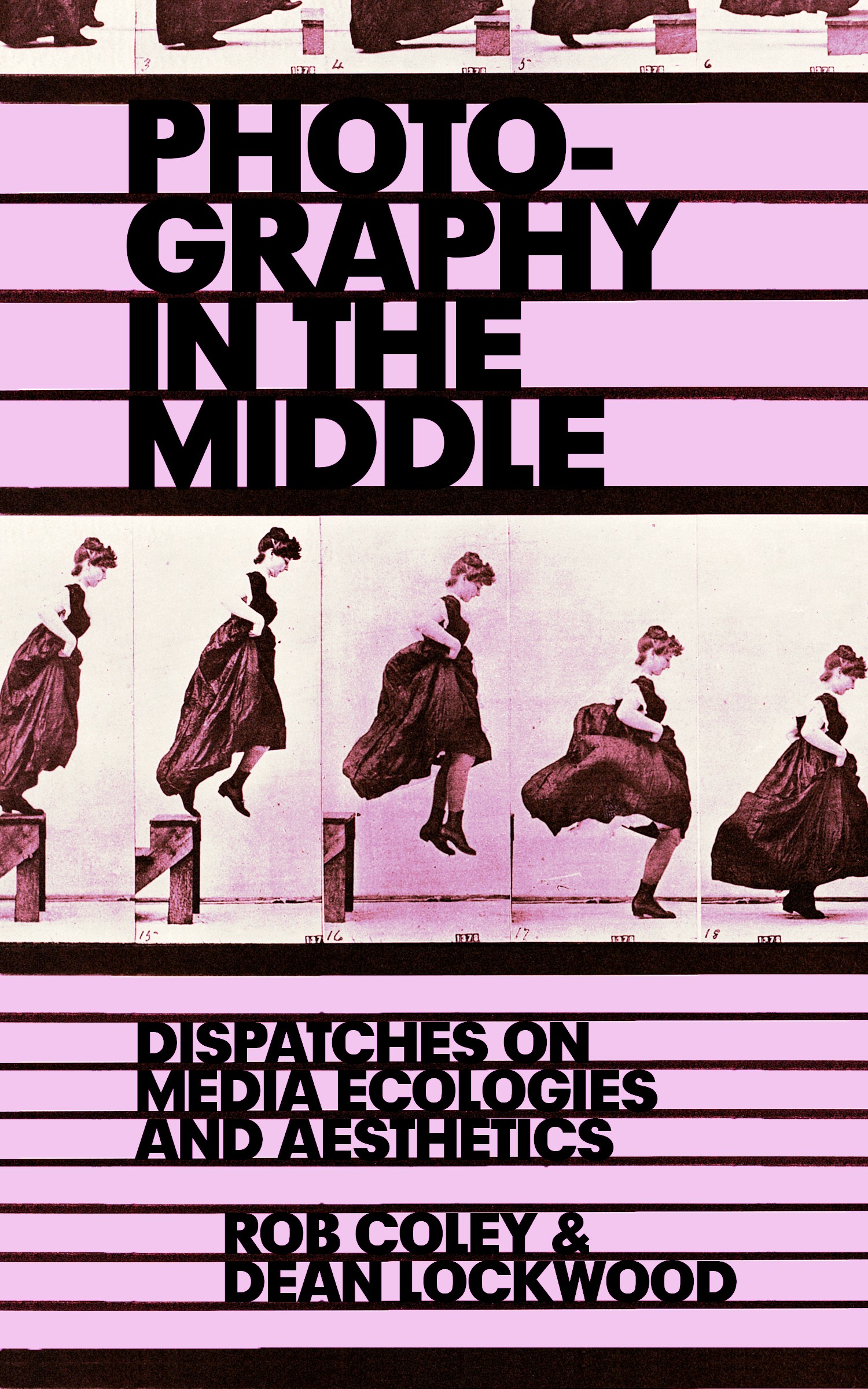
Photography in the Middle
Dispatches on Media Ecologies and Aesthetics
Book information
- Publisher
- punctum books
- Publication
- Published 31 October 2016
- Place
- Earth, Milky Way
- Catalogue record
- View in the catalogue
Abstract
It’s easy to forget there’s a war on when the front line is everywhere encrypted in plain sight. Gathered in this book’s several chapters are dispatches on the role of photography in a War Universe, a space and time in which photographers such as Hilla Becher, Don McCullin and Eadweard Muybridge exist only insofar as they are a mark of possession, in the sway of larger forces. These photographers are conceptual personae that collectively fabulate a different kind of photography, a paraphotography in which the camera produces negative abyssal flashes or ‘endarkenment.’ In his Vietnam War memoir, Dispatches, Michael Herr imagines a ‘dropped camera’ receiving ‘jumping and falling’ images, images which capture the weird indivisibility of medium and mediated in a time of war. The movies and the war, the photographs and the torn bodies, fused and exchanged. Reporting from the chaos at the middle of things, Herr invokes a kind of writing attuned to this experience. Photography in the Middle, eschewing a high theoretical mode, seeks to exploit the bag of tricks that is the dispatch. The dispatch makes no grand statement about the progress of the war. Cultivating the most perverse implications of its sources, it tries to express what the daily briefing never can. Ports of entry in the script we’re given, odd and hasty little glyphs, unhelpful rips in the cover story, dispatches are futile, dark intuitions, an expeditious inefficacy. They are bleak but necessary responses to an indifferent world in which any action whatever has little noticeable effect.
As luck would have it, Photography in the Middle begins with some nasty accidents, and extracts from the wreckage a few lessons learned. Dusting itself off, it ships out and puts up with a bunch of battle scarred, big gun photojournalists in the Holiday Inn of a typical world city. Later, it immerses itself within the leaked files of an enigmatic police cabal which detail the surveillance of conceptual photographers Bernd and Hilla Becher, an operation that even extends to the duo’s dreams. Further back in time, in 1897, we are invited to an inflammatory, yet patchily documented public lecture given by the Titan, Muybridge.
More than any other, it is William Burroughs, conceived here as a war photographer, who is our tutelary figure, hovering over all these pages in his attempt to map emergent vectors of mediation, ever more intimate forms of control and accelerants of planetary catastrophe. Burroughs believed that it was necessary to both keep pace with and formulate new vectors, vectors that might act as intersections with a nonhuman outside. Photography has an agency of its own, one that scrambles the patterns and refrains of mediation upon which human life is based, glitching the human and provoking relations with external coordinates. With Burroughs, and other inspirations such as J.G. Ballard, Georges Bataille, Tom McCarthy and Eugene Thacker, our notion of the dispatch does not offer positive knowledge of something that we can reconcile with existing rational explanations, but rather the revelation of a nightside, our redundancy in a photography that suspends all operations in a general blindness.
Where its authors and editors are based
Countries of the institutions the book's authors, editors and chapter authors were affiliated to when it was published.
- AUTHORS / EDITORS
- CITATIONS Phase 2
- USAGE Phase 3
| Country | Authors / editors |
|---|---|
| United Kingdom | 2 |
About this data
These figures cover 1 work. Each value comes from the most trusted source that has it; a correction made by OBC staff outranks every source.
| Source | Confidence | Works |
|---|---|---|
| Thoth | 90 / 100 | 1 |
| Works with a publication date | 100% |
|---|---|
| Works with a DOI | 100% |
| Works with a funder recorded | 0% |
| Authors with an affiliation | 100% |
| Affiliations matched to an institution (ROR) | 100% |
| Affiliations with a country | 100% |
Countries come from the institution each author was affiliated to when they published, as recorded in ROR. A country is never guessed, so authors without a matched institution are not counted on the maps.
Funders come from OpenAlex for articles and Thoth for books, where publishers recorded them. Most works record none, so a funder's figures show what is recorded, not everything it funded.
Chapters count as works: their authors and editors, and the countries of their institutions, are in every figure where Thoth records an affiliation for them.
Citations (Phase 2) and usage (Phase 3) are not collected yet.