
Book view
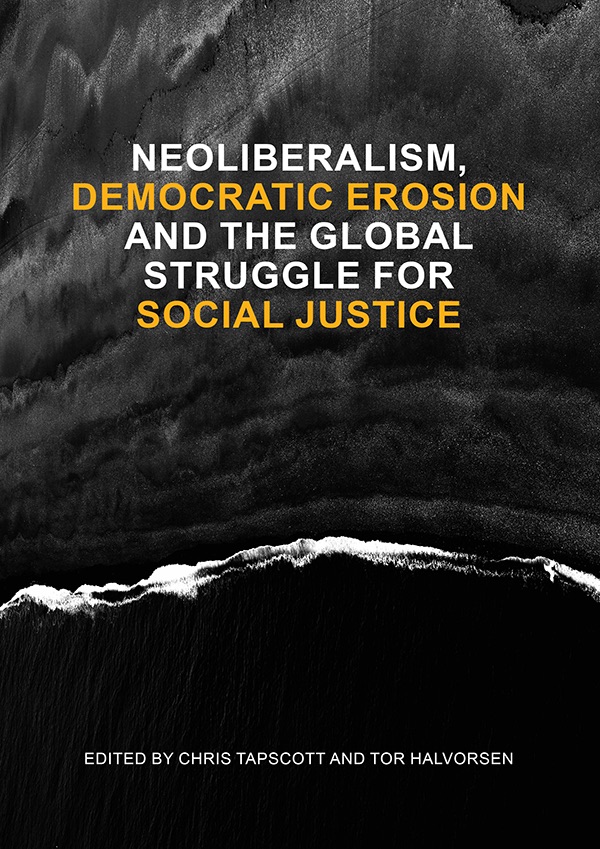
Neoliberalism, Democratic Erosion and the Global Struggle for Social Justice
Edited by Tor Halvorsen, Chris Tapscott
Book information
- Publisher
- African Minds
- Publication
- Published 24 May 2026
- Catalogue record
- View in the catalogue
Abstract
The global expansion of neoliberal capitalism and its contentious relationship with democracy remains one of the most pressing debates of our time. This book offers a comprehensive examination of how capitalism has adapted from merchant and industrial forms into the modern era of financialization which underpins the current globalising order. By tracing the evolution of the state, it explores the deliberate political decisions that have prioritised market efficiency over social welfare.The central thesis of this book is that neoliberalism is not an inevitable evolutionary endpoint of human development, but rather a crafted ideology designed to “tame” democracy through technocratic and judicial constraints. The authors argue that a fundamental tension exists between the market’s “free play of forces” and the democratic principle of social entitlement. As the state shifts from an economic regulator to a market broker, democratic oversight is increasingly displaced by insulated, expert-driven authorities. This restructuring has not only fuelled global inequality but has also turned technology into a tool for digital coloniality, where transnational firms extract value through surveillance and algorithmic optimisation. “Techno-feudalism” epitomises how the contemporary trajectory of datafication serves corporate interests over democratic publics.Unlike literature that merely critiques, this book identifies emerging “geo-economic fragmentation” and the revival of socialdemocratic ideas as openings for democratic renewal. Ultimately, the book argues that the current hegemony is neither inevitable nor irreversible. By analysing the rise of right-wing populism and the growing disillusionment with the neoliberal narrative, the contributors highlight the urgent need to reassert democratic control over economic systems to address the existential threats of environmental collapse and social polarisation.
Chapters
Where its authors and editors are based
Countries of the institutions the book's authors, editors and chapter authors were affiliated to when it was published.
- AUTHORS / EDITORS
- CITATIONS Phase 2
- USAGE Phase 3
No affiliations with a known country in these years yet.
About this data
These figures cover 12 works. Each value comes from the most trusted source that has it; a correction made by OBC staff outranks every source.
| Source | Confidence | Works |
|---|---|---|
| Thoth | 90 / 100 | 12 |
| Works with a publication date | 100% |
|---|---|
| Works with a DOI | 100% |
| Works with a funder recorded | 0% |
| Authors with an affiliation | 0% |
Countries come from the institution each author was affiliated to when they published, as recorded in ROR. A country is never guessed, so authors without a matched institution are not counted on the maps.
Funders come from OpenAlex for articles and Thoth for books, where publishers recorded them. Most works record none, so a funder's figures show what is recorded, not everything it funded.
Chapters count as works: their authors and editors, and the countries of their institutions, are in every figure where Thoth records an affiliation for them.
Citations (Phase 2) and usage (Phase 3) are not collected yet.