
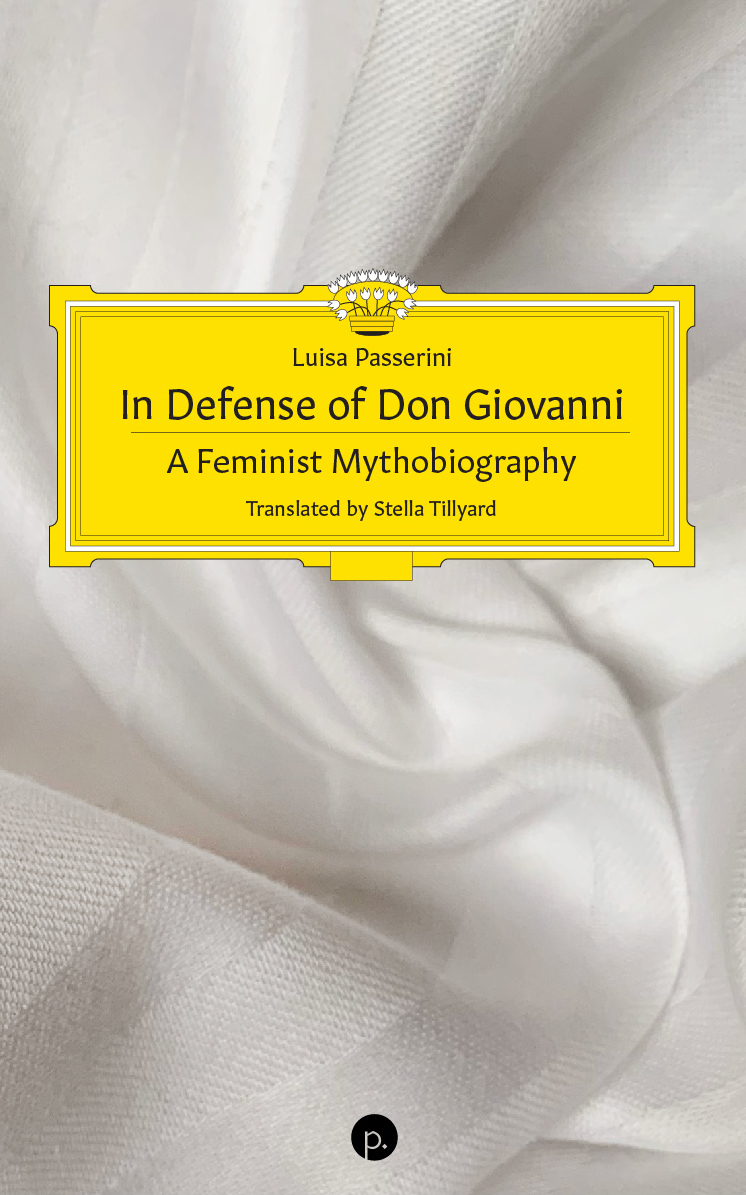
Book information
- Publisher
- punctum books
- Publication
- Published 28 March 2024
- Place
- Earth, Milky Way
- Catalogue record
- View in the catalogue
Abstract
Who wants to champion the figure of Don Giovanni in the time of Harvey Weinstein and #MeToo? Don Giovanni is a rapist, murderer, serial seducer, and liar. Can he ever be held up as a role model or seen as a figure to be enjoyed? This is the task that the eminent Italian historian and lifelong feminist, Luisa Passerini, sets for herself in In Defense of Don Giovanni. As she developed the long arc of her distinguished career, Don Giovanni surprisingly became not only her role model but also a secret object of research.
Taking her method from oral history, Passerini creates a series of characters with whom she discusses the forms and incarnations of the myth of Don Giovanni across time, from its first appearance in early medieval Spain and Commedia dell’Arte to its many European variations and its transposition to the colonial and postcolonial world in the Middle East, the Americas, and Africa. Pivoting round Don Giovanni’s best known incarnation in Mozart’s opera, Passerini and her interlocutors meet in different locations from Venice and Bern to Paris and Turin. They discuss plays, films, and operas and talk about art, novels, and psychoanalytic interpretations of the myth while also sharing their own life stories, in which Don Giovanni often plays a part that is, by turns, destructive, mischievous, and full of the joy of life.
From his early beginnings in the Iberian Peninsula to recent analysis of the sexuality of colonial conquest and postcolonial revenge and return, Don Giovanni shape-shifts between rapacious hyper-masculinity, comic trickster, and morally vacuous loser whose annoyingly persistent nemesis Don Ottavio emerges as an alternative and ultimately better object of desire. As she tracks Don Giovanni’s image across the world and through the centuries, however, Passerini comes to see that it also plays another role, that of a mirror, in which women can see themselves emerge as individuals with their own life force.
Where its authors and editors are based
Countries of the institutions the book's authors, editors and chapter authors were affiliated to when it was published.
- AUTHORS / EDITORS
- CITATIONS Phase 2
- USAGE Phase 3
| Country | Authors / editors |
|---|---|
| Italy | 1 |
| United Kingdom | 1 |
About this data
These figures cover 1 work. Each value comes from the most trusted source that has it; a correction made by OBC staff outranks every source.
| Source | Confidence | Works |
|---|---|---|
| Thoth | 90 / 100 | 1 |
| Works with a publication date | 100% |
|---|---|
| Works with a DOI | 100% |
| Works with a funder recorded | 0% |
| Authors with an affiliation | 100% |
| Affiliations matched to an institution (ROR) | 100% |
| Affiliations with a country | 100% |
Countries come from the institution each author was affiliated to when they published, as recorded in ROR. A country is never guessed, so authors without a matched institution are not counted on the maps.
Funders come from OpenAlex for articles and Thoth for books, where publishers recorded them. Most works record none, so a funder's figures show what is recorded, not everything it funded.
Chapters count as works: their authors and editors, and the countries of their institutions, are in every figure where Thoth records an affiliation for them.
Citations (Phase 2) and usage (Phase 3) are not collected yet.