
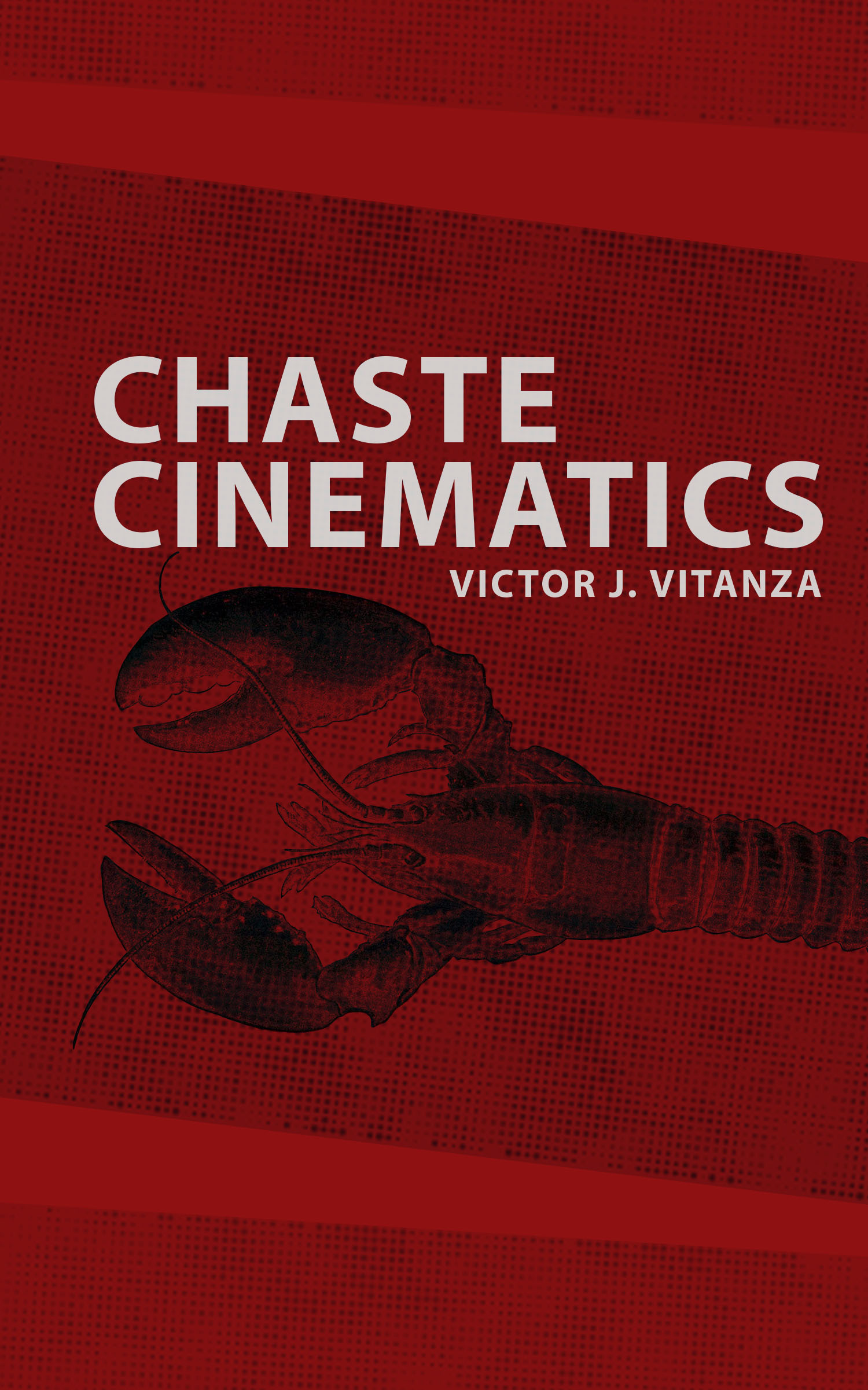
Book information
- Publisher
- punctum books
- Publication
- Published 31 October 2015
- Place
- Brooklyn, NY
- Catalogue record
- View in the catalogue
Abstract
Victor J. Vitanza continues to rethink the problem of sexual violence in cinema and how rape is often represented in “chaste” ways, in the form of a Chaste Cinematics. Vitanza continues to discuss Chaste Cinematics as participating in transdisciplinary-rhetorical traditions that establish the very foundations (groundings, points of stasis) for nation states and cultures. In this offering, however, the initial grounding for the discussions is “base materialism” (George Bataille): divine filth, the sacred and profane. It is this post-philosophical base materialism that destabilizes binaries, fixedness, and brings forth excluded thirds. Vitanza asks: why is it that a repressed third, or a third figure, returns, most strangely as a “product” of rape and torture? He works with Jean-Paul Sartre and Page duBois’s suggestion that the “product” is a new “species.”
Always attempting unorthodox ways of approaching social problems, Vitanza organizes his table of contents as a DVD menu of “Extras” (supplements). This menu includes Alternate Endings and Easter Eggs as well as an Excursus, which invokes readers to take up the political exigency of the DVD-Book. Vitanza’s first “Extra” studies a trio of films that need to be reconsidered, given what they offer as insights into Chaste Cinematics: Amadeus (a mad god), Henry Fool (a foolish god), and Multiple Maniacs (a divine god who is raped and eats excrement). The second examines Helke Sander’s documentary Liberators Take Liberties, which re-thinks the rapes of German women by the Russians and Allies during the Battle of Berlin. The third rethinks Margie Strosser’s video-film Rape Stories that calls for revenge. In the Alternate Endings, Vitanza rethinks the problem of reversibility in G. Noé’s Irréversible. In the Easter Eggs, he considers Dominique Laporte’s “the Irreparable,” as the object of loss and Giorgio Agamben’s “the Irreparable,” as hope in what is without remedy. The result is not another film-studies book, but a new genre, a new set of rhetorics, for new ways of thinking about cinematics, perhaps postcinematics.
Where its authors and editors are based
Countries of the institutions the book's authors, editors and chapter authors were affiliated to when it was published.
- AUTHORS / EDITORS
- CITATIONS Phase 2
- USAGE Phase 3
| Country | Authors / editors |
|---|---|
| Switzerland | 1 |
| United States | 1 |
About this data
These figures cover 1 work. Each value comes from the most trusted source that has it; a correction made by OBC staff outranks every source.
| Source | Confidence | Works |
|---|---|---|
| Thoth | 90 / 100 | 1 |
| Works with a publication date | 100% |
|---|---|
| Works with a DOI | 100% |
| Works with a funder recorded | 0% |
| Authors with an affiliation | 100% |
| Affiliations matched to an institution (ROR) | 100% |
| Affiliations with a country | 100% |
Countries come from the institution each author was affiliated to when they published, as recorded in ROR. A country is never guessed, so authors without a matched institution are not counted on the maps.
Funders come from OpenAlex for articles and Thoth for books, where publishers recorded them. Most works record none, so a funder's figures show what is recorded, not everything it funded.
Chapters count as works: their authors and editors, and the countries of their institutions, are in every figure where Thoth records an affiliation for them.
Citations (Phase 2) and usage (Phase 3) are not collected yet.