
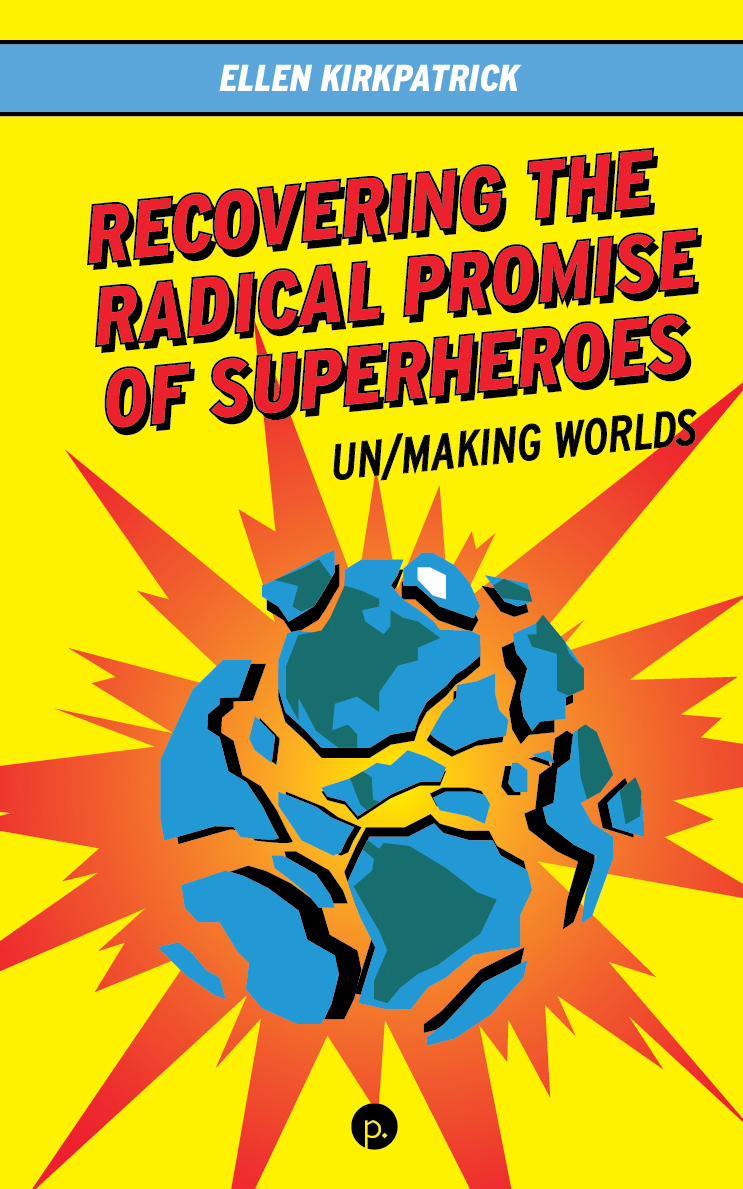
Book information
- Publisher
- punctum books
- Publication
- Published 24 August 2023
- Place
- Earth, Milky Way
- Catalogue record
- View in the catalogue
Abstract
Superhero meaning making is a site of struggle. Superheroes (are thought to) trouble borders and normative ways of seeing and being in the world. Superhero narratives (are thought to) represent, and thereby inspire, alternative visions of the real world. The superhero genre is (thought to be) a repository for radical or progressive ideas. In the superhero world and beyond, much is made of the genre’s utopian and dystopian landscapes, queer identity-play, and transforming bodies, but might it not be the case that the genre’s overblown normative framing, or representation, serves to muzzle, rather than express, its protagonists’ radical promise? Why, when set against otherwise unbounded, and often extreme, transformation—human to machine, human to animal, human to god—are certain categories seemingly untouchable? Why does this speculative genre routinely fail to fully speculate about other worlds and ways of being in those worlds? For all their nonconformity, superhero stories do not live up to the idea of a radical genre, in look, feel, or tone. The mainstream American superhero genre, and its surrounding discourses, tells and facilitates an astonishingly seamless tale of opposing ideologies. But how?
Recovering the Radical Promise of Superheroes: Un/Making Worlds serves a speculative response, detailing not so much a hunt for genre meaning as a trip through a genre’s meaningscape. Looking anew at superhero meaning-making practices allows a distinct way of thinking about and describing the creative, formal, and ideological conditions of the genre and its protagonists, one removed from corralling binaries, one foregrounding the idea of a synergy—often unseen, uneasy, and even hostile—between official and unofficial agents of superhero meaning and one reframing familiar questions: What kinds of meaning do superhero texts engender? How is this meaning made? By whom and under what conditions? What processes and practices inform, regulate, and extend superhero meaning? And finally, superhero narratives present a new question: How might we reimagine its agents, surfaces, and spaces? Centering the experiences and practices of excluded and marginalized superhero fans, Recovering the Radical Promise of Superheroes reveals that genre meaning is not lodged in one place or another, neither in its official creators or fans, nor in “black and white” conservatism or in a “rainbow” of progressive possibilities. Nor is it even located somewhere in the in-between; it is instead better conceived of as an antagonistic, in-process nexus of meaning undergirded by systems of power.
Where its authors and editors are based
Countries of the institutions the book's authors, editors and chapter authors were affiliated to when it was published.
- AUTHORS / EDITORS
- CITATIONS Phase 2
- USAGE Phase 3
No affiliations with a known country in these years yet.
About this data
These figures cover 1 work. Each value comes from the most trusted source that has it; a correction made by OBC staff outranks every source.
| Source | Confidence | Works |
|---|---|---|
| Thoth | 90 / 100 | 1 |
| Works with a publication date | 100% |
|---|---|
| Works with a DOI | 100% |
| Works with a funder recorded | 0% |
| Authors with an affiliation | 0% |
Countries come from the institution each author was affiliated to when they published, as recorded in ROR. A country is never guessed, so authors without a matched institution are not counted on the maps.
Funders come from OpenAlex for articles and Thoth for books, where publishers recorded them. Most works record none, so a funder's figures show what is recorded, not everything it funded.
Chapters count as works: their authors and editors, and the countries of their institutions, are in every figure where Thoth records an affiliation for them.
Citations (Phase 2) and usage (Phase 3) are not collected yet.