
Book information
- Publisher
- punctum books
- Publication
- Forthcoming 1 June 2026
- Place
- Earth, Milky Way
- Catalogue record
- View in the catalogue
Abstract
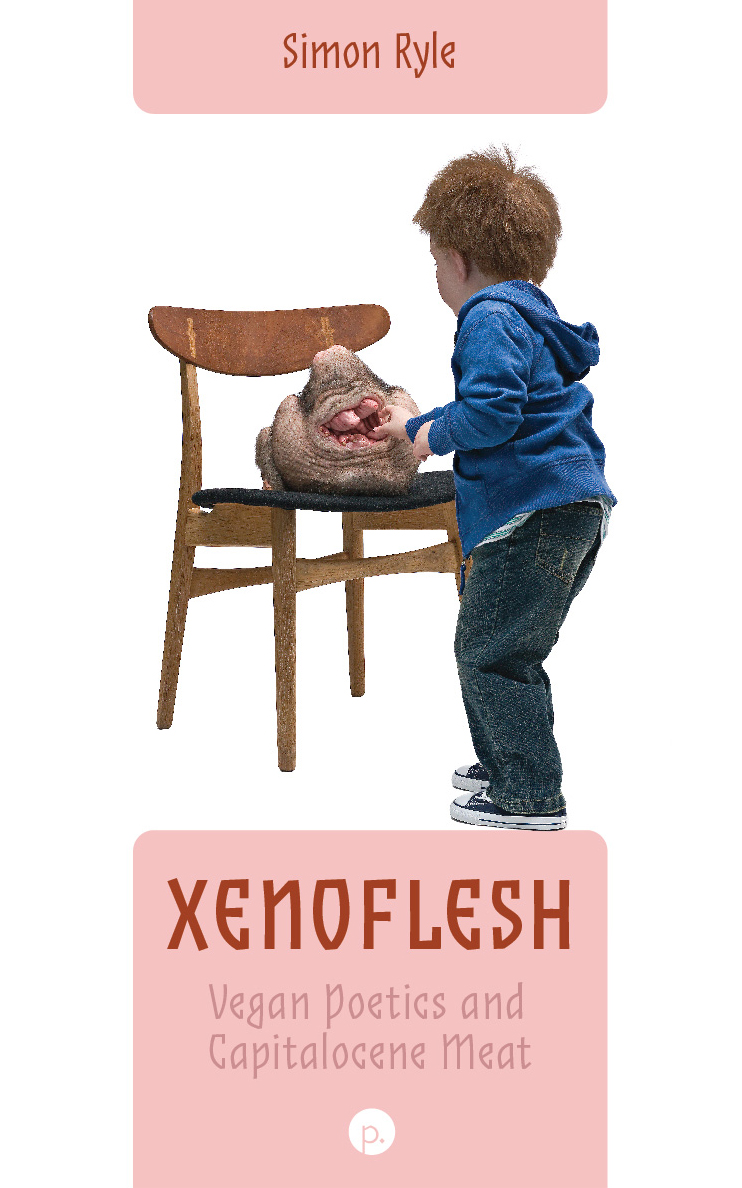
In Xenoflesh: Vegan Poetics and Capitalocene Meat, Simon Ryle considers the representation of flesh and meat in an eclectic range of literary texts, artworks, and films produced incipient to and across capitalocene modernity, from Hesiod’s Theogony and Rembrandt’s The Slaughtered Ox to Tobe Hooper’s The Texas Chainsaw Massacre and Olga Tokarczuk’s Drive Your Plow Over the Bones of the Dead. Encompassing sensational genre pieces alongside high-brow canonical works, Xenoflesh explores a diverse array of affective, sensational, uncanny, and weird meat and flesh aesthetics. Centrally, the book seeks to understand these representations in the context of industrial models of production and resource extraction, and explores how these artworks trouble or contest normative modes of affect, sensation, and consumption promulgated by the Capitalocene’s creation of surplus value from industrially farmed animal flesh, one of the key drivers of land degradation, mass extinction, and climate breakdown.
The central concept “xenoflesh” describes aesthetic forms and motifs that produce a sudden awareness of uncanny embodiment. Prefixing the flesh of creaturely being with the Greek xeno- (from xenos, meaning “stranger,” “other,” “foreigner,” “alien,” and “guest”), xenoflesh conceptualizes the strange and obscured continuum of our own fleshy alterity-to-ourselves with that of other flesh creatures. Xenoflesh involves the aesthetic production of discomfiting bodily solidarity – a sensation of weirdness that impels praxes of mutuality and veganism. Constituting a multi-disciplinary account of philosophical, ecological, psychological, and economic flesh, the book engages with canonical and contemporary literary criticism and theory, ecocriticism, ecofeminism, vegan studies, animal studies, posthumanism, phenomenology, cognitive theory, black studies, and animal liberation theory.
Where its authors and editors are based
Countries of the institutions the book's authors, editors and chapter authors were affiliated to when it was published.
- AUTHORS / EDITORS
- CITATIONS Phase 2
- USAGE Phase 3
| Country | Authors / editors |
|---|---|
| Croatia | 1 |
About this data
These figures cover 1 work. Each value comes from the most trusted source that has it; a correction made by OBC staff outranks every source.
| Source | Confidence | Works |
|---|---|---|
| Thoth | 90 / 100 | 1 |
| Works with a publication date | 100% |
|---|---|
| Works with a DOI | 100% |
| Works with a funder recorded | 0% |
| Authors with an affiliation | 100% |
| Affiliations matched to an institution (ROR) | 100% |
| Affiliations with a country | 100% |
Countries come from the institution each author was affiliated to when they published, as recorded in ROR. A country is never guessed, so authors without a matched institution are not counted on the maps.
Funders come from OpenAlex for articles and Thoth for books, where publishers recorded them. Most works record none, so a funder's figures show what is recorded, not everything it funded.
Chapters count as works: their authors and editors, and the countries of their institutions, are in every figure where Thoth records an affiliation for them.
Citations (Phase 2) and usage (Phase 3) are not collected yet.