
Book information
- Publisher
- punctum books
- Publication
- Published 24 August 2017
- Place
- Earth, Milky Way
- Catalogue record
- View in the catalogue
Abstract
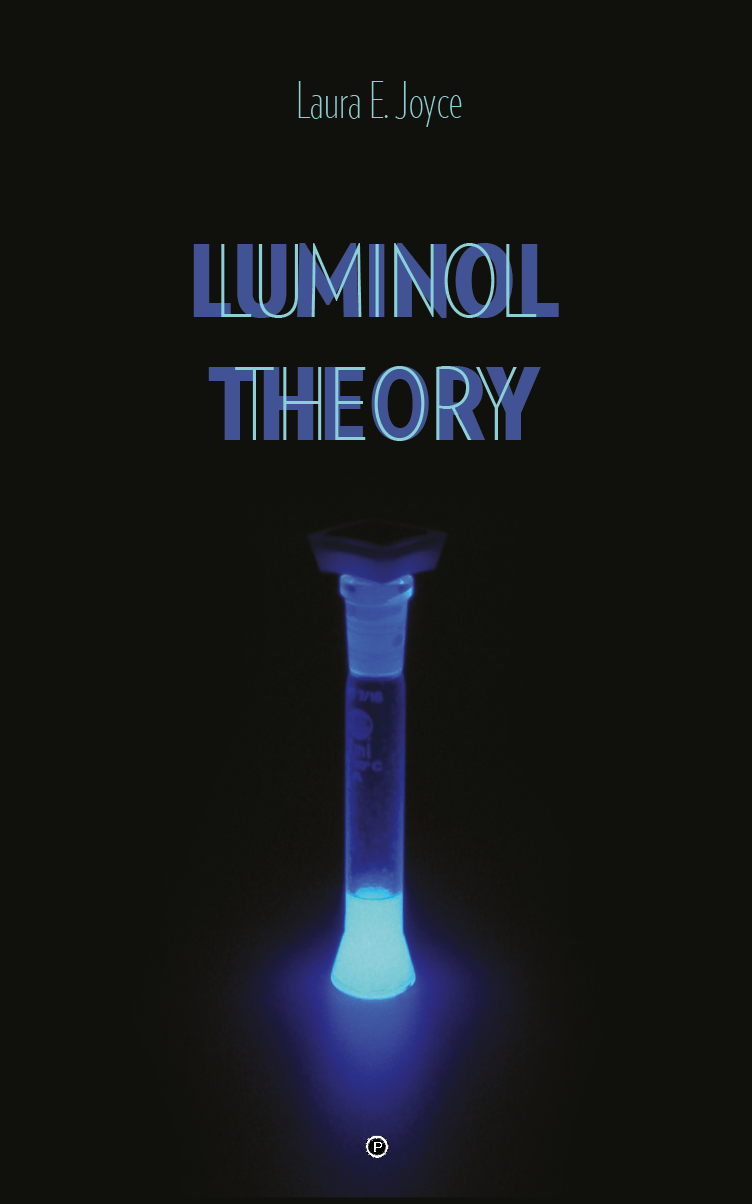
Representations of forensic procedures saturate popular culture in both fiction and true crime. One of the most striking forensic tools used in these narratives is the chemical luminol, so named because it glows an eerie greenish-blue when it comes into contact with the tiniest drops of human blood.
Luminol is a deeply ambivalent object: it is both a tool of the police, historically abused and misappropriated, and yet it offers hope to families of victims by allowing hidden crimes to surface. Forensic enquiry can exonerate those falsely accused of crimes, and yet the rise of forensic science is synonymous with the development of the deeply racist ‘science’ of eugenics.
Luminol Theory investigates the possibility of using a tool of the state in subversive, or radical, ways. By introducing luminol as an agent of forensic inquiry, Luminol Theory approaches the exploratory stages that a crime scene investigation might take, exploring experimental literature as though these texts were ‘crime scenes’ in order to discover what this deeply strange object can tell us about crime, death, and history, to make visible violent crimes, and to offer a tangible encounter with death and finitude. At the luminol-drenched crime scene, flashes of illumination throw up words, sentences, and fragments that offer luminous, strange glimpses, bobbing up from below their polished surfaces. When luminol shines its light, it reveals, it is magical, it is prescient, and it has a nasty allure.
Where its authors and editors are based
Countries of the institutions the book's authors, editors and chapter authors were affiliated to when it was published.
- AUTHORS / EDITORS
- CITATIONS Phase 2
- USAGE Phase 3
| Country | Authors / editors |
|---|---|
| United Kingdom | 1 |
About this data
These figures cover 1 work. Each value comes from the most trusted source that has it; a correction made by OBC staff outranks every source.
| Source | Confidence | Works |
|---|---|---|
| Thoth | 90 / 100 | 1 |
| Works with a publication date | 100% |
|---|---|
| Works with a DOI | 100% |
| Works with a funder recorded | 0% |
| Authors with an affiliation | 100% |
| Affiliations matched to an institution (ROR) | 100% |
| Affiliations with a country | 100% |
Countries come from the institution each author was affiliated to when they published, as recorded in ROR. A country is never guessed, so authors without a matched institution are not counted on the maps.
Funders come from OpenAlex for articles and Thoth for books, where publishers recorded them. Most works record none, so a funder's figures show what is recorded, not everything it funded.
Chapters count as works: their authors and editors, and the countries of their institutions, are in every figure where Thoth records an affiliation for them.
Citations (Phase 2) and usage (Phase 3) are not collected yet.