
Book information
- Publisher
- punctum books
- Publication
- Published 24 February 2017
- Place
- Earth, Milky Way
- Catalogue record
- View in the catalogue
Abstract
At the end of his life, Pierre Hadot was a professor at the Collège de France — a “professor’s professor” — and he helped Michel Foucault, most famously, conceptualize ethics. Hadot devoted his career to recovering the ancient conception of philosophy, according to which the discourses of universities are but a fragment of what philosophy is. His engagement with this theme helped Bendik-Keymer understand and develop a personal counter-culture to his academic work, a kind of original academics truer to the idea of the philosophical school Plato first developed in his Ἀκαδήµεια. But while Plato’s school developed a useful form of life, it had an ambivalent relation to democracy and to everyday people. Whereas Plato was in some ways one of the first egalitarians by merit (especially concerning women), he was also deeply classist in his categorization of intellectual potentials. He effectively thought some people were stupid by nature, having no philosophical worth. Hence the Ἀκαδήµεια existed outside the city, in practice exclusive and somewhat sequestered. To some extent, Plato’s vision of philosophy — at least as explained by Hadot — had the practical point of philosophy right, but this point still needed to be rendered thoroughly democratic in the polyphony and multiple intelligences of people. Doing so coheres with what Foucault was after in his application of Hadot. It is also what Bendik-Keymer is after — to extract what is good from original academics and make it democratic, as opposed to dumbing people down.
Imagine the kind of philosophy book you might have wished for when you were growing up. Seeking a reader who would be patient and open-minded enough to live with her own questions and to walk around town with her thoughts, this book would not have a single thesis but would rather work through multiple problems and be an experience, born out of life-experience. It would not be summarizable. It would be larger than the reader and open onto different kinds of readings. This is the kind of philosophy book that was at home in the 19th century.
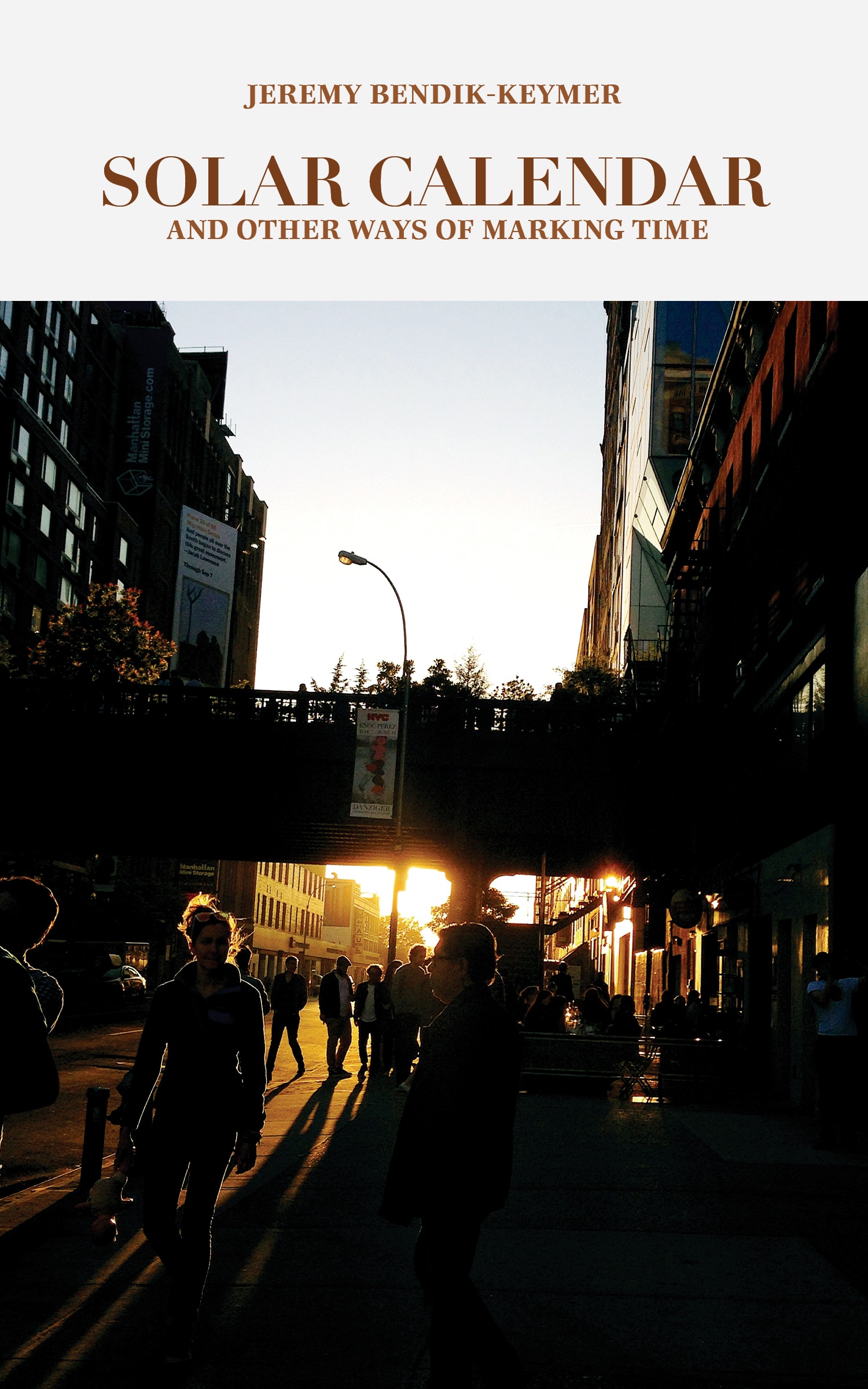
Solar Calendar (a follow-up to Bendik-Keymer’s The Ecological Life: Discovering Citizenship and a Sense of Humanity) contains six oddities: a family portrait, a parody-essay, a time-capsule poem, an exploded essay, a poetic record of an act, and an aphorism journal for a year. Their inspirations are Epictetus’s notebooks, Tarkovski’s Mirror, and Apollinaire’s roving “Zone.” Also experiments in ecology — the study of home — the six sections originate in rifts that challenge us as growing people. They alternate between environmental problems and tensions within families, as if the fissures in love and in society wash back and forth between each other as we try to make a home in the world. Multiple times layer over each other like the sounds of a large, democratic city. The personal and the planetary intersect. The space before, and against, policy where politics arises as assertion opens up in glimpses, fragmenting the body and inertia of oppressive orders. Philosophy arises as a homely and idiosyncratic practice of multiple forms of intuition, reflection and intelligence for muddling through life. Painstaking exercises in being human are grounded in unconditional love and in truthfulness — in the desire to become.
Where its authors and editors are based
Countries of the institutions the book's authors, editors and chapter authors were affiliated to when it was published.
- AUTHORS / EDITORS
- CITATIONS Phase 2
- USAGE Phase 3
| Country | Authors / editors |
|---|---|
| United States | 1 |
About this data
These figures cover 1 work. Each value comes from the most trusted source that has it; a correction made by OBC staff outranks every source.
| Source | Confidence | Works |
|---|---|---|
| Thoth | 90 / 100 | 1 |
| Works with a publication date | 100% |
|---|---|
| Works with a DOI | 100% |
| Works with a funder recorded | 0% |
| Authors with an affiliation | 100% |
| Affiliations matched to an institution (ROR) | 100% |
| Affiliations with a country | 100% |
Countries come from the institution each author was affiliated to when they published, as recorded in ROR. A country is never guessed, so authors without a matched institution are not counted on the maps.
Funders come from OpenAlex for articles and Thoth for books, where publishers recorded them. Most works record none, so a funder's figures show what is recorded, not everything it funded.
Chapters count as works: their authors and editors, and the countries of their institutions, are in every figure where Thoth records an affiliation for them.
Citations (Phase 2) and usage (Phase 3) are not collected yet.