
Book information
- Publisher
- punctum books
- Publication
- Published 21 November 2024
- Place
- Earth, Milky Way
- Catalogue record
- View in the catalogue
Abstract
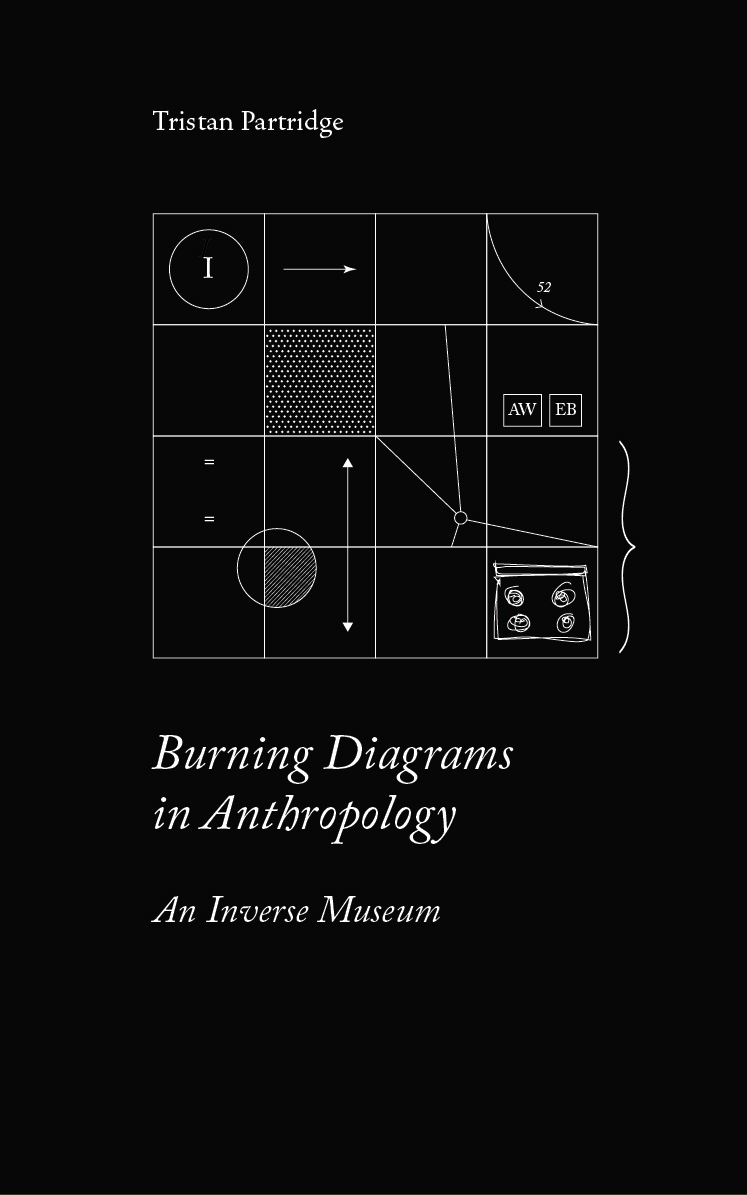
Burning Diagrams in Anthropology examines the use of diagrams in anthropology to reimagine how we think about, and challenge, intellectual histories. Highlighting the impossibility of escaping what different disciplines and institutions deem to be “past,” the author combines critical analysis of selected diagrams with an expansive, exploratory reimmersion in their aesthetic, ethical, and political potential.
Diagrams persist. Yet while other visual components of scholarly work—especially photography, cartography, and film—have been subject to significant critical scrutiny, diagrams have received far less reflexive attention. Reversing this trend, Partridge presents a collection of 52 diagrams, covering a period of 150 years, to create an “inverse museum”—a space where the collection matters less than reactions to it. While the images are drawn from sociocultural anthropology, they are discussed in dialogue with approaches from philosophy, postcolonial studies, architecture, aesthetics, posthumanism, and critical art theory.
Dissecting the notion of The Canon in order to confront academic complicity in hierarchical and racialized relations of inequality, the figurative burning of the title refers to how we might prepare the ground for scholarly work that meets the immediate, collective needs of an Earth in crisis—not least, by refusing adherence to disciplinary normalcy. By refusing this adherence, Partridge reaffirms knowledge creation in general, and anthropology in particular, as deeply ethical, creative, and relational processes.
Where its authors and editors are based
Countries of the institutions the book's authors, editors and chapter authors were affiliated to when it was published.
- AUTHORS / EDITORS
- CITATIONS Phase 2
- USAGE Phase 3
| Country | Authors / editors |
|---|---|
| United States | 1 |
About this data
These figures cover 1 work. Each value comes from the most trusted source that has it; a correction made by OBC staff outranks every source.
| Source | Confidence | Works |
|---|---|---|
| Thoth | 90 / 100 | 1 |
| Works with a publication date | 100% |
|---|---|
| Works with a DOI | 100% |
| Works with a funder recorded | 0% |
| Authors with an affiliation | 100% |
| Affiliations matched to an institution (ROR) | 100% |
| Affiliations with a country | 100% |
Countries come from the institution each author was affiliated to when they published, as recorded in ROR. A country is never guessed, so authors without a matched institution are not counted on the maps.
Funders come from OpenAlex for articles and Thoth for books, where publishers recorded them. Most works record none, so a funder's figures show what is recorded, not everything it funded.
Chapters count as works: their authors and editors, and the countries of their institutions, are in every figure where Thoth records an affiliation for them.
Citations (Phase 2) and usage (Phase 3) are not collected yet.