
Book view
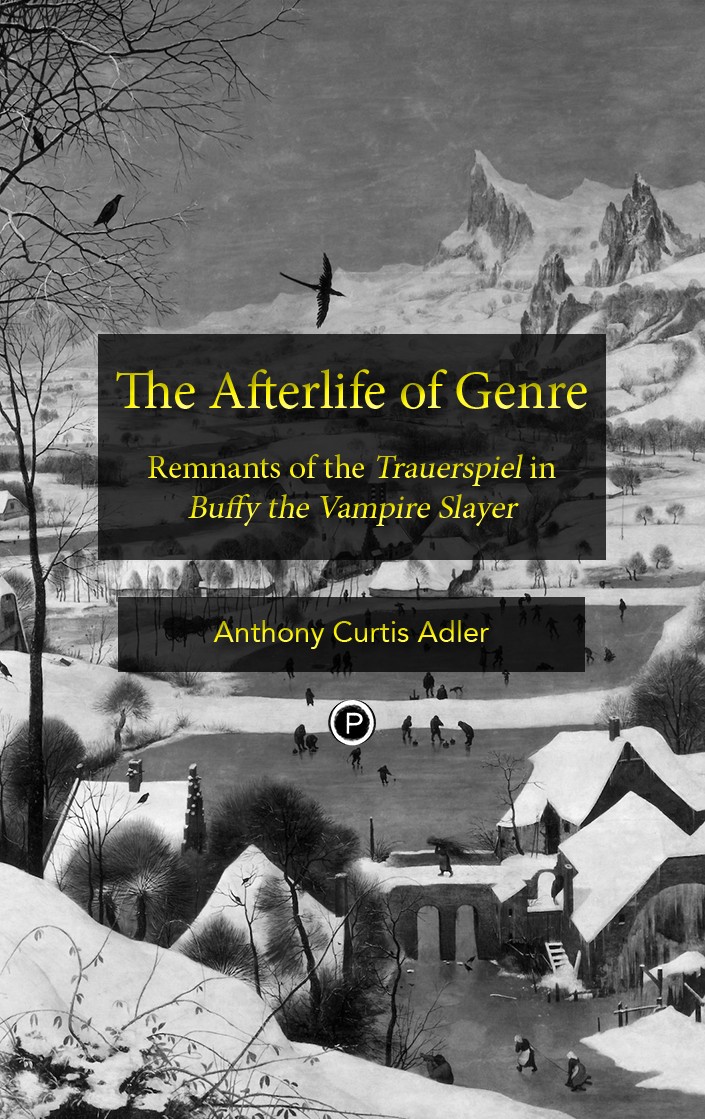
The Afterlife of Genre
Remnants of the Trauerspiel in Buffy the Vampire Slayer
Book information
- Publisher
- punctum books
- Publication
- Published 21 February 2014
- Place
- Brooklyn, NY
- Catalogue record
- View in the catalogue
Abstract
Could there have been television without California? California without television? The one shows the other: the ostentatiously novel singularity of the place and the seemingly self-effacing transparency of the medium. Yet if television and California both promise again and again to offer us something new, young, immaculate in its transience — a pure surface that will never get caught in the ditch of time — they are also both haunted through and through: by the itinerant contents of the past that they cannot banish, by memories of the infantile-perverse utopian fantasies that taunt us in constant replay (“If you’re going to San Francisco…,” “two girls for every guy”), by the contradiction played out in the very gesture of dismissing history and leaving the dead to bury the dead. California and television, as it were, conspire in a vampirologic: the forever-young is what has been there the longest, what really “takes us back.”
And so we also will take ourselves back: to Buffy the Vampire Slayer, already almost charmingly quaint, and Walter Benjamin’s magnum opus The Origin of the German Mourning-Play. What can come of this improbable conjunction? It will not seem too strange that Benjamin, posthumous wanderer across the textures of Americana, should again take up lodging at the Hotel California. But more is at stake than just another hapless visitation from the on high of high theory: reading Buffy as the remediated afterlife of the dead-on-arrival genre of the baroque German mourning play, Adler’s book records the first broken, awkward steps toward a project that, with the recent rise of “quality television,” seems more urgent than ever before: a political-theological characteristic of the television series.
Where its authors and editors are based
Countries of the institutions the book's authors, editors and chapter authors were affiliated to when it was published.
- AUTHORS / EDITORS
- CITATIONS Phase 2
- USAGE Phase 3
| Country | Authors / editors |
|---|---|
| South Korea | 1 |
About this data
These figures cover 1 work. Each value comes from the most trusted source that has it; a correction made by OBC staff outranks every source.
| Source | Confidence | Works |
|---|---|---|
| Thoth | 90 / 100 | 1 |
| Works with a publication date | 100% |
|---|---|
| Works with a DOI | 100% |
| Works with a funder recorded | 0% |
| Authors with an affiliation | 100% |
| Affiliations matched to an institution (ROR) | 100% |
| Affiliations with a country | 100% |
Countries come from the institution each author was affiliated to when they published, as recorded in ROR. A country is never guessed, so authors without a matched institution are not counted on the maps.
Funders come from OpenAlex for articles and Thoth for books, where publishers recorded them. Most works record none, so a funder's figures show what is recorded, not everything it funded.
Chapters count as works: their authors and editors, and the countries of their institutions, are in every figure where Thoth records an affiliation for them.
Citations (Phase 2) and usage (Phase 3) are not collected yet.