
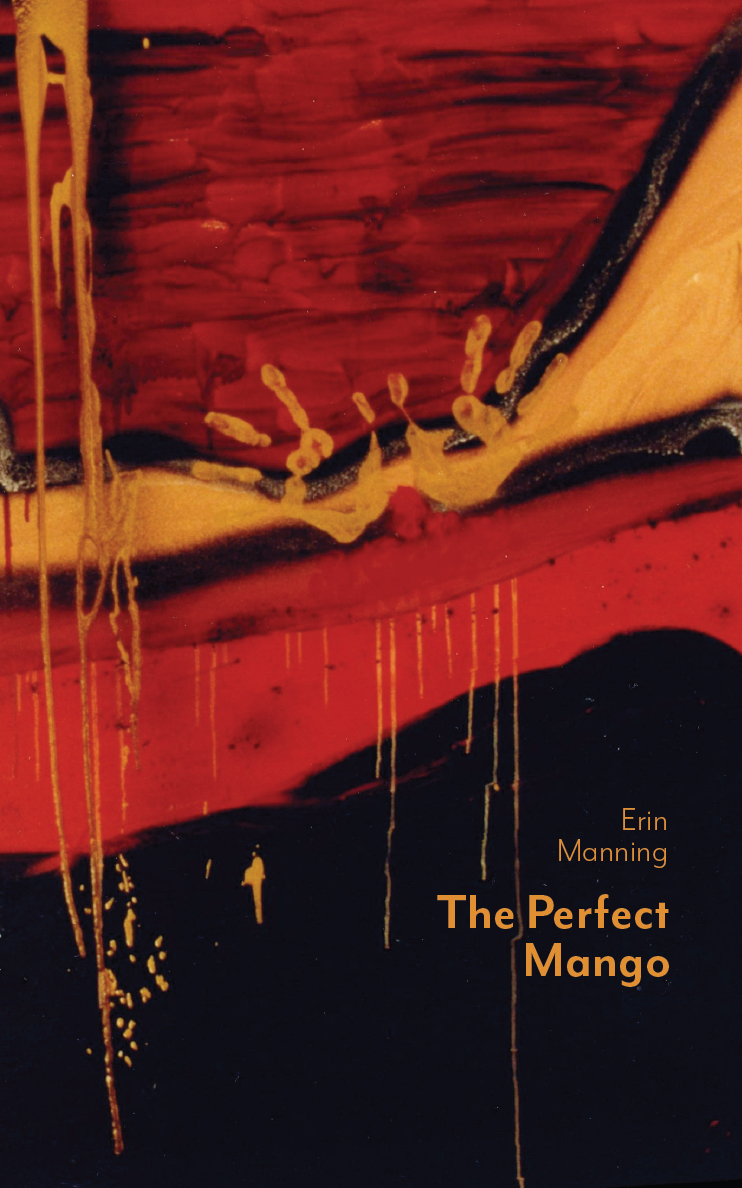
Book information
- Publisher
- punctum books
- Publication
- Published 20 February 2019
- Place
- Earth, Milky Way
- Catalogue record
- View in the catalogue
Abstract
In 1994, at the age of twenty-five, when the “terrible brokenness that comes with sexual assault” was folded deep within her body and thoughts of suicide were always close by, Erin Manning wrote The Perfect Mango at an almost feverish pitch: nineteen chapters in nineteen days, a sort of self-rescue operation, where writing became a form of making (and feeling) life otherwise. Throughout those nineteen days, and although not able to fully articulate it to herself at the time, Manning wrote her way into a “composition that asks how else life might be lived.” And in the rhythms of that composition, which was also a living, Manning was, and is, able to refuse the category and norm and stillness of “victim” (while still understanding the inheritances of violence) in order to follow instead the more-than-I as well as the joy of the “more-than of experience in the making.”
Twenty-five years later, Manning allows these earlier writings to find their way back into the world, which is also a way of giving “voice to those moments of messy survival” while also asking us, who share in (and help to bear) those moments as readers, to consider “other ways of listening to the urgency that is living.” To (re)publish the book now is to give it a place in the world in a way that honors its force as something that is always beyond anyone’s claim to it, even Manning’s. In this sense, The Perfect Mango invites us, with Manning, to be in excess of ourselves, and also to consider, in Manning’s words, “how to create conditions for living beyond humanism’s fierce belief that we, the privileged, the neurotypicals, the as-yet-unscathed, the able-bodied, hold the key to all perspectives in the theatre of living.” Ultimately, The Perfect Mango and Manning’s reflections on its composition ask us to consider living “in the fierce celebration of a world invented by those modes of life which tear at the colonial, white, neurotypical fabric of life as we know it.”
Where its authors and editors are based
Countries of the institutions the book's authors, editors and chapter authors were affiliated to when it was published.
- AUTHORS / EDITORS
- CITATIONS Phase 2
- USAGE Phase 3
| Country | Authors / editors |
|---|---|
| Canada | 1 |
About this data
These figures cover 1 work. Each value comes from the most trusted source that has it; a correction made by OBC staff outranks every source.
| Source | Confidence | Works |
|---|---|---|
| Thoth | 90 / 100 | 1 |
| Works with a publication date | 100% |
|---|---|
| Works with a DOI | 100% |
| Works with a funder recorded | 0% |
| Authors with an affiliation | 100% |
| Affiliations matched to an institution (ROR) | 100% |
| Affiliations with a country | 100% |
Countries come from the institution each author was affiliated to when they published, as recorded in ROR. A country is never guessed, so authors without a matched institution are not counted on the maps.
Funders come from OpenAlex for articles and Thoth for books, where publishers recorded them. Most works record none, so a funder's figures show what is recorded, not everything it funded.
Chapters count as works: their authors and editors, and the countries of their institutions, are in every figure where Thoth records an affiliation for them.
Citations (Phase 2) and usage (Phase 3) are not collected yet.