
Book view
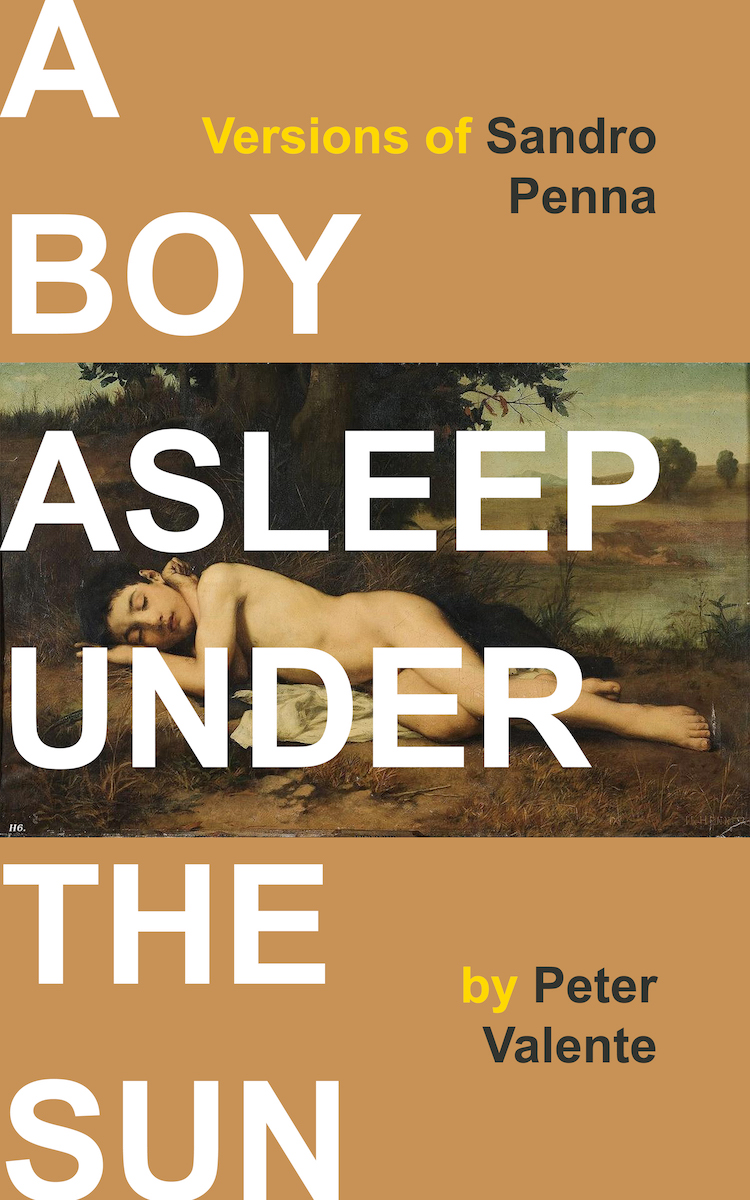
A Boy Asleep under the Sun
Versions of Sandro Penna
Edited by Peter Valente; by Sandro Penna, Peter Valente
Book information
- Publisher
- punctum books
- Publication
- Published 11 November 2014
- Place
- Brooklyn, NY
- Catalogue record
- View in the catalogue
Abstract
Peter Valente’s first encounter with Sandro Penna’s poetry was while translating Pier Paolo Pasolini. At the time, Valente was reading a biography on Pasolini and learned of his close friendship with Penna. Pasolini insisted that among serious readers of poetry, Penna could not be ignored. Born in Perugia on June 12, 1906, Sandro Penna lived most of his life in Rome (he died there on January 21, 1977), except for a brief period in Milan where he worked as a library clerk. When Pasolini arrived in Rome in 1950 he sought out Penna to “show him around.” He knew that Penna was in love with the same ragazzi who prowled the outskirts of Rome.
In his poetry Penna clearly says who he is and how he feels. That is a rare enough quality these days. He moves away from the trappings of identity toward an honest expression of love. In Penna’s work the beautiful is not conscious of itself and is therefore erotic: “Is not the beauty of those who are unaware of their beauty / more beautiful than those who are aware?” He is critical of those who hide their desires behind a thin façade of modesty:
Here they are, these lords of life.
Even with their senses fully aroused,
Penna never hid his sexuality in interviews. He once told a reporter (who probably had to pay dearly for the interview), “I am not a homosexual. I am a pederasta.…Homosexuality is a privilege.” Penna’s homosexuality is complicated in one sense by a moral dilemma:
whether I am doing the right thing
But there is another sense in which Penna accepts the impossibility of a moral resolution to his “problem” and instead turns this negative to a positive value:
There are always boys in my poems.
But I do not know how to speak of anything else.
Everything else is just a tedious noise.
I am unable to sing of Good Deeds.
Since his poems chiefly concern homosexual love, they face being relegated to a gay-only ghetto of readers or to another ghetto that even homosexuals avoid: pederastia. This is a problematic issue in the United States where scandal surrounding sexual orientation is still prevalent. But more importantly, there are no glamorous pronouncements or concern with gender politics in Penna’s poetry. You also won’t find a vision of historical process or a mass of physical details. What you will find is an attachment to everyday reality. Penna’s poetry is candid, uncluttered, minimalist, and of profound lyrical intensity and as Pasolini, a great supporter of Penna’s work, wrote in the 1970 preface to Penna’s collected poems, he is, “perhaps the greatest and most joyful…Italian poet.”
Where its authors and editors are based
Countries of the institutions the book's authors, editors and chapter authors were affiliated to when it was published.
- AUTHORS / EDITORS
- CITATIONS Phase 2
- USAGE Phase 3
No affiliations with a known country in these years yet.
About this data
These figures cover 1 work. Each value comes from the most trusted source that has it; a correction made by OBC staff outranks every source.
| Source | Confidence | Works |
|---|---|---|
| Thoth | 90 / 100 | 1 |
| Works with a publication date | 100% |
|---|---|
| Works with a DOI | 100% |
| Works with a funder recorded | 0% |
| Authors with an affiliation | 0% |
Countries come from the institution each author was affiliated to when they published, as recorded in ROR. A country is never guessed, so authors without a matched institution are not counted on the maps.
Funders come from OpenAlex for articles and Thoth for books, where publishers recorded them. Most works record none, so a funder's figures show what is recorded, not everything it funded.
Chapters count as works: their authors and editors, and the countries of their institutions, are in every figure where Thoth records an affiliation for them.
Citations (Phase 2) and usage (Phase 3) are not collected yet.