
Book view
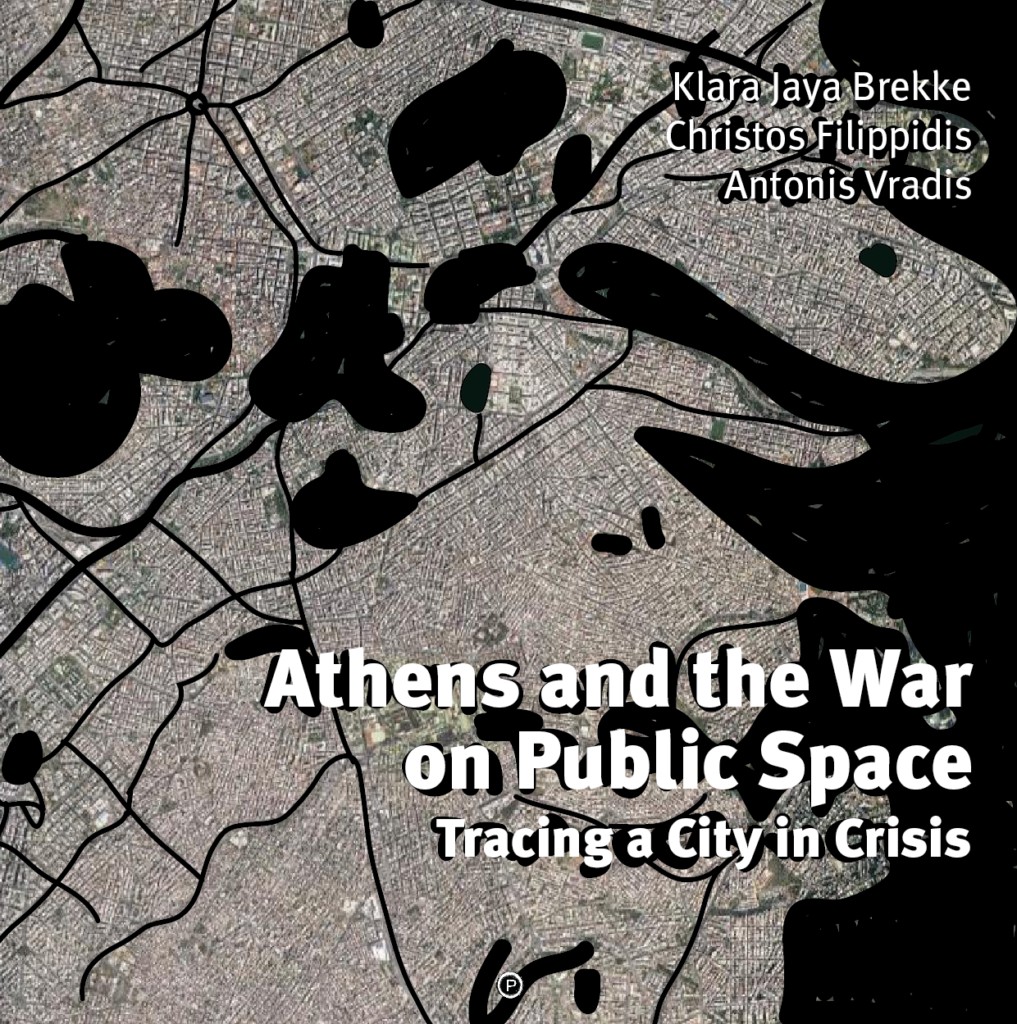
Athens and the War on Public Space
Tracing a City in Crisis
Book information
- Publisher
- punctum books
- Publication
- Published 20 April 2018
- Place
- Earth, Milky Way
- Catalogue record
- View in the catalogue
Abstract
Drifting away from an eerily empty avenue, a lonely figure heads downstairs, into a metro station…
Sometimes, the maelstrom of a crisis can be captured in a single image. The image of the mundane, barely noticeable movement of an urban dweller as they go about their everyday life. Athens and the War on Public Space commences from images just like this one, collected over a two-year period of research (2012–2014) in Athens during a time of severe financial and political crisis. For the author-curators of this volume, public space became a light-sensitive surface upon which they could begin to map the material imprints of the most structural and violent characteristics of the crisis, and their research spread in different directions, tracking the role of infrastructure and the shifts the financial crisis brought about upon built environments, the violent manifestations of the official anti-migrant policy, the rise of racism, the imposition of the emergency upon public space, and the phenomenology of mass transit.
The book first provides a chronological, visual timeline highlighting major events and their impacts on public spaces from the beginnings of the global financial crisis in 2008 until mid-2014. This is followed by an essay by Christos Filippidis, “Biopolitical Narratives against a White Background: Medical Police as City Cartographer,” which analyses the ways in which the collective presence of migrants in Athenian public space was criminalised through policies of informal bans on public gatherings under the pretext of hygienic arguments. In the following chapter, “Mapping Racist Violence,” Klara Jaya Brekke provides an analogue version of the online Crisis-Scape map of incidences of violent racist attacks experienced by migrants in Greece during the crisis. Antonis Vradis contributes two chapters — “The Utter Violence of the Unuttered” and “Metronome” — that reflect, in textual and visual (photographic) modes, on the Athenian metro as a point of departure for revealing and understanding the antagonisms and tensions that grew in this quintessential everyday space as the crisis deepened. In the final chapter, “Performing the State of Emergency,” Christos Filippidis analyses the police attacks launched against squats and occupied social centers in Athens in early 2013, which he argues were attack against specific facets of public space.
Athens and the War on Public Space is a compilation of work done during the larger Crisis-Scape project. The team comprised Klara Jaya Brekke, Dimitris Dalakoglou, Ross Domoney, Christos Filippidis, and Antonis Vradis.
Where its authors and editors are based
Countries of the institutions the book's authors, editors and chapter authors were affiliated to when it was published.
- AUTHORS / EDITORS
- CITATIONS Phase 2
- USAGE Phase 3
| Country | Authors / editors |
|---|---|
| United Kingdom | 2 |
About this data
These figures cover 1 work. Each value comes from the most trusted source that has it; a correction made by OBC staff outranks every source.
| Source | Confidence | Works |
|---|---|---|
| Thoth | 90 / 100 | 1 |
| Works with a publication date | 100% |
|---|---|
| Works with a DOI | 100% |
| Works with a funder recorded | 0% |
| Authors with an affiliation | 67% |
| Affiliations matched to an institution (ROR) | 100% |
| Affiliations with a country | 100% |
Countries come from the institution each author was affiliated to when they published, as recorded in ROR. A country is never guessed, so authors without a matched institution are not counted on the maps.
Funders come from OpenAlex for articles and Thoth for books, where publishers recorded them. Most works record none, so a funder's figures show what is recorded, not everything it funded.
Chapters count as works: their authors and editors, and the countries of their institutions, are in every figure where Thoth records an affiliation for them.
Citations (Phase 2) and usage (Phase 3) are not collected yet.