
Book view
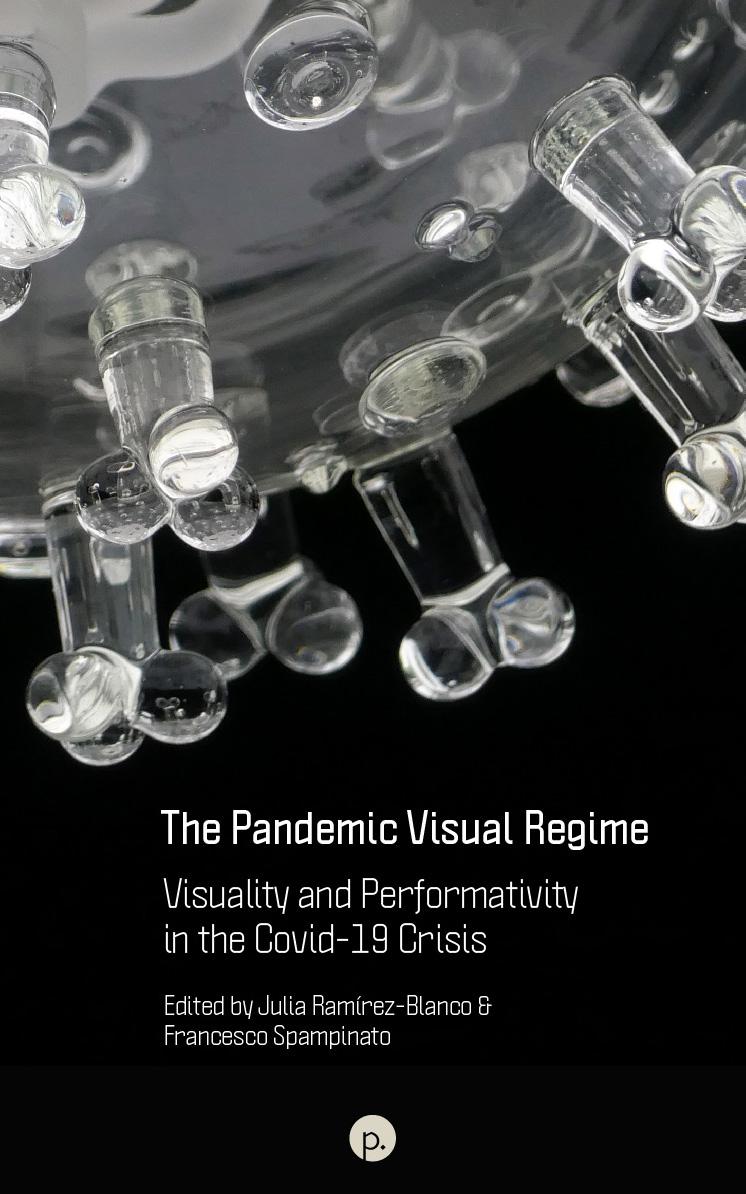
The Pandemic Visual Regime
Visuality and Performativity in the Covid-19 Crisis
Edited by Julia Ramírez-Blanco, Francesco Spampinato
Book information
- Publisher
- punctum books
- Publication
- Published 9 November 2023
- Place
- Earth, Milky Way
- Catalogue record
- View in the catalogue
Abstract
The Covid-19 pandemic has been expressed in various ways through visuality and performance, and some of its more nuanced cultural implications have taken place in a realm that goes beyond words. Through the exploration of the visual culture produced during and in response to the Covid-19 pandemic, The Pandemic Visual Regime: Visuality and Performativity in the Covid-19 Crisis highlights the key role played by images in shaping our understanding of the epochal transformations our society is undergoing.
This book argues that visuality and its relationships with the performative have played such a significant role in the Covid-19 pandemic that we can even speak of the emergence of a “pandemic visual regime,” a new way of seeing and representing the world under this global emergency.
Through an interdisciplinary framework, The Pandemic Visual Regime aims to answer an array of questions: In which ways have the effects of the pandemic been racialized, thereby reinforcing white supremacy? How are our responses to Covid-19 shaped by the Hollywood “outbreak narrative” of films such as Contagion? How has design responded to our new pandemic needs? How have infographics affected our perception? In which new ways have we come to inhabit private, public, and virtual spaces? Regarding the latter, what changes have there been in the forms of digital surveillance? On the other side of the spectrum, what forms has mutual aid taken and what have been our forms of relating with nature, both during lockdown and after lockdown was over? All these questions open the field to rethinking the visuality of our post-pandemic zeitgeist.
Chapters
| Chapter | Author | Institution at publication |
|---|---|---|
| Introduction | Julia Ramírez-Blanco, Francesco Spampinato | Universidad Complutense de Madrid; University of Bologna |
| Backmatter | Julia Ramírez-Blanco, Francesco Spampinato | Universidad Complutense de Madrid; University of Bologna |
| Covid-19 Comics and the Data Visualization of Everyday Life | Anna Feigenbaum, Alexandra Alberda | Bournemouth University; University of Manchester |
| From "Contagion" to Covid | Dahlia Schweitzer | Fashion Institute of Technology |
| Frontmatter | Julia Ramírez-Blanco, Francesco Spampinato | Universidad Complutense de Madrid; University of Bologna |
| Going Viral | Manuel Olveira | |
| Pandemic Pastoral | Julia Ramírez-Blanco | Universidad Complutense de Madrid |
| Pandemic Visuality | Nicholas Mirzoeff | New York University |
| Societies in Movement | Marina Sitrin | Binghamton University |
| The Rise of Digital Governmentality in the Era of Covid-19 | Ramón Reichert | Baden-Wuerttemberg Cooperative State University; University of Applied Arts Vienna; Universität für Weiterbildung Krems |
| Wearable Virus Shields | Francesco Spampinato | University of Bologna |
Where its authors and editors are based
Countries of the institutions the book's authors, editors and chapter authors were affiliated to when it was published.
- AUTHORS / EDITORS
- CITATIONS Phase 2
- USAGE Phase 3
| Country | Authors / editors |
|---|---|
| United States | 3 |
| United Kingdom | 2 |
| Austria | 1 |
| Germany | 1 |
| Italy | 1 |
| Spain | 1 |
About this data
These figures cover 12 works. Each value comes from the most trusted source that has it; a correction made by OBC staff outranks every source.
| Source | Confidence | Works |
|---|---|---|
| Thoth | 90 / 100 | 12 |
| Works with a publication date | 100% |
|---|---|
| Works with a DOI | 100% |
| Works with a funder recorded | 8% |
| Authors with an affiliation | 94% |
| Affiliations matched to an institution (ROR) | 100% |
| Affiliations with a country | 100% |
Countries come from the institution each author was affiliated to when they published, as recorded in ROR. A country is never guessed, so authors without a matched institution are not counted on the maps.
Funders come from OpenAlex for articles and Thoth for books, where publishers recorded them. Most works record none, so a funder's figures show what is recorded, not everything it funded.
Chapters count as works: their authors and editors, and the countries of their institutions, are in every figure where Thoth records an affiliation for them.
Citations (Phase 2) and usage (Phase 3) are not collected yet.