
Book information
- Publisher
- punctum books
- Publication
- Published 9 April 2015
- Place
- Brooklyn, NY
- Catalogue record
- View in the catalogue
Abstract
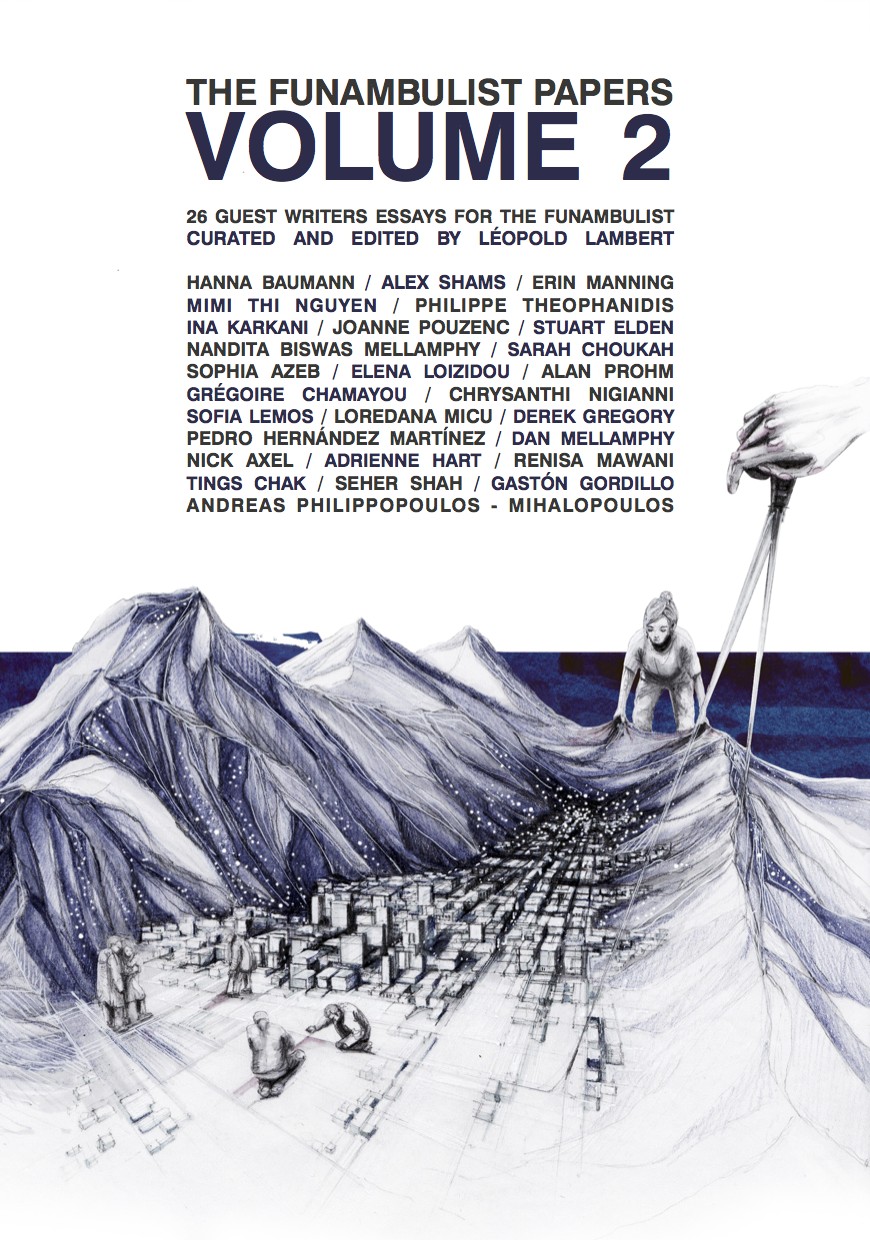
This book is the second volume of texts curated specifically for The Funambulist since 2011. The editorial line of this second series of twenty-six essays is dedicated to philosophical and political questions about bodies. This choice is informed by Léopold Lambert’s own interest in the (often violent) relation between the designed environment and bodies. Corporeal politics do not exist in a void of objects, buildings and cities; on the contrary, they operate through the continuous material encounters between living and non-living bodies. Several texts proposed in this volume examine various forms of corporeal violence (racism, gender-based violence, etc.). This examination, however, can only exist in the integration of the designed environment’s conditioning of this violence. As Mimi Thi Nguyen argues in the conclusion of this book’s first chapter, “the process of attending to the body — unhooded, unveiled, unclothed — cannot be the solution to racism, because that body is always already an abstraction, an effect of law and its violence.” Although the readers won’t find indications about the disciplinary background of the contributors — the “witty” self-descriptions at the end of the book being preferred to academic resumés — the content of the texts will certainly attest to the broad imaginaries at work throughout this volume. Dialogues between dancers and geographers, between artists and biohackers, between architects and philosophers, and so forth, provide the richness of this volume through difference rather than similarity.
The Funambulist Papers are published by the CTM Documents Initiative imprint, Center for Transformative Media, Parsons School of Design, The New School. CTM is a transdisciplinary media research initiative bridging design and the social sciences, and dedicated to the exploration of the transformative potential of emerging technologies upon the foundational practices of everyday life across a range of settings.
Chapters
Where its authors and editors are based
Countries of the institutions the book's authors, editors and chapter authors were affiliated to when it was published.
- AUTHORS / EDITORS
- CITATIONS Phase 2
- USAGE Phase 3
| Country | Authors / editors |
|---|---|
| Canada | 8 |
| United Kingdom | 5 |
| United States | 4 |
| France | 2 |
| Australia | 1 |
| Germany | 1 |
| Spain | 1 |
| Sweden | 1 |
All 9 countries
| Country | Authors / editors |
|---|---|
| Canada | 8 |
| United Kingdom | 5 |
| United States | 4 |
| France | 2 |
| Australia | 1 |
| Germany | 1 |
| Spain | 1 |
| Sweden | 1 |
| The Netherlands | 1 |
About this data
These figures cover 30 works. Each value comes from the most trusted source that has it; a correction made by OBC staff outranks every source.
| Source | Confidence | Works |
|---|---|---|
| Thoth | 90 / 100 | 30 |
| Works with a publication date | 100% |
|---|---|
| Works with a DOI | 100% |
| Works with a funder recorded | 0% |
| Authors with an affiliation | 77% |
| Affiliations matched to an institution (ROR) | 100% |
| Affiliations with a country | 100% |
Countries come from the institution each author was affiliated to when they published, as recorded in ROR. A country is never guessed, so authors without a matched institution are not counted on the maps.
Funders come from OpenAlex for articles and Thoth for books, where publishers recorded them. Most works record none, so a funder's figures show what is recorded, not everything it funded.
Chapters count as works: their authors and editors, and the countries of their institutions, are in every figure where Thoth records an affiliation for them.
Citations (Phase 2) and usage (Phase 3) are not collected yet.