
Book view
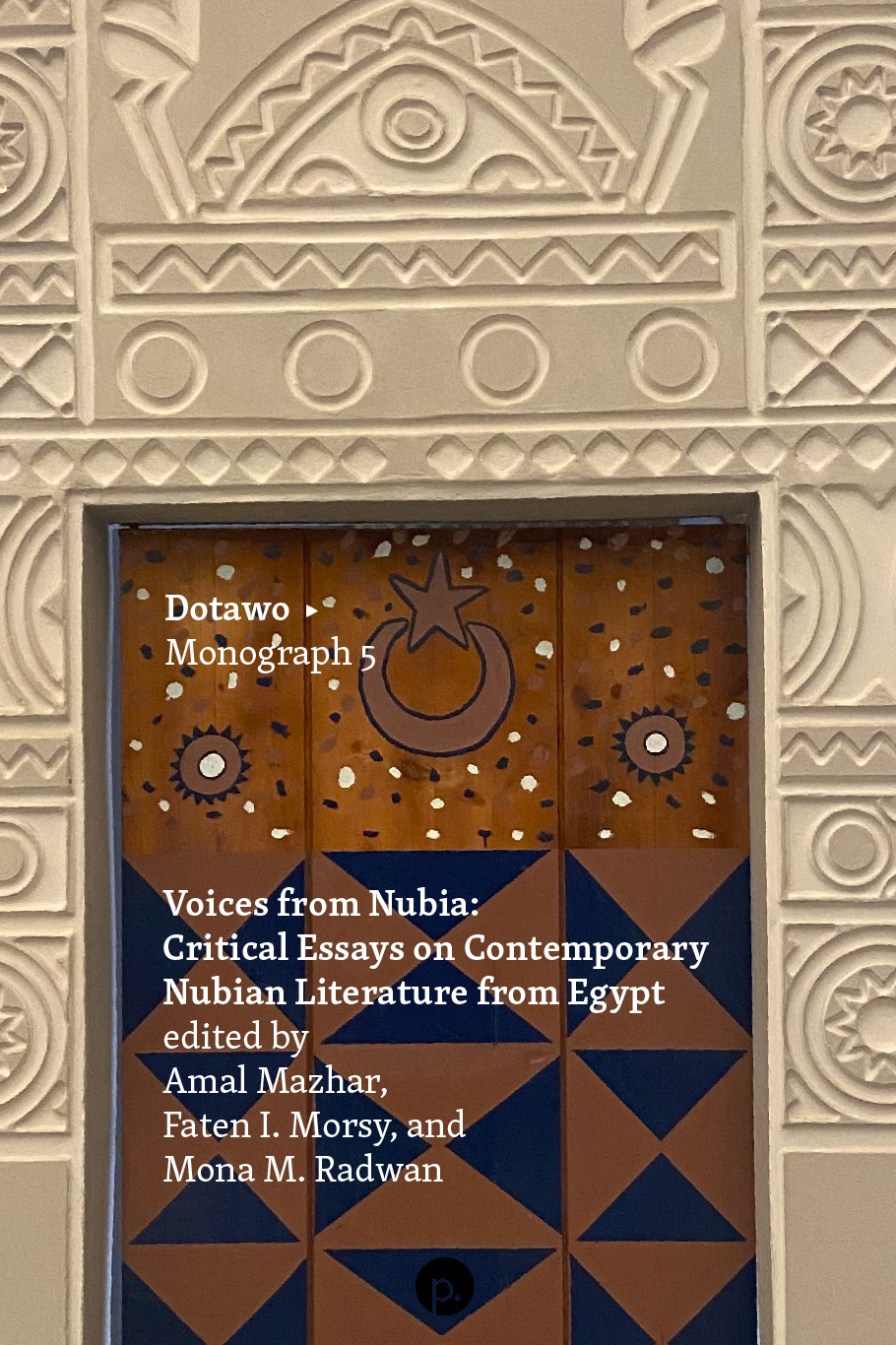
Voices from Nubia
Critical Essays on Contemporary Nubian Literature from Egypt
Edited by Amal Mazhar, Faten I. Morsy, Mona M. Radwan; by Rasheed El-Enany
Book information
- Publisher
- punctum books
- Publication
- Published 1 August 2024
- Place
- Earth, Milky Way
- Catalogue record
- View in the catalogue
Abstract
The Nubians, the largest ethnic community in Egypt, saw their ancestral homelands disappear beneath the waters of the Nile from the dawn of the 20th century through to 1964. The massive displacement of this population has been the subject of numerous literary works by Nubian writers who seek to save their heritage from oblivion and to preserve their Nubian collective memory. Despite the renewal of socio-political interest in Nubia in post-2011 Egypt, the authors of Voices from Nubia, all non-Nubian Egyptians, claim that art in general and literature in particular remain the domain in which the problematics of what has been called the Nubian Question can be primarily vocalized. Only through a thorough reading and analysis of the literary output of Egyptian Nubians can the complexities of Nubia, its people, and culture can find full expression.
The rich literary heritage of contemporary Nubian literature allows for a multiplicity of critiques that makes possible a reading of this literature that crosses the borderlines between literature, history, geography, politics, gender, and ethnicity. The diversity of themes and tropes in Voices from Nubia reflects a hallmark of Nubian literary output which is generally marked by a common feeling of solidarity around the Nubian cause. The array of critical studies included in the volume’s eight chapters covers a multiplicity of approaches: cultural, postcolonial, ecofeminist, and critical race theory.
Voices from Nubia constitutes an attempt to go beyond the dichotomy between the activist Nubian writer who views the Nubian Question as a human rights issue and Arab-Egyptian nationalists who consider the discussion of Nubians as a distinct ethnic group or minority a threat to societal cohesion and national security. The editors conclude the book with interviews with three Egyptian Nubian writers belonging to different generations and expressing different positions with regards to the Nubian Question. It is thus hoped that this book will introduce the English-speaking reader to the rich tradition of contemporary Nubian literature from Egypt, written in Arabic. On the other hand, the book also forces the Egyptian-Arab reader to question some of the most cherished assumptions and ingrained ideas about the nature of culture, history, and identity. As such, Voices from Nubia has far-reaching implications for how we think about the diverse nature of our societies and nations.
Chapters
Where its authors and editors are based
Countries of the institutions the book's authors, editors and chapter authors were affiliated to when it was published.
- AUTHORS / EDITORS
- CITATIONS Phase 2
- USAGE Phase 3
| Country | Authors / editors |
|---|---|
| Egypt | 8 |
| United Kingdom | 1 |
About this data
These figures cover 13 works. Each value comes from the most trusted source that has it; a correction made by OBC staff outranks every source.
| Source | Confidence | Works |
|---|---|---|
| Thoth | 90 / 100 | 13 |
| Works with a publication date | 100% |
|---|---|
| Works with a DOI | 100% |
| Works with a funder recorded | 0% |
| Authors with an affiliation | 84% |
| Affiliations matched to an institution (ROR) | 100% |
| Affiliations with a country | 100% |
Countries come from the institution each author was affiliated to when they published, as recorded in ROR. A country is never guessed, so authors without a matched institution are not counted on the maps.
Funders come from OpenAlex for articles and Thoth for books, where publishers recorded them. Most works record none, so a funder's figures show what is recorded, not everything it funded.
Chapters count as works: their authors and editors, and the countries of their institutions, are in every figure where Thoth records an affiliation for them.
Citations (Phase 2) and usage (Phase 3) are not collected yet.